[ research · updated september 2026 ]
10 Intercom alternatives for 2026, priced, after the Salesforce deal
Ten Intercom alternatives with every price read from the vendor's own page, now that Intercom has renamed itself Fin and agreed to sell to Salesforce for about $3.6 billion.
Intercom alternatives in 2026: the short version
The product you bought as Intercom is now a company called Fin, which renamed itself after its AI agent in May and has since been bought by Salesforce: the agreement was signed in June and the deal closed on 10 September 2026, at a price the press release states as approximately $3.6 billion. Fin remains the strongest resolution engine in the category, and its pricing remains the category's most expensive habit: $0.99 per Fin outcome on top of seat prices, which at a modest 2,000 conversations a month works out to roughly $18,000 a year in outcome fees alone, arithmetic we show below. The alternatives are real and cheaper, but they are not interchangeable: Zendesk sells the full helpdesk suite by the seat, Gorgias meters ecommerce tickets, Freshchat and Help Scout sell seats with a metered AI line, Crisp, Tidio, Chatbase, Botpress and tawk.to hold down the small-team end, and each fits a different company. What follows is the map of ten Intercom alternatives as the pricing pages actually read, every claim linked to its source, including the cases where staying on Fin is the right call.
What happened to Intercom, with dates
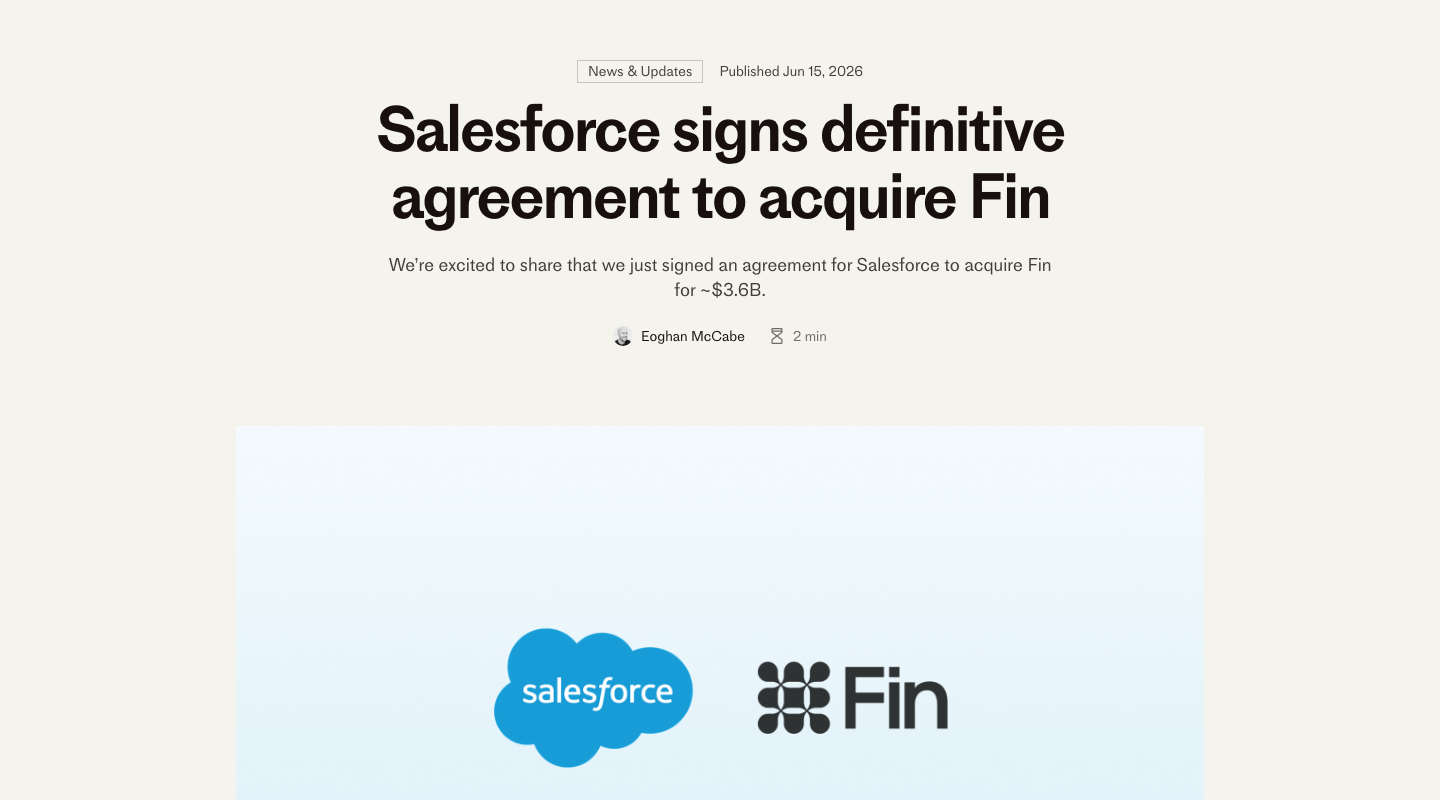
On 12 May 2026 Eoghan McCabe announced that Intercom had changed the name of our company to Fin, his words, keeping Intercom as the name of the helpdesk product and moving the corporate identity to the AI agent. Thirty-four days later, on 15 June, he published a second post: the company had signed an agreement for Salesforce to acquire Fin, at a price Salesforce's own press release puts at approximately $3.6 billion, with the deal expected to close in the fourth quarter of Salesforce's fiscal 2027 (it closed early, on 10 September 2026) and Marc Benioff describing Fin as technology that will, in his words, complement Agentforce. McCabe's post promises customers that little will practically change. That may hold. But an acquired vendor's roadmap is set by its acquirer's platform, and this is not an isolated event: it is the fourth conversational-AI vendor in seven months to fold into a CRM platform, after what happened to Drift, to Qualified, and to Warmly.
- Dec 2025
Salesforce signs a definitive agreement to acquire Qualified.
- 6 Mar 2026
Salesloft and Clari name 1mind the exclusive AI successor to the retired Drift.
- 12 May 2026
Intercom renames the company to Fin: "Intercom will live on as our customer service software platform, but Fin is our future."
- 15 Jun 2026
Salesforce signs a definitive agreement to acquire Fin for approximately $3.6 billion.
- 30 Jun 2026
Warmly announces it has entered into an agreement to be acquired by HubSpot.
- 10 Sep 2026
Fin AI pricing: what $0.99 per outcome means at real volumes
Fin's pricing has two meters. The first is seats: Essential at $29 a seat a month on annual billing, Advanced at $85, Expert at $132. The second is the agent itself, at $0.99 per Fin outcome, the page's own wording, and the definition of an outcome is where you should read closely. Intercom's pricing page counts one when a customer confirms their issue is resolved, when they don't ask for more help after Fin responds, or when Fin completes a workflow, including handoffs. Silence bills the same as a confirmed fix, and a handoff to your human team can bill too. Chat itself is not the meter: the page's footer states that all plans include free, unlimited live chat. And you can run Fin on a helpdesk you already own, with no seats and a minimum monthly commitment the page illustrates at 50 outcomes.
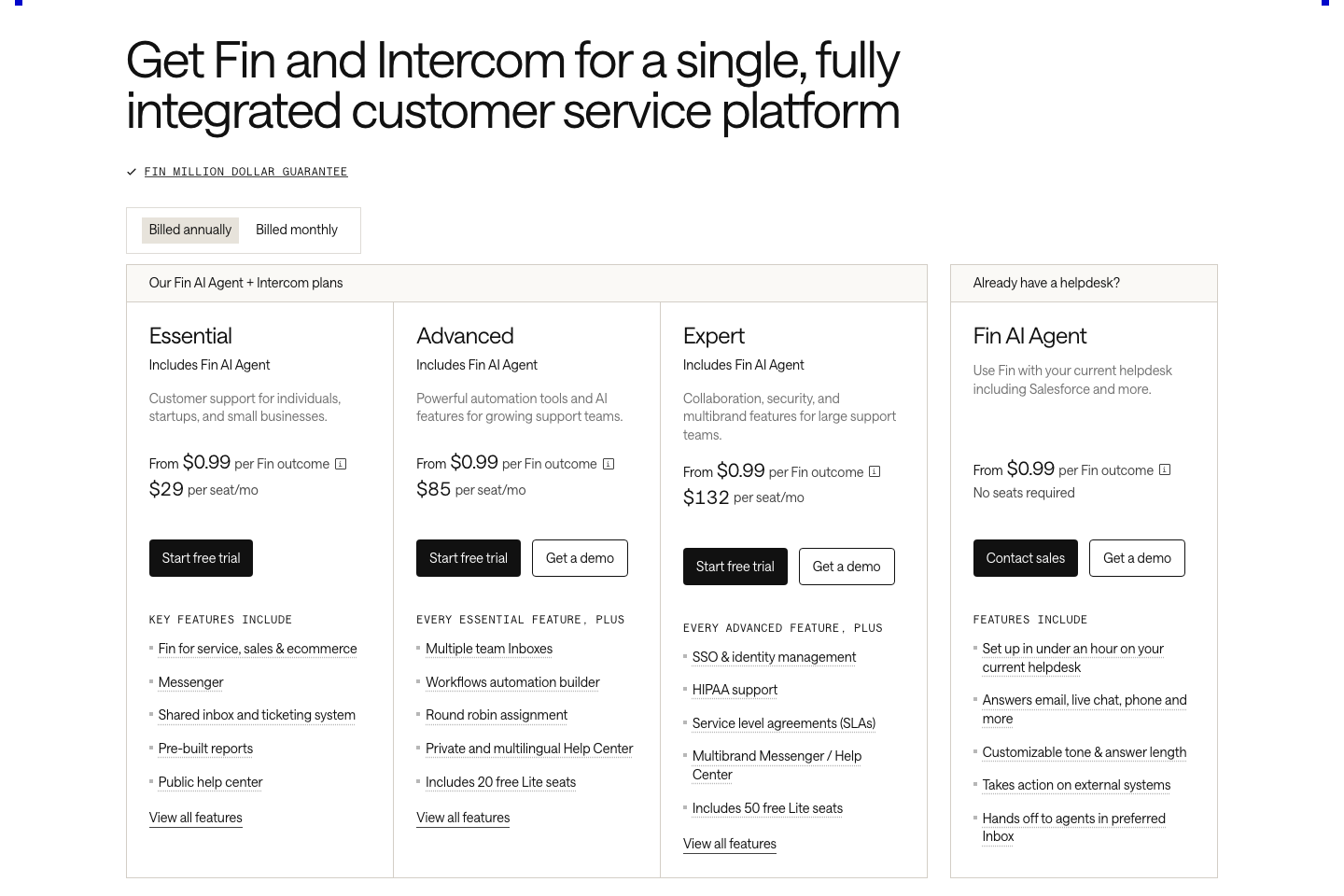
Now the arithmetic, using Fin's own numbers. Fin reports resolution rates averaging 76% across more than 12,000 customers. A team handling 2,000 conversations a month at that average generates about 1,520 outcomes, which is $1,504.80 a month and roughly $18,000 a year before a single seat is paid. At 10,000 conversations a month the same math reads $7,524 a month, north of $90,000 a year. Five agents on the Advanced plan add $5,100 a year on top.
Two honest things must be said about that model. First, it is arguably the fairest meter in the category: you pay for work that succeeded, not for a seat that might. Second, it has a property no other pricing does: your bill grows every time the product improves. Fin's own homepage says its average resolution rate rises about 1% every month. On a per-resolution contract, that progress is a price increase you did not negotiate.
The best Intercom alternatives, by pricing model
Start with the case for staying. Fin is, by the visible evidence, the best pure resolution engine on the market: the vendor-reported 76% average is ahead of anything comparable, and it claims to be live with any helpdesk in less than an hour. If you run a large support organisation, your volume justifies the meter, and a Salesforce future is neutral or good news for your stack, staying is defensible and possibly right. The acquisition is a reason to renegotiate, not automatically a reason to leave.
Zendesk is the door for teams that want the whole support operation, not just the agent. Its seats start at $19 an agent a month for basic ticketing and $55 for the Suite tier that includes its AI agents, rising to $115. The caveat is that its AI usage is metered per automated resolution, and the price of that unit is not published on the pricing page; you learn it in a sales conversation. Predictable seats, unpredictable AI line.
Gorgias is the door for ecommerce brands, and it prices the opposite way: never priced per agent, its page says, but per ticket volume. The Starter plan is $40 a month with 50 tickets and 30 automated interactions included, Basic is $77 a month billed annually with 300 tickets, and past your limit the AI costs $1.50 per automated interaction, which is notably more per unit than Fin. If your support is Shopify orders, refunds and where-is-my-package, its integrations earn the premium; if it is not, they don't.
At the small end, Crisp and Tidio both publish free tiers and flat prices. Crisp charges per workspace rather than per person: $45 a month per workspace with four seats included, $95 with ten, $295 for the AI-first tier, with AI usage covered by included credit allowances rather than a per-resolution meter. Tidio's Starter plan lists $24.17 a month on annual billing, and its Lyro AI agent sells standalone from $32.50 a month for 50 AI conversations. Both are honest products at honest prices; neither will run your systems for you, and both meter the AI conversations you are buying them for. We hold Tidio to the same standard on our Tidio comparison page.
Five more Intercom alternatives: Freshchat, Help Scout, Chatbase, Botpress, tawk.to
Freshchat and Help Scout are the two other helpdesks that sell seats with a metered AI line, the same shape as Fin at lower numbers. Freshchat's pricing page, which showed euros when we read it, runs a free plan for up to 10 agents with no AI, then seats at EUR 19, 49 and 79 an agent a month billed annually, with the Freddy AI Agent at EUR 45 per 100 sessions on top and a 14-day trial. Help Scout's pricing page runs a free plan for 5 users, then $25, $45 and $75 a user a month, with AI Answers as an add-on at $0.75 a resolution, a monthly cap you can set on it, and a 15-day trial on the paid plans. Help Scout's meter is the closest thing on this list to Fin's own, at three quarters of the price per unit and with a ceiling Fin does not offer. Our Freshchat comparison page has the three-meter arithmetic.
Chatbase and Botpress are agent builders rather than helpdesks: you build the agent yourself and connect it to whatever inbox you already have. Chatbase's pricing page runs from a free plan to $40, $150 and $500 a month, metered in message credits with extra credits at $40 per 1,000 and a 7-day trial on the paid tiers; voice, telephony and its own helpdesk unlock at $150. Botpress's pricing page runs a free plan of 100 conversations a month, then $150 and $750 a month billed annually, never per seat, with conversations sold in packs of 100 that are added automatically when you run low and, in its own words, cannot be switched off. Chatbase names the models behind its answers, by tier, and Botpress lets you bring any model through its Hub, which is more than most of this category will say. We compare each one on one on our Chatbase comparison page and our Botpress comparison page.
tawk.to is the free row. Its live chat, inbox, ticketing and knowledge base cost $0 for any number of seats, and the add-ons page lists what it does charge for: AI Assist at $29 a month with a limited free tier, whitelabel at $29 a month per property. The AI drafts and a human approves every send, so it is a copilot for your team, not an agent that answers on its own. If your people are at the desk and the budget is zero, it is hard to argue with; our tawk.to comparison page says where it stops.
The 10 best Intercom alternatives, priced
Every number below was read from the vendor's own pricing page, linked in the prose above, on 31 August 2026 for the first five rows and on 3 September 2026 for the rest. Freshchat's prices are printed in euros as its page showed them. One disclosure before the last row: Algomo is our product. Judge that row by the same standard as the others.
| Published price | Pricing model | Free plan or trial | Fits when | |
|---|---|---|---|---|
| Intercom Fin | $0.99 per outcome; seats $29 to $132 | Per Fin outcome, plus per seat | 14-day trial; first year free for startups | A large support org whose volume earns the meter |
| 1. Zendesk | $19 an agent a month for ticketing only, $55 to $115 on Suite; AI unit price not published | Per seat; AI metered per automated resolution | 14-day trial | You want the whole helpdesk suite, phone included |
| 2. Gorgias | From $40 a month, 50 tickets included | Per ticket volume, never per seat | Free trial | A Shopify store: orders, refunds, where is my package |
| 3. Crisp | Free tier; $45 to $295 a workspace a month | Flat per workspace, AI by credits | Free tier and trial | A small team that wants one flat price, not seats |
| 4. Tidio | Free tier; Starter $24.17 a month; Lyro from $0.50 a conversation | Per conversation quota | Free tier, 7-day trial | An ecommerce store whose customers write on WhatsApp and Instagram |
| 5. Freshchat | EUR 0 to 79 an agent a month; Freddy AI EUR 45 per 100 sessions | Per seat; AI per 100 sessions | Free plan for 10 agents, no AI; 14-day trial | Ten agents on a free inbox, adding AI later |
| 6. Help Scout | Free for 5 users; $25 to $75 a user a month; AI Answers $0.75 a resolution | Per seat; AI per resolution, with a cap you set | Free plan; 15-day trial | Early-stage SaaS that wants Fin's meter at a lower rate with a ceiling |
| 7. Chatbase | Free, then $40 to $500 a month; $40 per extra 1,000 credits | Per message credit, in tiers | Free plan; 7-day trial on paid tiers | You want to build the agent yourself; voice from $150 |
| 8. Botpress | Free, then $150 and $750 a month, billed annually | Per conversation; packs of 100 auto-added | Free plan, no card | A developer who wants 500 connectors and never pays per seat |
| 9. tawk.to | Core $0 forever; AI Assist $29 a month | Flat add-ons | Free forever, no card | Your people answer the chat and the budget is zero |
| 10. Algomo | Free plan; then a monthly amount you set, $50 to $4,300 | Credits: five per useful conversation, none for one that went nowhere | The free plan | One agent for support and inbound sales on your site, at an amount you cap |
Which Intercom alternative fits which team
Early-stage SaaS. Help Scout is free for five users and $25 a seat after, with the AI capped at a number you choose. Crisp is a flat $45 a workspace. Chatbase is $40 a month for a solo operator. Fin itself gives startups a free first year, which is a real offer and worth taking if you expect to grow into the meter. Algomo, our product, is free and then an amount you set, and does the pre-sales conversation as well as support, which at that stage is usually the same person's job.
Ecommerce. Gorgias if you live in Shopify and your tickets are orders and refunds; Tidio if your customers write on WhatsApp, Instagram and Messenger and you want the chat, the inbox and the Lyro agent in one app. Both meter the AI on top of the plan, so read the per-unit price before the tier price.
Phone-heavy. This is where the cheap rows fall away. Fin answers on voice; Zendesk sells voice inside the Suite; Chatbase unlocks telephony at $150 a month. None of the other rows sold an AI agent that answers the phone on the pricing pages we read, and tawk.to's Voice Agents were still on a waitlist. Algomo does not do voice at all: it is web chat on your site, so if most of your support arrives by phone, buy one of the first three.
Free. tawk.to is free forever for any number of seats, and is the only row where the core product itself never costs money. Help Scout is free for five users, Freshchat for ten agents without the AI, Crisp, Tidio, Chatbase and Botpress have free tiers with usage limits, and Algomo has a free plan. Fin has no free plan, only the trial and the startup year. The question to ask of every free row, ours included, is whether the thing you came for is in the free tier.
How we verified these Intercom alternative prices
Every load-bearing claim in this post is linked at the phrase that makes it. The rename and the acquisition are sourced to Intercom's own blog posts and Salesforce's press release, not to coverage of them, fetched by us on 31 August 2026. The first five vendors' prices were read from their pricing pages on the same day; Freshchat, Help Scout, Chatbase, Botpress and tawk.to were read on 3 September 2026, the same day we read them for our one-on-one comparison pages. Every quoted phrase is verbatim from the captured text. Where a number is a vendor's claim about itself, such as Fin's 76% average resolution rate, we label it vendor-reported rather than repeat it as fact.
Four things we could not verify, stated plainly. The acquisition closed on 10 September 2026, but what Salesforce does with Fin's pricing and roadmap is unknowable today, including by the people promising continuity. Zendesk's price per automated resolution is not on its pricing page, so we can report the meter but not the rate. Freshchat's page showed euro prices with a note that USD pricing may differ by region, so we print the euros as read and do not convert them. And no vendor's resolution percentage, Fin's included and ours included, has been audited by anyone independent; treat every such number as marketing until you have measured it on your own tickets.
Intercom alternatives: questions, answered
Is Salesforce buying Intercom?
Yes, in effect. Intercom renamed the company to Fin on 12 May 2026, and on 15 June 2026 Salesforce signed a definitive agreement to acquire Fin for approximately $3.6 billion. The deal closed on 10 September 2026.
What is Fin by Intercom?
Fin is the AI support agent Intercom launched in 2023, and since May 2026 it is also the name of the company itself: the corporate entity renamed from Intercom to Fin, keeping Intercom as the helpdesk product's name. Fin answers and resolves customer conversations across chat, email, phone and other channels, and reports resolution rates averaging 76% across more than 12,000 customers, a vendor-reported figure.
How much does Intercom Fin cost?
Fin is priced at $0.99 per outcome, counted when a customer confirms a resolution, goes quiet after Fin's answer, or when Fin completes a workflow. On Intercom's own helpdesk you add seats at $29 to $132 a month each; on another helpdesk there are no seats but a minimum monthly commitment applies. At 2,000 conversations a month and Fin's average resolution rate, the outcome fees alone are roughly $18,000 a year; the arithmetic is in the post above.
Is there a free version of Intercom?
No. Intercom offers a 14-day free trial and a free first year for startups that qualify for its programme, but no free plan: when the trial ends, the $0.99 per outcome meter and the seat prices start. Among the alternatives, tawk.to is free forever, Help Scout is free for five users, Freshchat is free for ten agents without the AI, and Crisp, Tidio, Chatbase, Botpress and Algomo, our product, all have free tiers.
What is the best Intercom alternative?
It depends on which Intercom you were buying. For a full omnichannel helpdesk with predictable seat pricing, Zendesk, from $19 an agent a month, is the established door, with its AI metered separately. For ecommerce brands, Gorgias prices by ticket volume rather than seats. For early-stage SaaS, Help Scout is free for five users with AI at $0.75 a resolution. For small teams, Crisp and Tidio both publish free tiers and flat prices. For a team that wants one agent doing support and pre-sales work together, sold as one monthly amount you set, against Fin's $0.99 per outcome, that is the gap Algomo is built for, and it is our product, so test that claim rather than trusting it.
Who are Intercom's competitors?
On the helpdesk side, Zendesk, Gorgias, Freshchat, Help Scout and tawk.to. On the AI-agent side, Chatbase, Botpress, Crisp and Tidio at the self-serve end, and Sierra, Decagon and Ada at the enterprise end, all three of which sell through a sales call and publish no prices. Our comparisons page holds all of them, and us, to the same standard.
Is there a free Intercom alternative?
Yes, several. tawk.to is free forever for any number of seats. Help Scout is free for five users and Freshchat for ten agents, without the AI. Crisp, Tidio, Chatbase and Botpress publish free tiers with paid plans from $45, $24.17, $40 and $150 a month respectively. Algomo, our product, has a free plan, then a monthly amount you set from $50 to $4,300 that is also the most any one charge can be. Fin offers a free trial but no free tier, and its metered pricing starts the day the trial ends.
Algomo as an Intercom alternative, stated plainly
Algomo is our product, so weigh this section accordingly. We count the same event Fin does, a conversation that actually helped, because it is the fairest standard in the category. The difference is the ceiling: Fin bills every outcome with no limit, while Algomo is a monthly amount you pick, spent as credits at five per useful conversation, and the amount is the most any one charge can be; the numbers are on our pricing page. The deeper difference is the job: Fin is built to resolve support tickets, and it is excellent at that; Algomo does the support job and the sales-side job in one agent, answering the visitor with a problem and qualifying the visitor about to buy, because for a company between five and five hundred people those are the same inbox. It integrates itself by riding the interfaces your site already exposes, so going live is minutes rather than a project, and there is a free plan with no sales call in front of it. Our customer service page says what it does and does not do: conversations in web chat only, no voice, no ticket creation in your helpdesk. We compare the two agents directly, feature by feature, on our comparison page, and we said what happened to Drift in the sales-side version of this post.
If you run an enterprise support organisation and Fin's engine earns its meter, stay and renegotiate; the acquisition gives you leverage. If you want the suite, take Zendesk; if you live in Shopify, take Gorgias; if your people answer the chat, take tawk.to. And if you want to know what an agent does on your site rather than in a demo, point Algomo at your site on the free plan this afternoon and ask it what your last real visitor asked you.
[ next step ]