
Summarize withChatGPTPerplexityClaudeGrokAlgomo vs Zowie
TL;DRZowie fits a large service team that wants one governed agent across chat, email and phone, and Algomo fits a team that wants its website agent connected and reading live pages the same day.
Two worries hold up most AI agent projects. One is the weeks of wiring before the agent can look up an order or an account. The other is the day it repeats a policy you already changed.
Algomo meets the first worry by finding the calls your pages already make and connecting to them itself. It meets the second by reading the live page each time. If a reviewed agent ever contradicts your site, your next month is free. Your team builds and edits it from the coding assistant it already uses.
One note on the name. Zowie here means the customer service company at getzowie.com, not the ZOWIE gaming gear sold by BenQ.
Algomo vs Zowie at a glance
| Algomo | Zowie | |
|---|---|---|
| Main job | Support and inbound sales on your website, with an inbox where your team can take over. | An AI agent platform for enterprise service teams in commerce, banking, insurance, telecoms and more, with its own inbox. |
| Who does the integration | Algomo's AI, which watches what your pages request and turns each request into a tool. | Your side, or Zowie's team. Processes call your systems from JavaScript code blocks. |
| Where the answers come from | The live page and the live data behind it, read for each question. | Policies imported from your help centre, your API or a web page, plus written policies, searched for each question. |
| Channels | Chat on your website, plus a follow-up email. | Web and app chat, email, phone, WhatsApp, Instagram and Messenger. |
| Published pricing | A free plan, then a single monthly amount between $50 and $4,300. | None. Vendr's buyers report a median of $158,000 a year, from three purchases. |
| How you buy it | Sign up yourself. No card on the free plan and no per-seat fee. | Book a 30-minute demo, then a scoped rollout. |
| Not a fit for | A team that mostly hears from customers by phone or email. | A team that wants to try the agent on its own site before talking to sales. |
| Biggest limitation | Does not answer phone calls or incoming email. | No public price, and each system the agent calls is a code block someone has to write. |
What part of Zowie do you need?
TL;DRZowie for one governed agent across phone, email and chat in a large contact centre, and Algomo for the questions and sales that start on your website.
You are rarely replacing everything at once. You are deciding who handles one stream of questions. Match yours to a line below:
- Phone calls, email and chat from one configuration, with handoff to your contact centre: Zowie.
- Questions that arrive on your website and need the live price, rate or stock: Algomo.
- An in-house system behind your site that no marketplace app covers: Algomo, which learns it from what your pages already call.
- A deployment inside your own cloud or on your own servers: Zowie.
The sections below start with the two risks, then cover the builder, the page, the channels and the price.
Who connects the agent to your systems, and how long does it take?
TL;DROn Zowie your side or Zowie's team writes a JavaScript block for each system the agent calls, while Algomo finds the calls your pages already make and connects to them itself, with a first version the same day.
Your website already talks to an order search, a stock check or an account service. The agent only becomes useful once it reaches those systems too. What decides your timeline is who builds that link, and how many weeks your team waits for it.
Zowie integrations
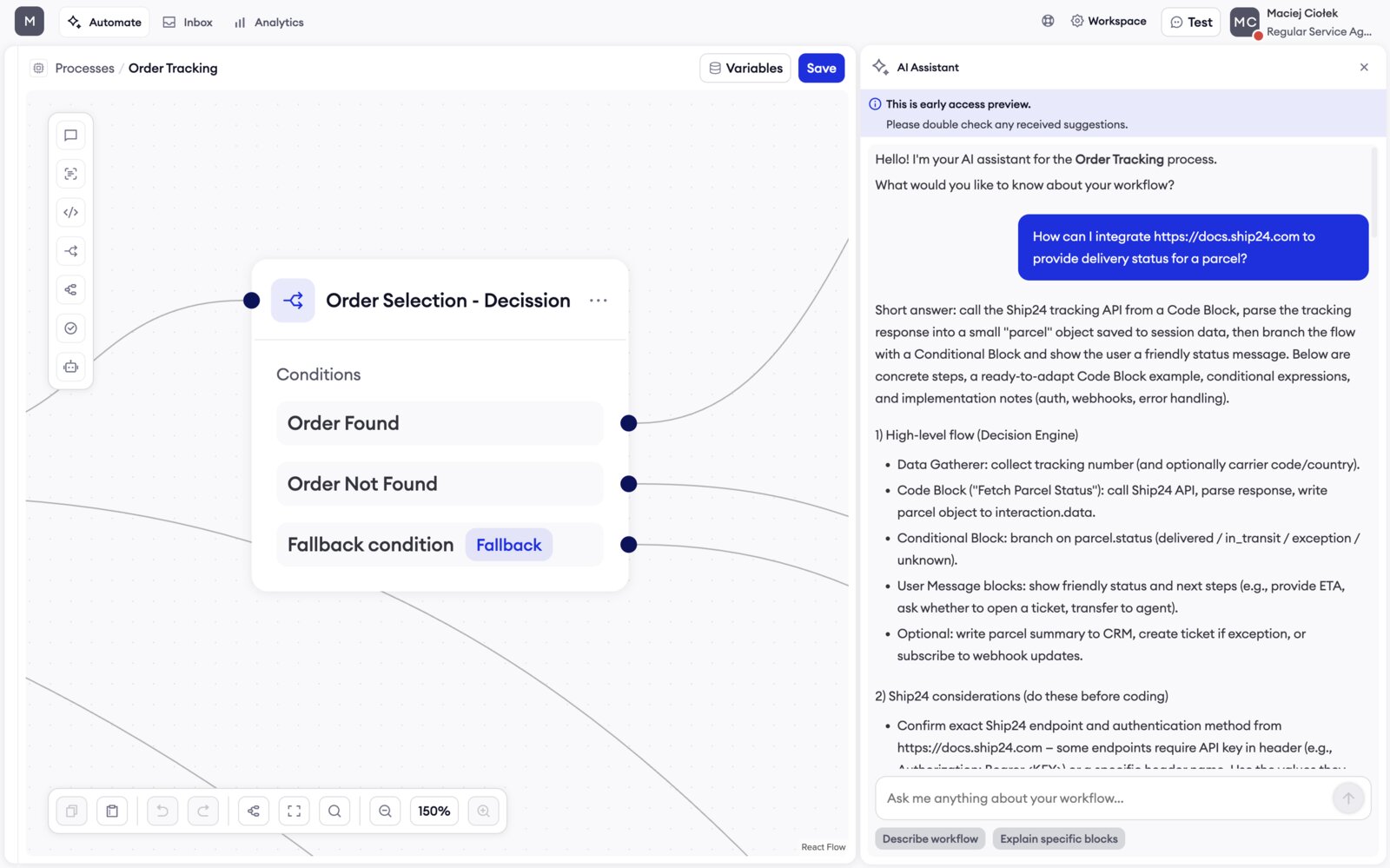
Zowie runs actions through its Decision Engine, where a process is a chain of blocks. The Code block runs JavaScript and API calls. Its docs say you write that code in the interface and set the endpoint and its login there.
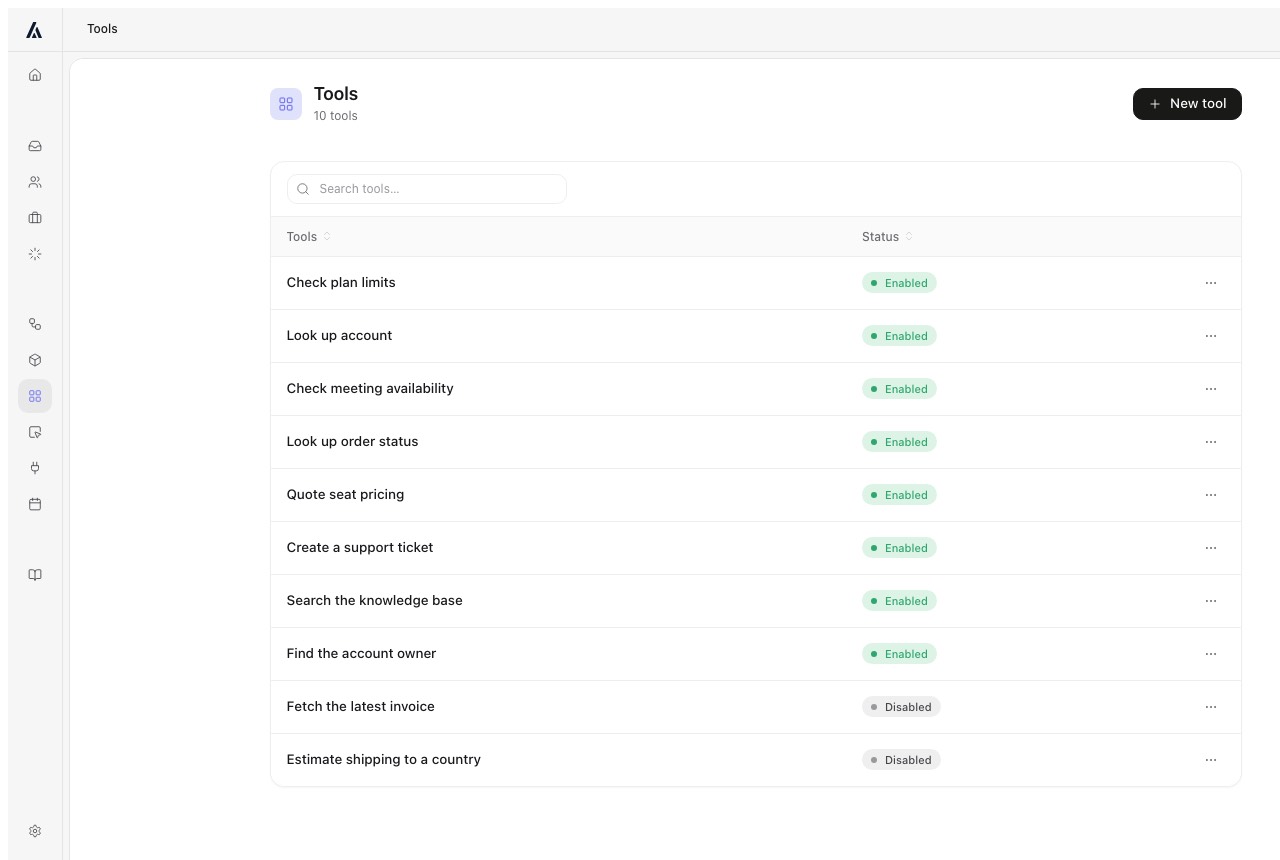
A Processes AI Assistant, shown as an early access preview, can draft the JavaScript for a block. Ready-made connections exist for tools such as Zendesk, Salesforce, NetSuite, Recharge and Loop Returns.
Zowie's homepage cites six weeks from kickoff to production for a regulated insurer. Its insurance page says live in six weeks, and its debt collection page says eight.
Algomo integrations
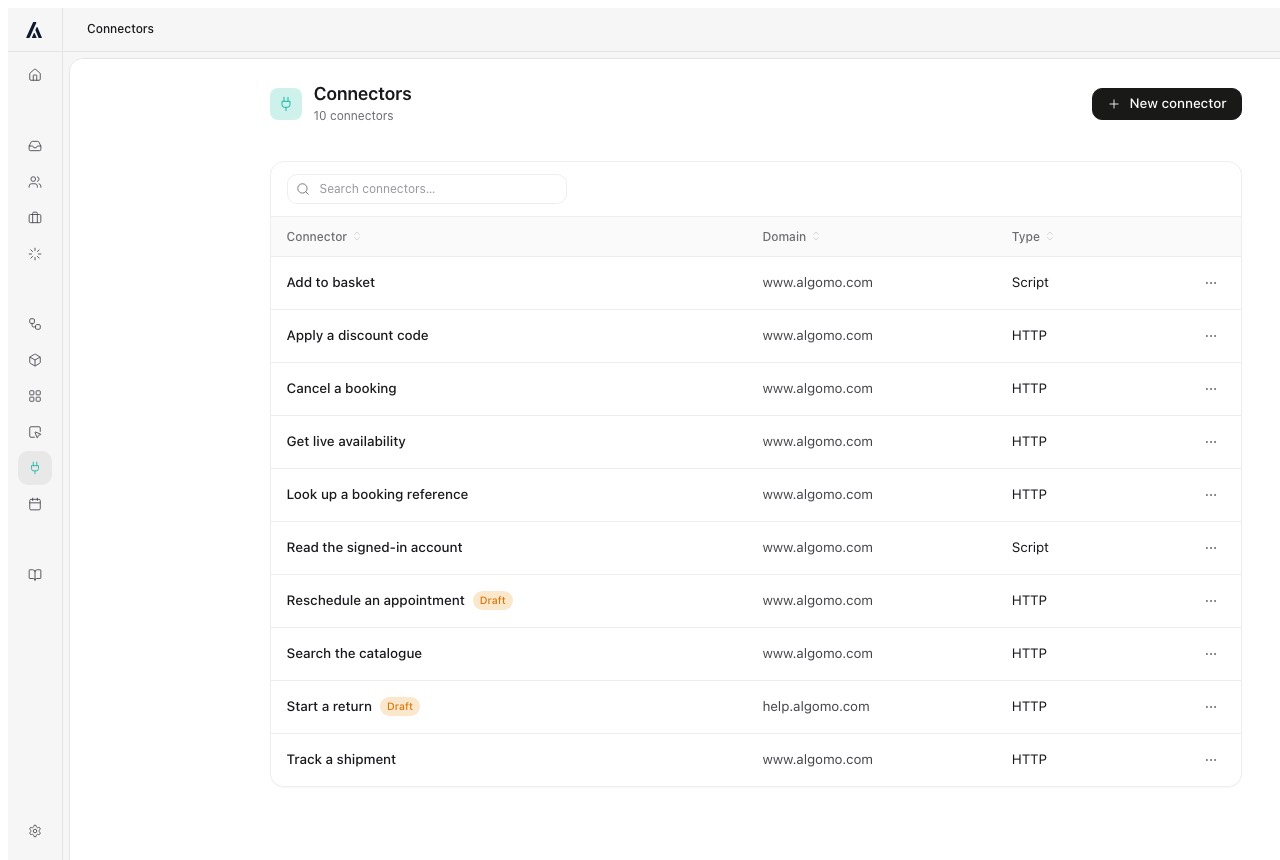
Algomo begins with your website, not a project plan. It watches what your pages request, such as a savings rate, a stock level or an order status. Each request becomes a tool for the agent. Algomo's AI deployment engineer handles the finding, the wiring and the maintenance, so a first version answers the same day.
The payoff grows with how unusual your stack is. A home-built booking engine, an ageing ERP or a platform no app store supports is where it saves the most time. Anything only staff can log into, such as a CRM, goes through a connector on the Business plan. When a redesign breaks a link, Algomo flags it and the mapping is rebuilt.
You can watch this in the demo library, on big brands' own systems that nobody at those brands had to wire up. In the Blinds 2go demo, one card prices three made-to-measure windows with the retailer's own price engine. In the Nike demo, the agent reads today's price and UK 9.5 stock from the live store. In the Nationwide demo, it sets two instant access savings accounts side by side at today's rates.
Connecting to your systems
| Algomo | Zowie | |
|---|---|---|
| Finds the systems behind your site | ✓ Algomo's AI, from what your pages call | ✗ Named and connected by your side |
| Builds the calls the agent makes | ✓ Algomo builds each tool itself | ✗ A JavaScript Code block per call |
| Help writing that code | No code to write | ✓ Processes AI Assistant, in early access |
| First version running | ✓ The same day | Six weeks quoted for an insurer |
| Systems behind a staff login | A connector, from the Business plan | ✓ A Code block or a ready-made integration |
Our take: pick the one system your customers ask about most, and ask each vendor to show the agent reading it on the first call, with a date for when it goes live.
Will its answers keep up when your policies change?
TL;DRZowie answers from policies imported from your help centre, your API or a crawled web page, while Algomo reads the live page for each question, and a reviewed agent that contradicts your website makes your next month free.
Rates, prices and return windows change more often than anyone re-imports them. An agent working from last month's text gives last month's answer, and sounds sure of it. In a regulated business, that answer can become a complaint.
Zowie knowledge
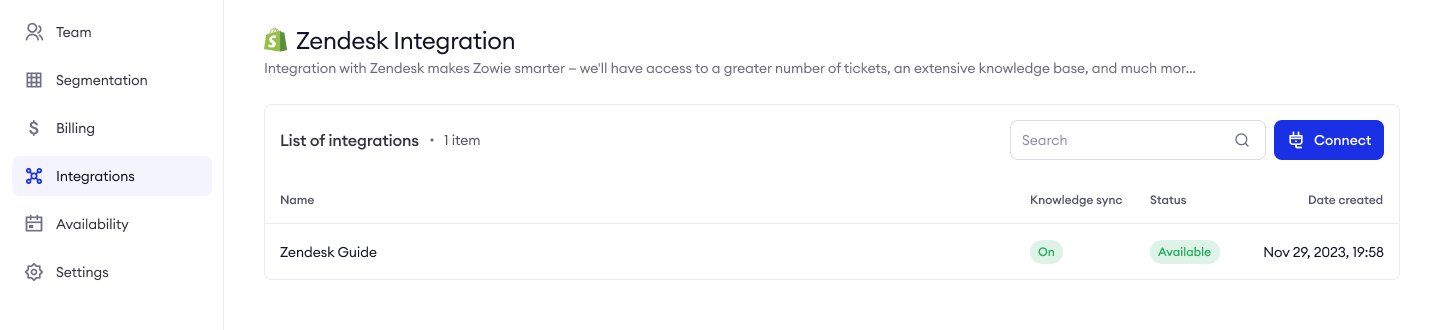
Policies can come from Zendesk, Kustomer or Salesforce articles, or from your own API. Your team can also write them, or pick part of a web page with a selector tool.
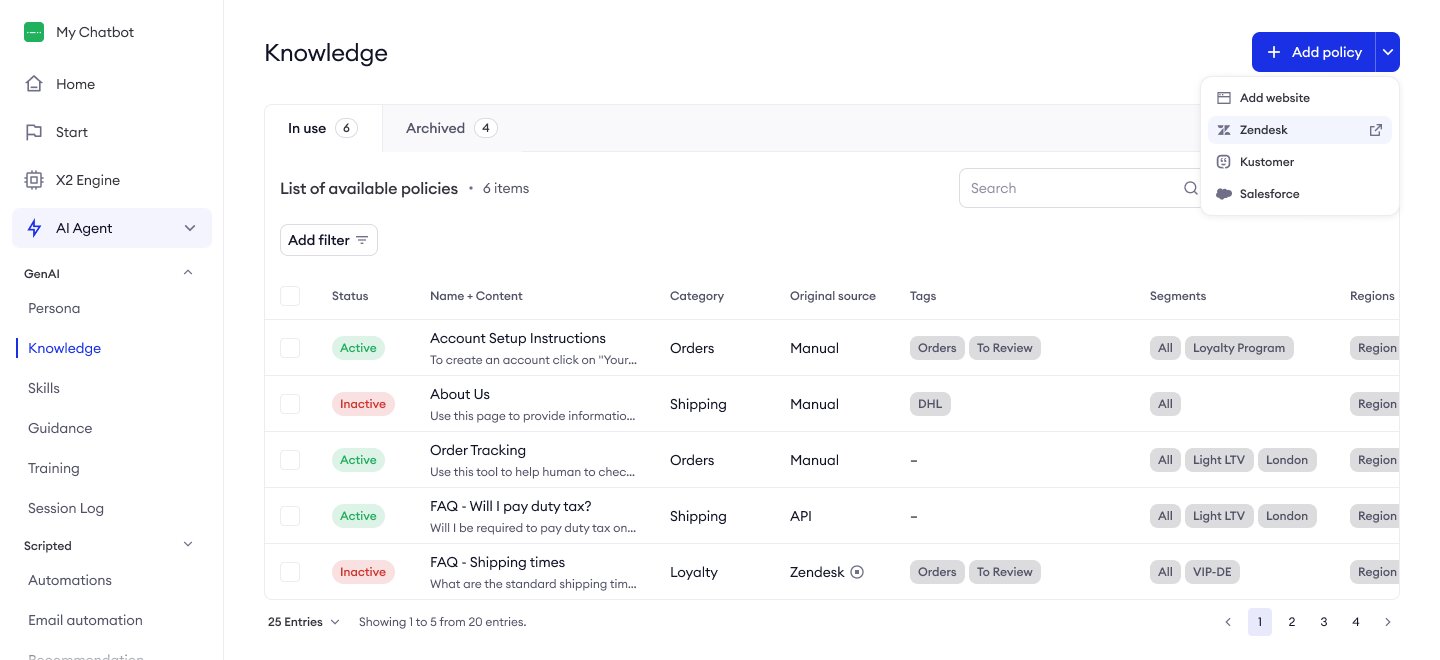
Zowie's knowledge page says help centre edits usually reach the index in under five minutes. Website crawls run on a schedule or when someone starts one. Data about one customer, such as an order or a balance, comes from a process that calls your system.
Algomo agentic search
Algomo does not answer from a stored copy of your site. Each time someone asks, it opens the page that holds the answer and reads it, with the live data behind it, while the customer waits. Edit a rate at nine in the morning, and the agent quotes the new rate a minute later.
Orders and account details arrive the same way, through the connections from the section above, at the moment of the question.
Algomo reviews every agent before launch. Should a reviewed agent ever contradict your website, you pay nothing for the following month, under the terms on the guarantee page.
Where each answer comes from
| Algomo | Zowie | |
|---|---|---|
| Your help centre articles | ✓ Read live, as pages of your site | ✓ Synced from Zendesk, Kustomer or Salesforce |
| Your public website | ✓ The live page, for each question | ✓ Imported pages, crawled on a schedule |
| Policies your team writes | ✓ Instructions in plain language | ✓ Policies written in Zowie |
| One customer's order or account | ✓ The calls your pages already make | ✓ A process that calls your system |
| A price or rate you edited a minute ago | ✓ Read from the page | After the next sync or crawl |
Our take: edit one policy line on your public site, ask both agents about it ten minutes later, and keep the one that quotes the new line.
What happened when we asked Zowie's AI on live sites?
TL;DROn 21 November 2026 we put 315 questions to the Zowie AI agent on 21 websites. It answered 127 correctly, and 10 of the sites gave at least one confirmed wrong answer.
We picked 21 sites that load Zowie's chat. Two of them could not be tested, because the chat was switched off or the site blocked our network. Each question asked about something the site prints, and we checked every answer against the site's own pages. An answer counted as wrong only when it contradicted the site for a first visitor and again for a fresh visitor with no cookies, and when no other page on the site backed it.
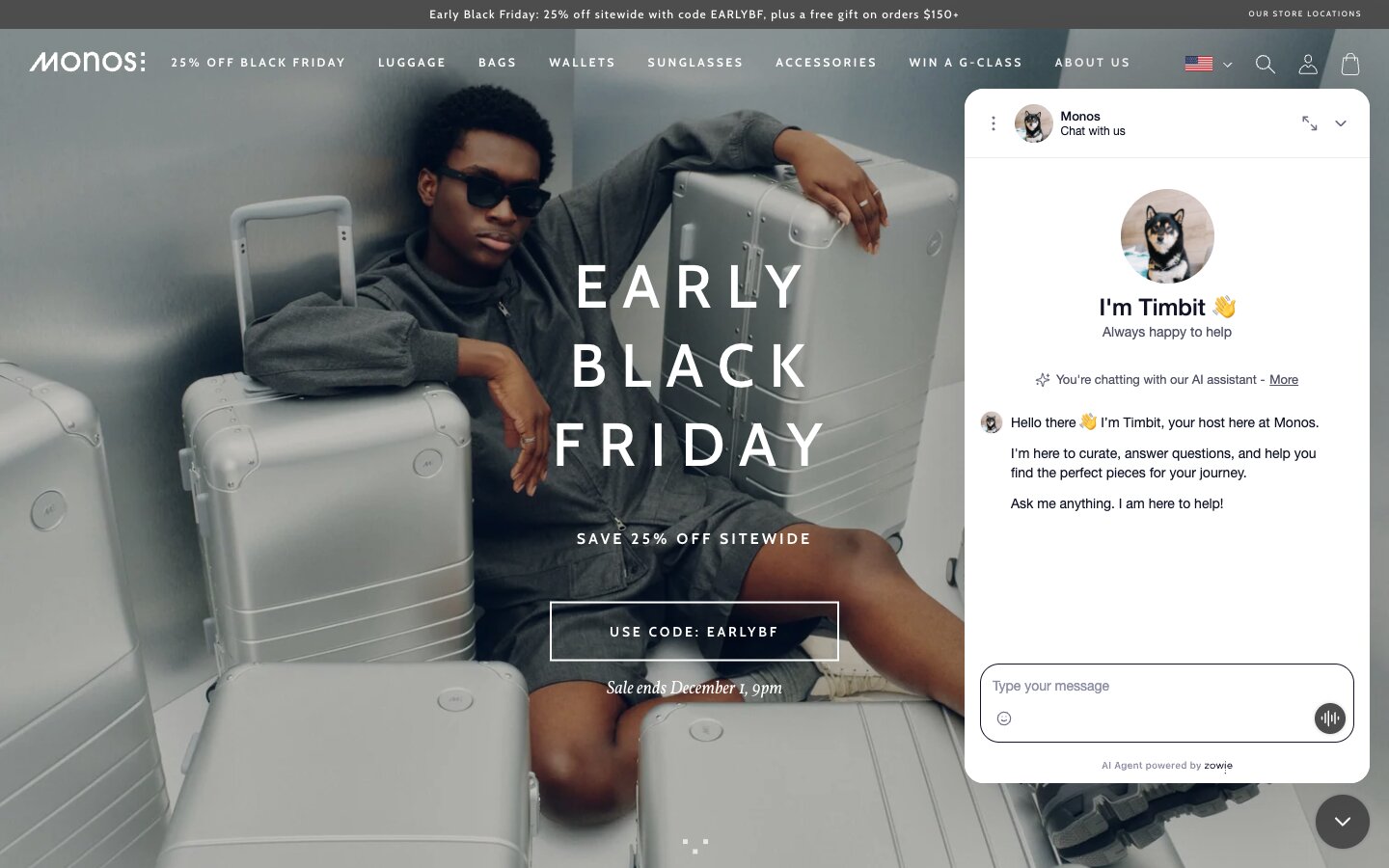
That left 17 confirmed wrong answers on 10 sites. They are spread out: TaxCycle gave four, YES gave three, and no other site gave more than two. Four sites, Monos, Monica Vinader, Missouri Star Quilt and Tip Top, answered almost every question correctly.
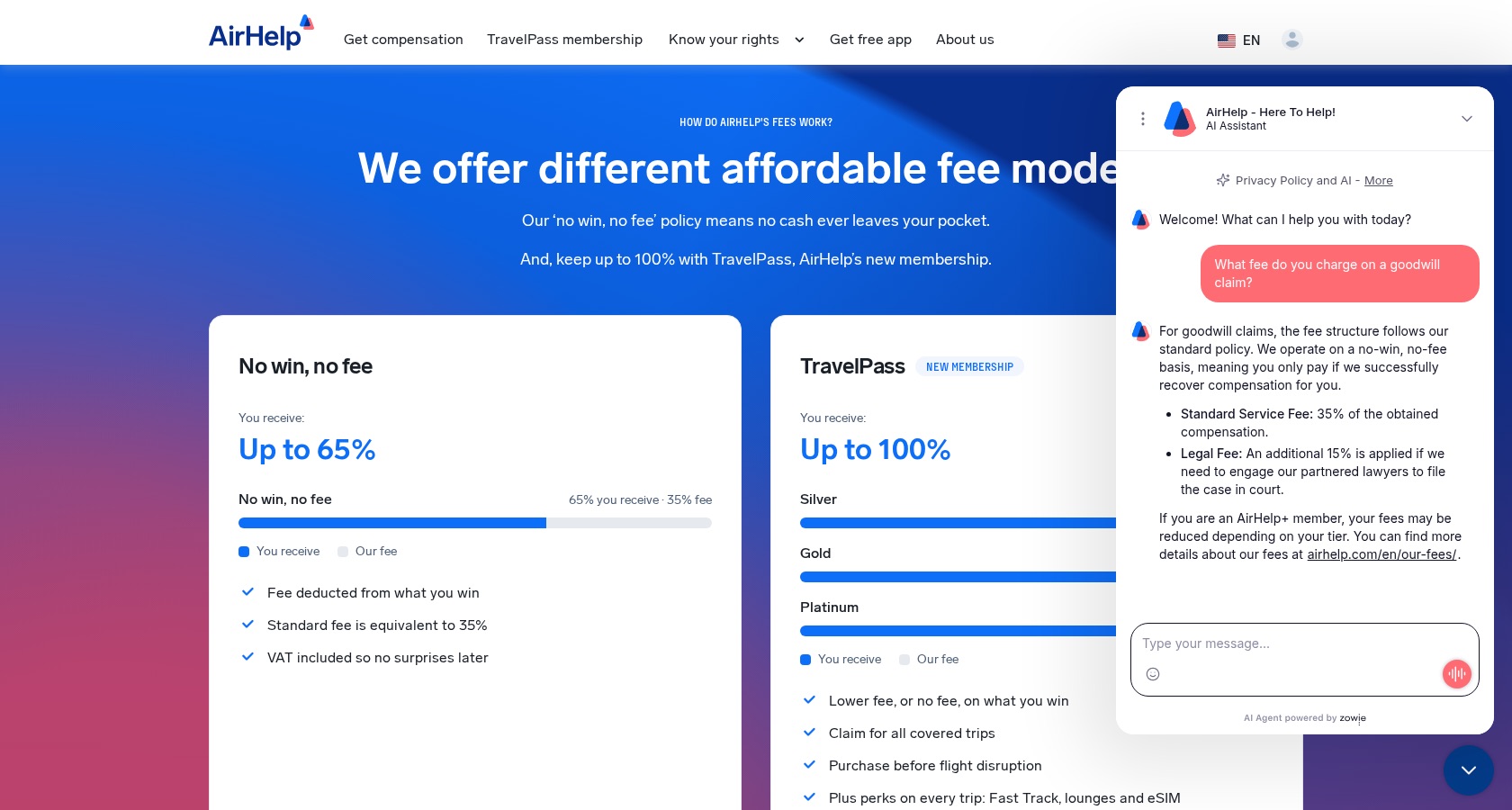
AirHelp: the fee on a goodwill claim
On 21 November 2026, the chat was open on the fees page of airhelp.com. We asked: "What fee do you charge on a goodwill claim?"
Zowie's AI said the standard service fee is 35%, with an extra 15% legal fee if legal action is needed. A fresh visitor heard: "Standard Service Fee: 35% of the obtained compensation."
The fees page says: "Where AirHelp has obtained Flight Compensation for a Goodwill Claim, we will charge you a fee of $29.99." The same $29.99 is on AirHelp's international and UK fee pages. Zowie publishes an AirHelp case study.
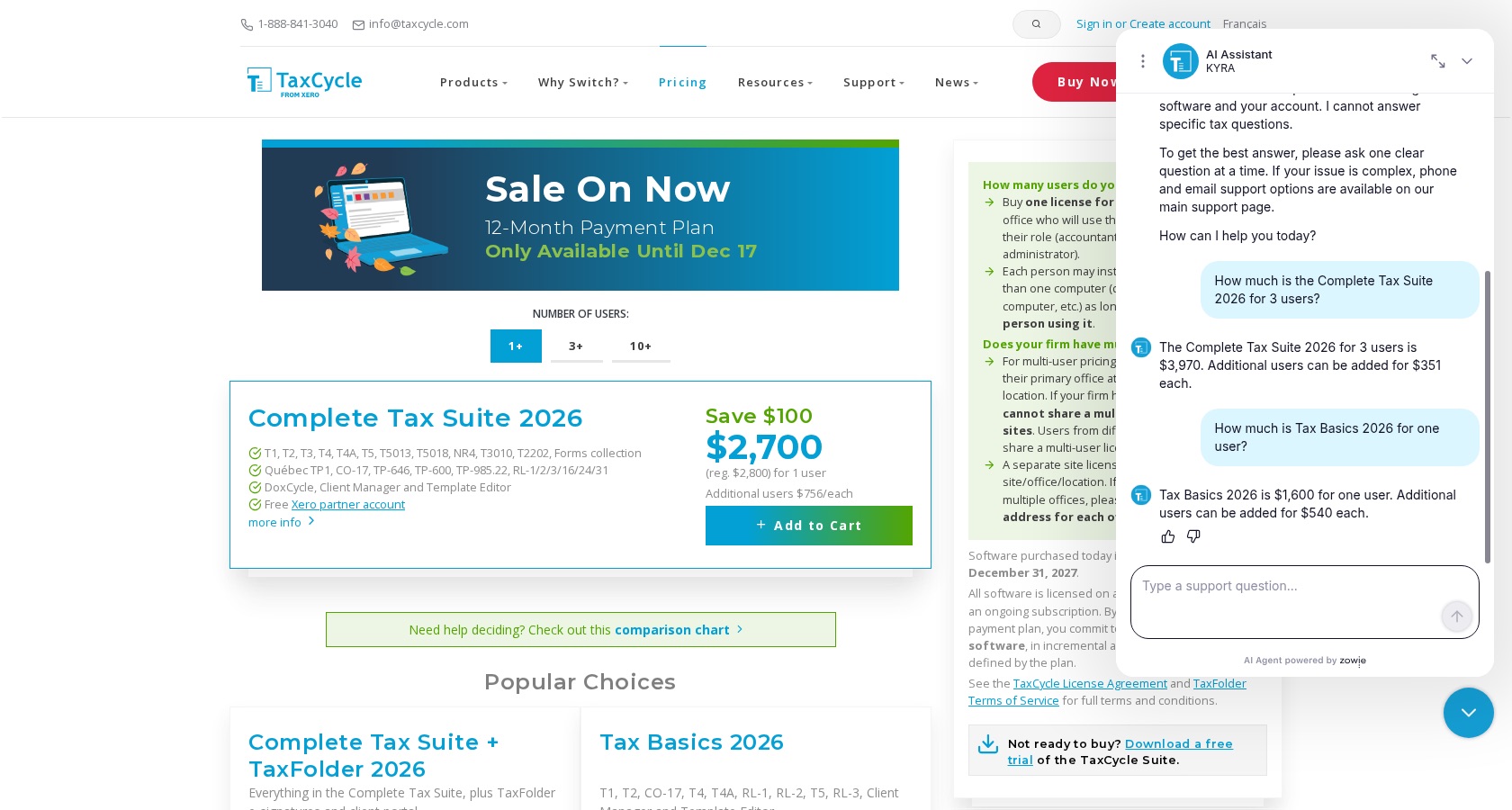
TaxCycle: the price of Tax Basics 2026
On 21 November 2026, the chat was open on the pricing page of taxcycle.com. We asked: "How much is Tax Basics 2026 for one user?"
Zowie's AI said: "Tax Basics 2026 is $1,600 for one user." A fresh visitor heard: "Tax Basics 2026 for one user is $1,600."
The pricing page prints "Save $25 (reg. $1,680)" and "$1,655 for 1 user". Three more TaxCycle prices came back wrong for two visitors each, and none of the four wrong prices appears on any TaxCycle page we searched. The chat footer reads "AI Agent powered by zowie".
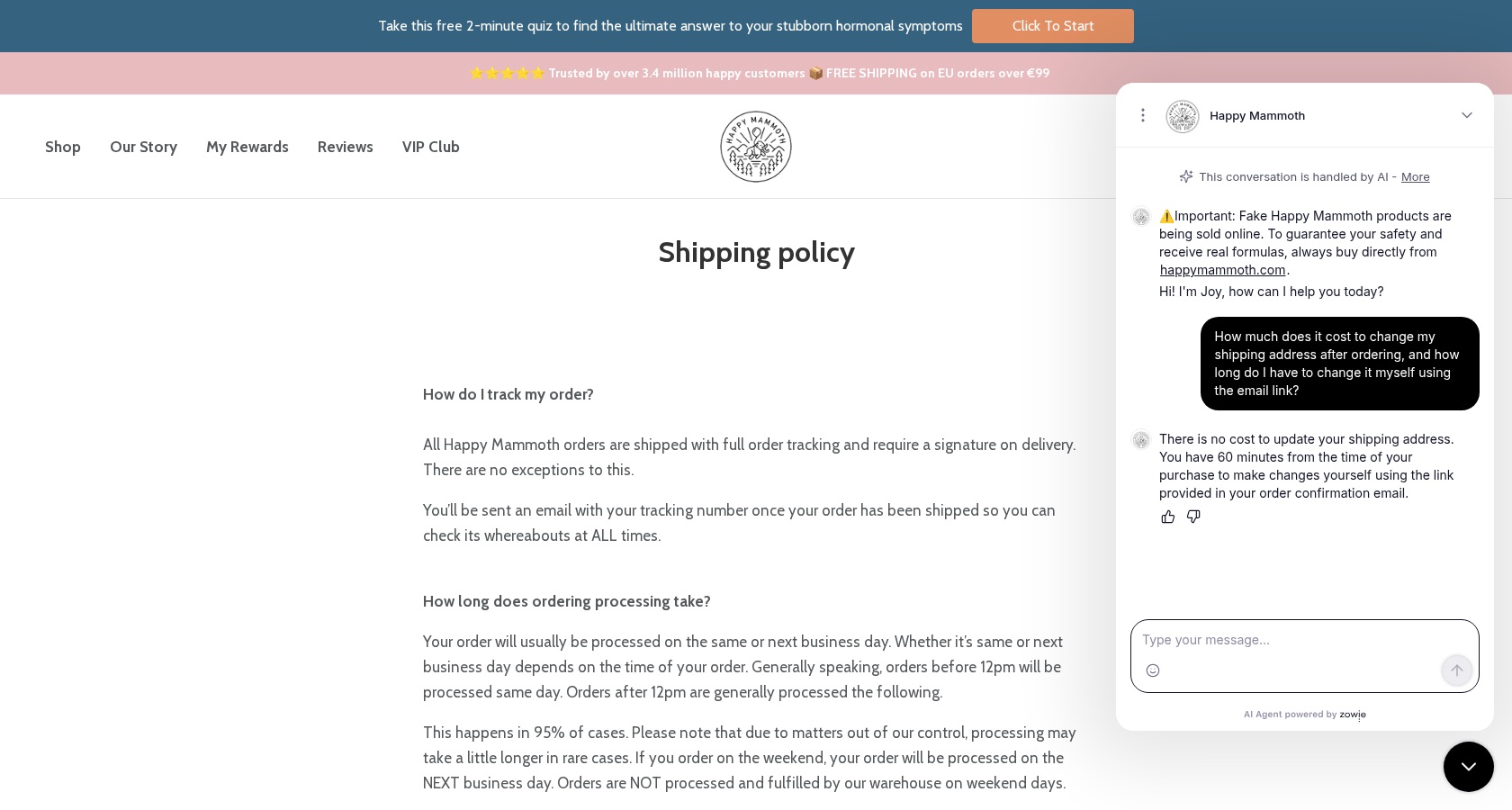
Happy Mammoth: the fee to change a shipping address
On 21 November 2026, the chat was open on the shipping policy page of eu.happymammoth.com. We asked: "How much does it cost to change my shipping address after ordering, and how long do I have to change it myself using the email link?"
Zowie's AI said: "There is no cost to update your shipping address." A fresh visitor got the same words.
The shipping policy says: "Our warehouse charges us a €9.00 fee for address modifications due to the manual effort involved." It adds that the €9.00 fee is charged to the customer before the change is made. Zowie publishes a Happy Mammoth case study.
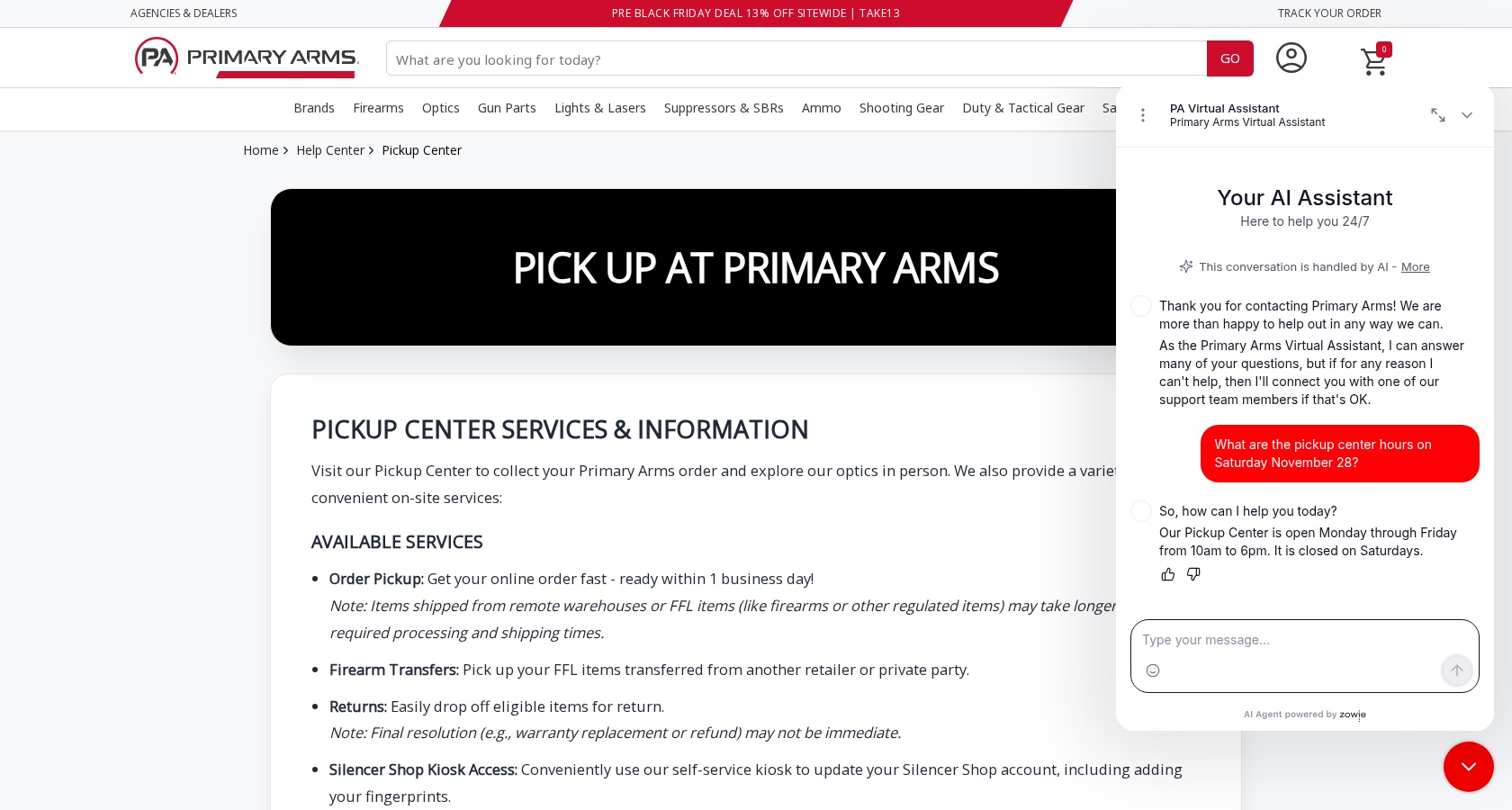
Primary Arms: pickup hours on the Saturday after Black Friday
On 21 November 2026, the chat was open on the pickup center page of primaryarms.com. We asked: "What are the pickup center hours on Saturday November 28?"
Zowie's AI said the pickup center is open Monday to Friday and "It is not open on Saturdays." A fresh visitor heard: "It is closed on Saturdays."
The same page lists special Black Friday hours, with the line "Sat 11/28: 10 AM – 3 PM". No other page on the site says the center is closed that day. Zowie publishes a Primary Arms case study.
We keep the full record behind every answer above: the transcript, a capture of the page at the time, the screenshots and the time stamps. If you work at Zowie or at a site named here and want that record, write to support@algomo.com.
Who changes the agent once it is live, and from where?
TL;DRBoth are now changed from a coding assistant over MCP with a staged draft, and the main difference is that Algomo also works from ChatGPT, which Zowie's docs say cannot connect yet.
The agent you launch is a first draft. A product line arrives, a fee changes, a rule needs an exception. How quickly your team makes that change, and how safely, sets the running cost of the agent.
Zowie Agent Studio and MCP
Zowie's Agent Studio holds the persona, the knowledge, the flows and the playbooks, which are instructions written in plain language. Since September 2026, Zowie's MCP server lets an assistant such as Claude, Claude Code or Codex read conversations and edit the configuration. MCP is the open protocol that lets one program operate another.
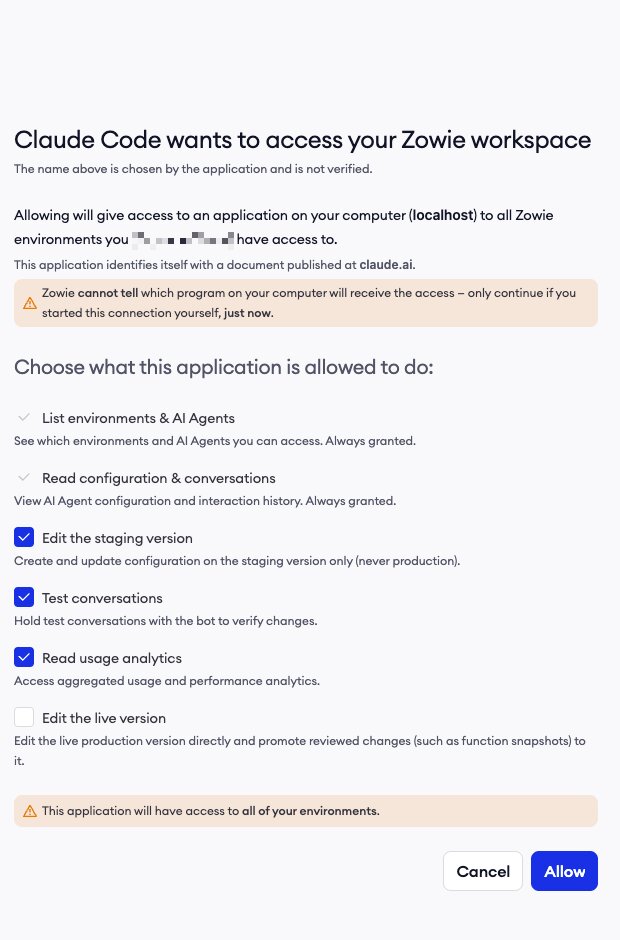
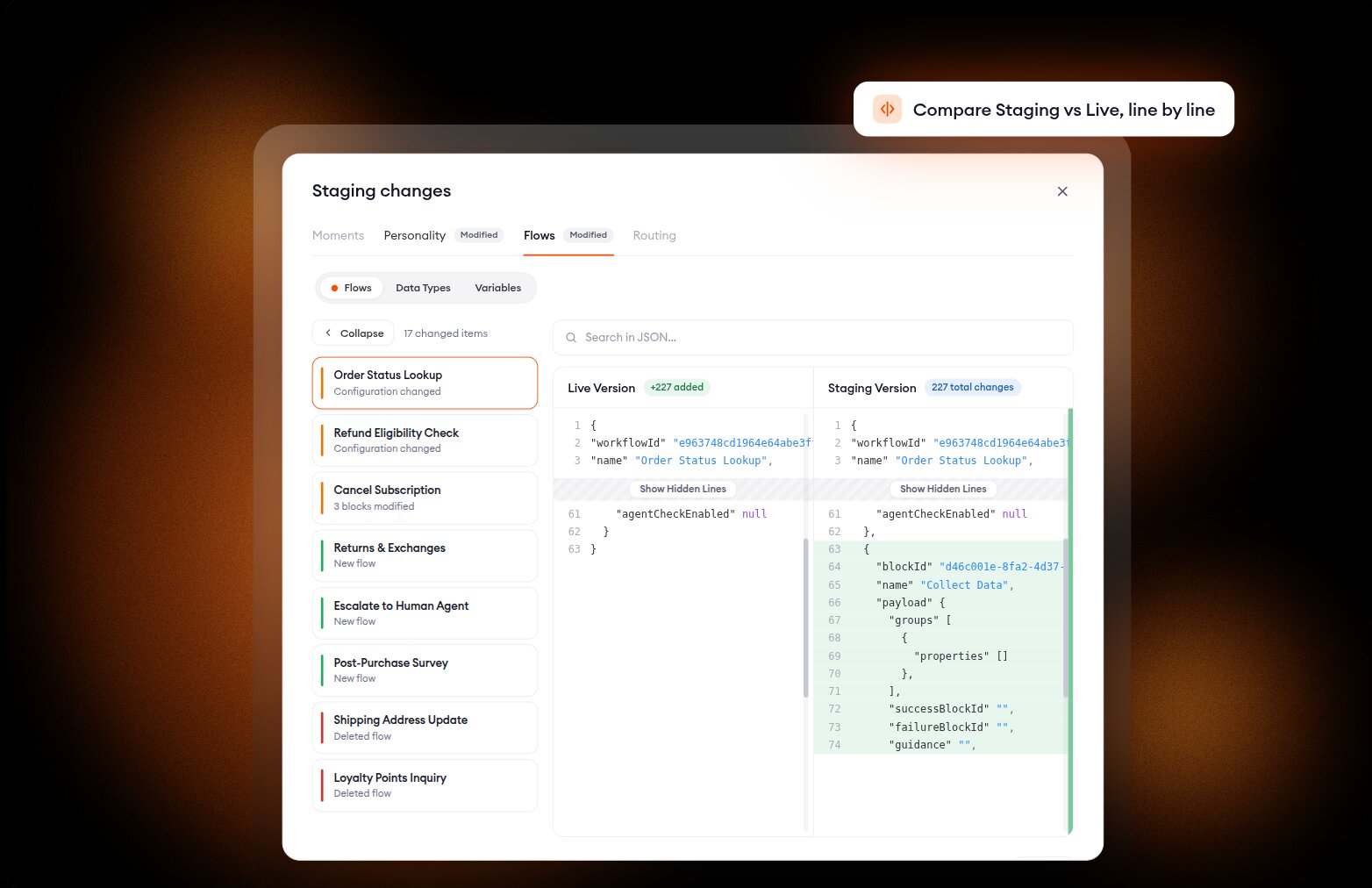
Edits made this way land in a staging copy that customers never see. You read the diff and publish it from the Zowie app. Zowie's docs add two limits. ChatGPT cannot connect to the server yet, and knowledge policies are shared between staging and live, so a policy edit reaches both at once.
Algomo AI-first platform
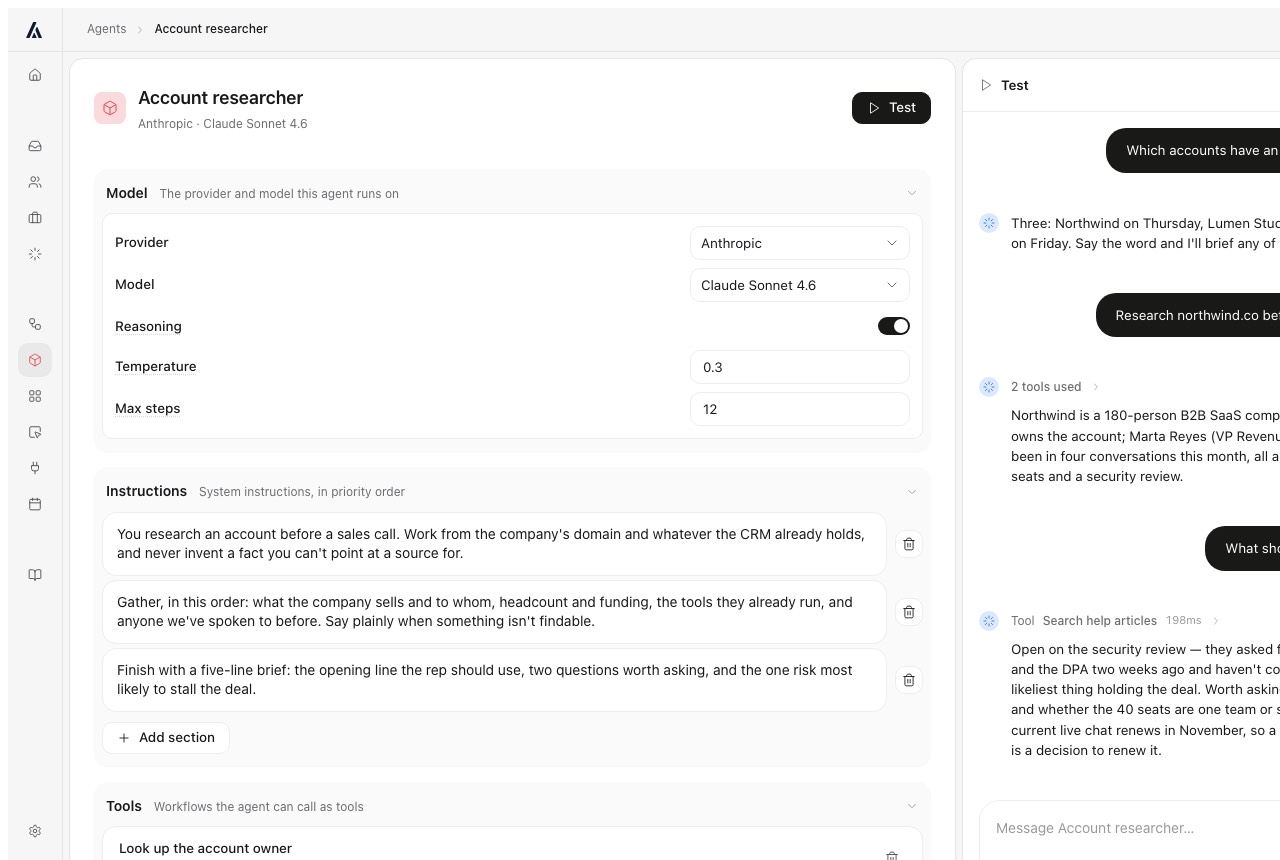
You run Algomo from the assistant you already code with: Claude Code, Codex, Cursor, ChatGPT or the Claude app, connected over MCP. Say what the agent should handle, and the assistant writes the setup.
Nothing goes live unstaged, knowledge edits included. You test the change on your own site, read the diff, then publish. Algomo records each change with its reason.
Our take: ask each vendor to change one policy from your own assistant during the demo, and to show what a customer would read before and after.
What can the agent do on the page for your visitor?
TL;DRZowie shows product cards and a cart inside its chat, and syncs your store's cart through code your developers add, while Algomo works in the visitor's own browser session and does the steps on your page in plain sight.
A shopper asking about a product usually wants it in the basket. A customer asking about an account wants it checked. What the agent can do on the page decides whether the chat ends in a sale or in a ticket.
Zowie visual aids and cart
Zowie's chat can show visual aids, such as product recommendations, a cart and input fields, plus custom ones your team builds as a web page. When the agent adds a product in the chat, the widget passes your code a list of the changes.
Zowie's docs say your developers use that list to update your website's cart through your store's own cart API. Without that code, the cart works inside the conversation, but the cart on your website does not change.
Algomo co-navigation
Algomo acts inside the visitor's own browser session, so it sees their prices, their country and their basket. It can narrow a product list, apply a discount code, or put an item in the real basket. It can also open a page next to the chat or look up the visitor's order, and the visitor sees each step.
It knows the page in front of the visitor and the pages they opened this visit. Acting in that session, it can see only what the visitor can see, and do only what your tools allow. No platform app is needed.
Acting for the visitor
| Algomo | Zowie | |
|---|---|---|
| Adds to the basket on your site | ✓ In the visitor's session, with no code | ✓ Through a callback your developers wire |
| Works the page with the visitor | ✓ Filters, applies a code, opens a page | ✓ Custom events your own code handles |
| Shows more than text | ✓ Cards, tables and reply buttons | ✓ Product cards, a cart, input fields |
| Knows where the visitor is | ✓ The page and what they viewed this visit | ✓ Product visits and cart, with tracking set up |
Our take: ask each agent to put one named product in your real basket on your own site, then reload the page and check the basket.
What can run behind the conversation?
TL;DRZowie runs fixed processes such as refunds and identity checks through its Decision Engine, while Algomo runs any function you describe, during the chat and after it, from a two-factor code to a research memo for your salesperson.
Some requests need work no page does. You may need to check who is asking, alert a manager, or follow up the next morning. How each product handles that work decides what still lands on your team.
Zowie Flows and playbooks
Zowie splits talking from acting. Flows are fixed processes for steps that must not vary, such as a refund, a claim or an identity check. The language model does not improvise them. Playbooks are written guidance the agent interprets in each conversation.
Algomo workflows and widgets
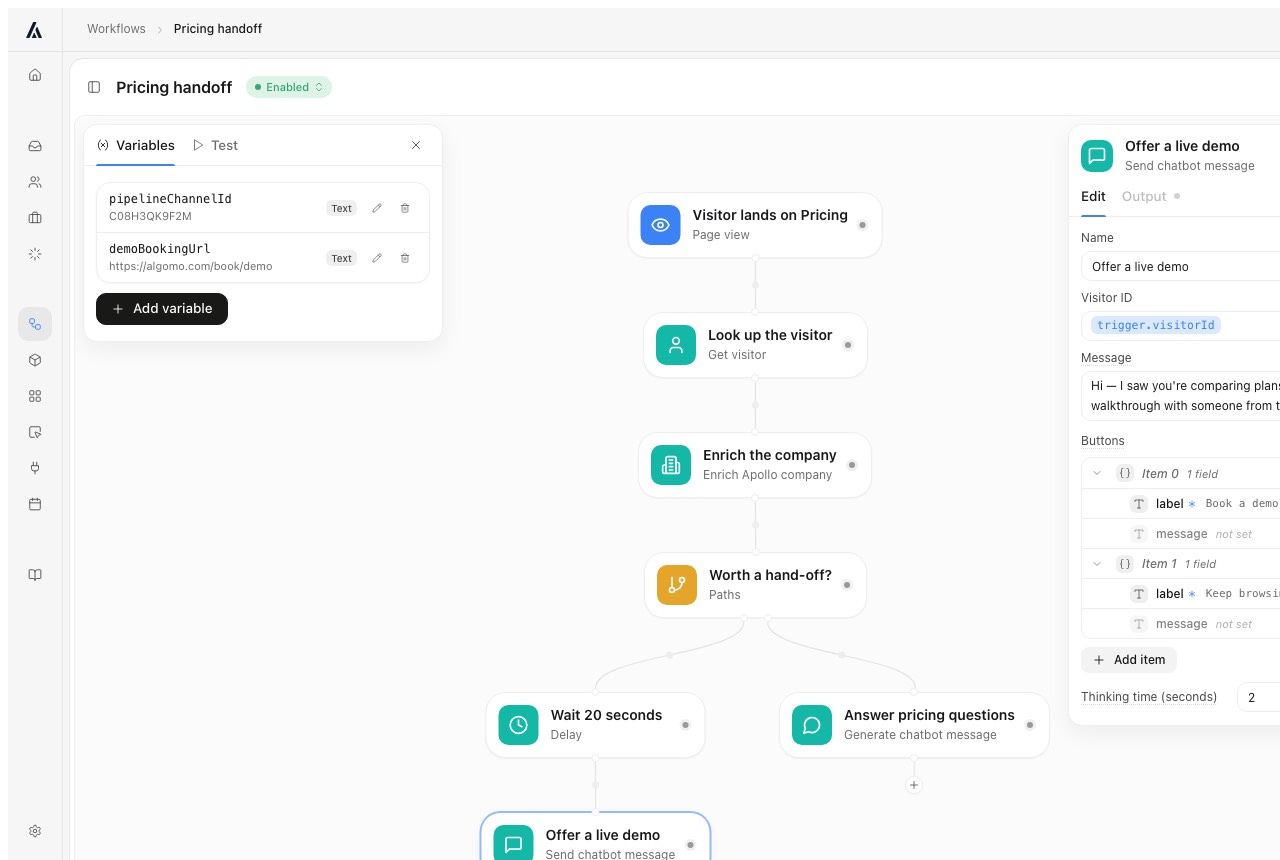
Every Algomo agent has a workflow engine behind it, so the chat can start real work. Mid-conversation, it might send a two-factor code before revealing an account, route the chat by your rules, or ping a colleague in Slack. Once the visitor leaves, it can email a summary, or look into the visitor's company and hand your salesperson a written memo.
For business-to-business sales, the same agent does the inbound work. Given an email or a domain, it works out who the visitor is and drafts a brief for the meeting. It shows calendars inside the chat and books the slot, rotating across your reps. Visitors from an account with an open deal reach that account's owner, on Salesforce or any other CRM.
Need a quote calculator or a booking panel in the chat? Describe it to your coding assistant, and Algomo ships it as a widget your visitor uses in the conversation.
Our take: write down one task your team does by hand after a chat ends, and ask each vendor to show it running without anyone touching it.
Which channels does each one answer?
TL;DRZowie answers web and app chat, email, phone, WhatsApp, Instagram and Messenger from one setup, and Algomo answers chat on your website and sends a follow-up email when a visitor leaves.
Your customers choose the channel, and the agent has to be there. If half of them phone, a website agent never hears from that half. No setting changes that later.
Zowie channels
Zowie answers chat on your website and in your apps, email, phone calls, WhatsApp, Instagram and Messenger, all from one configuration. Zowie Phone supports 36 languages, one per phone line, and passes calls to Genesys, Talkdesk, Twilio Flex, Amazon Connect or Aircall. Hello adds a voice mode inside the web chat itself.
Algomo channels
Algomo answers in the chat on your website and can email a visitor after they leave. Phone calls and incoming email are outside what it does.
Our take: if a large share of your contacts arrive by phone or email, choose Zowie, and count last month's contacts by channel before you decide.
How do you check it before launch, and see why it answered?
TL;DRZowie runs written test scenarios many times over and scores every conversation after launch, while Algomo lets you try the agent on your live site before any code is added and logs every call behind every answer.
You do not want to learn what the agent says from a customer. You need to run it first, and when an answer goes wrong you need to see why. That decides how fast your team finds and fixes a bad answer.
Zowie Tester, Supervisor and Traces
Zowie's AI Tester runs written scenarios again and again, and reports results as runs passed out of runs tried. Its docs say testing of Decision Engine processes is planned for a later release. After launch, Supervisor scores every conversation, and Traces records the reasoning behind each decision.
Algomo testing and audit
Before you add a line of code to your site, Algomo's browser extension lets you run the agent on your real pages. Tests draw on a separate monthly allowance, 200 credits on Free and 1,000 on Business, so they never use what live visitors need.
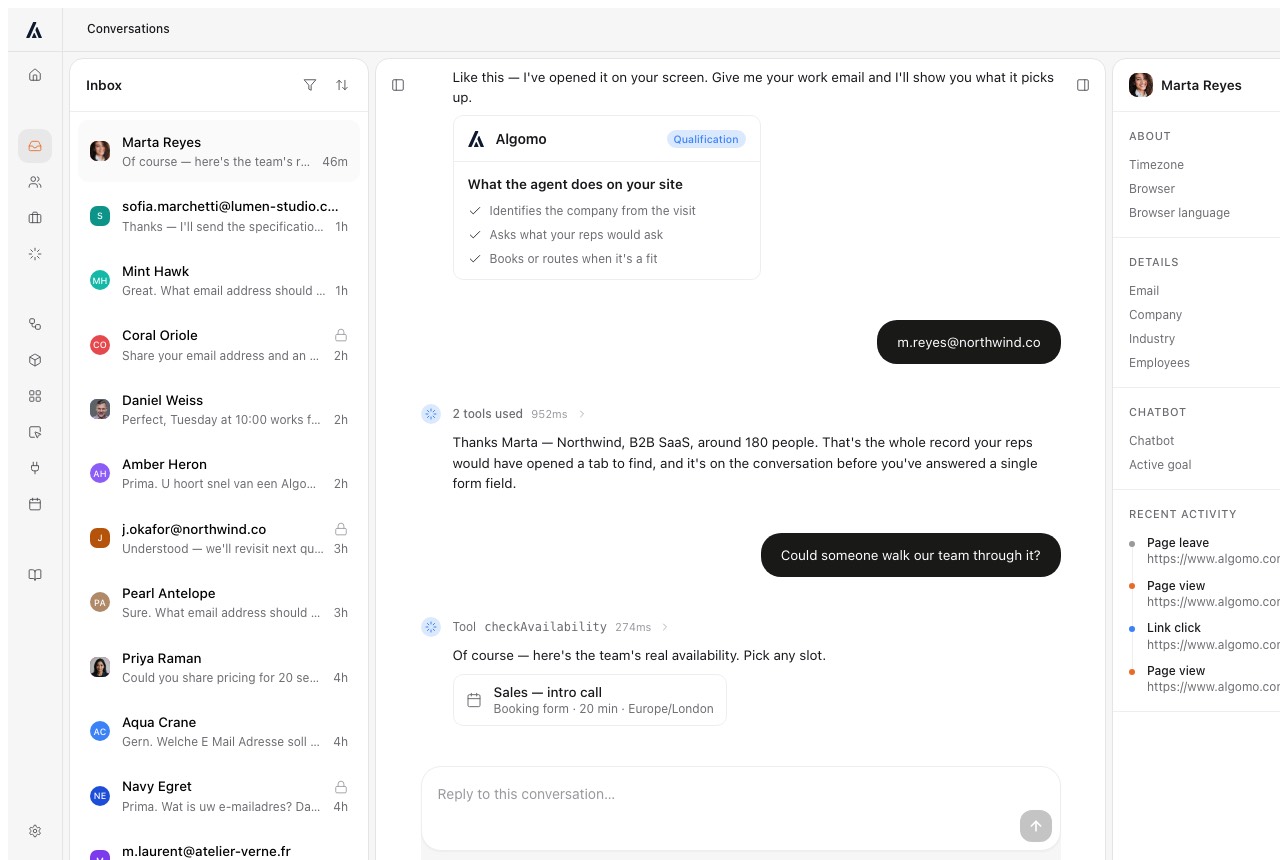
Once it is live, each answer keeps a record of every tool it called. You see what went in, what came back, how long it took and what it cost. Workflows keep a trace of each step. When an answer is wrong, you open it and read the cause.
Our take: pick one answer from the demo and ask each vendor to show the exact calls behind it, not a score.
What happens when a person needs to step in?
TL;DRZowie routes a conversation to Zowie Inbox or to your helpdesk by region, topic and working hours, while Algomo alerts the right person by email and Slack and lets them join the live chat on your site.
A complaint, a refund or a big buyer needs a person. The handoff decides whether that person starts with the context or asks the customer to repeat everything.
Zowie handoff
Zowie hands a conversation to Zowie Inbox, Zendesk, Gorgias, Intercom, LiveChat, Salesforce and others, with the context attached. You can set separate handovers by region, language, topic or working hours. Zowie's docs say the Zendesk, Intercom, LiveChat and Salesforce handovers are set up by its Customer Success team.
Algomo handoff
You decide when Algomo passes a chat to a person: on a topic, on a page, or whenever the visitor asks. Whoever you named gets an email and a Slack message, then picks up the same conversation on your site with everything said so far.
Teams that live in Zendesk or Gorgias can have a connector open a ticket there instead.
Our take: trigger a handoff on each and look at what the person taking over can see before they type anything.
What does the first week look like?
TL;DRZowie starts with a 30-minute demo and a rollout scoped with its team, while Algomo's free plan puts a working agent on your own site the same day, with no card.
A tool earns its budget in the first week, when your team sees it answer about your own business. The question is how much of that week goes on meetings and how much on answers.
Setting up Zowie
Zowie starts with a 30-minute demo, matched to your stack and team size. A technical account manager sets up pieces such as e-commerce tracking and voice. Zowie quotes six weeks to production for an insurer and eight for debt collection.
Setting up Algomo
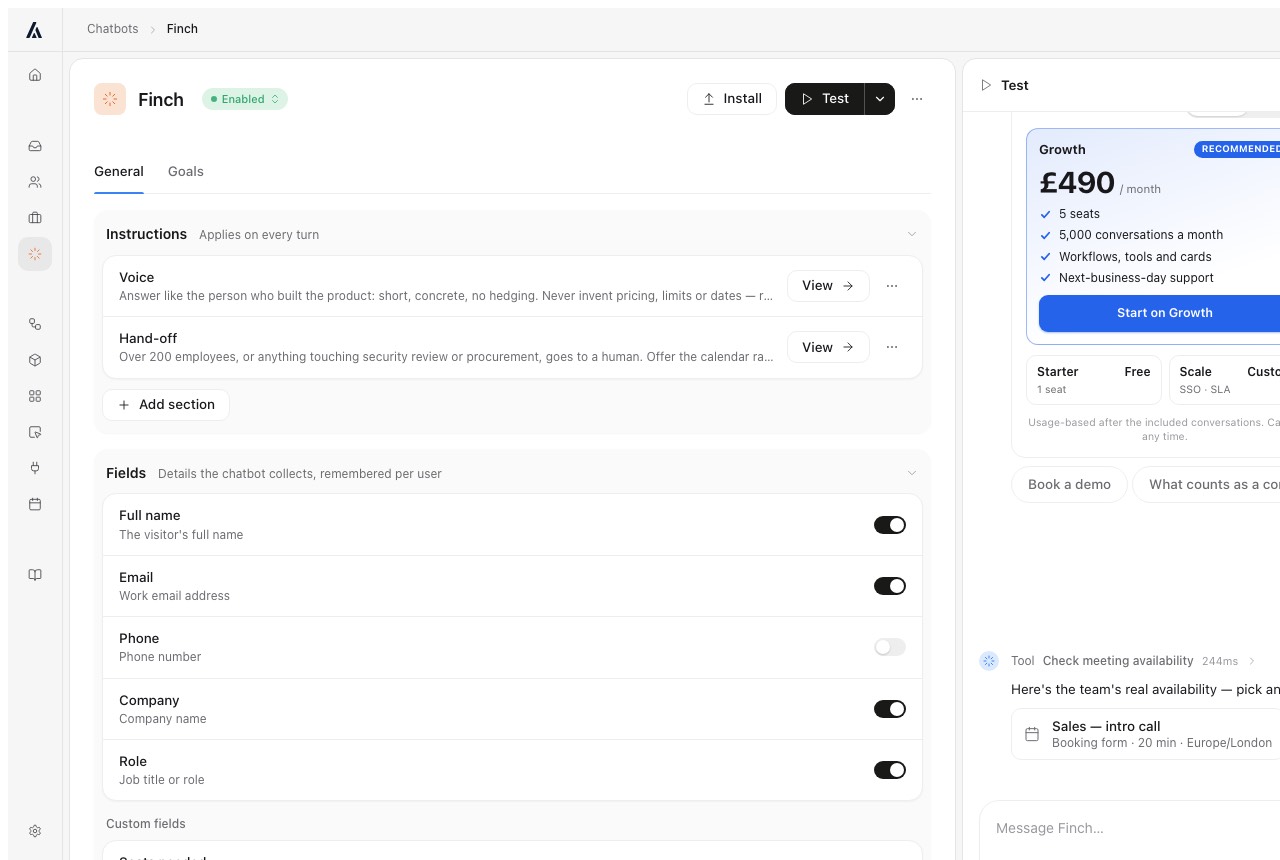
Algomo's free plan needs no card and no call. Enter your URL, let it map the systems your pages use, and a first version is answering the same day. Plain-language instructions set what it covers, with a test chat beside them.
On the Business plan you can add connectors for staff-only systems. You set them up yourself from your coding assistant, or in a session with Algomo's team that typically takes a day or two.
Our take: give both vendors the same three questions about your own business, and note which one answers them on your site first.
How does each one keep customer data safe?
TL;DRZowie lists SOC 2 and HIPAA and can run in your own cloud or on your servers, while Algomo's agent works from the visitor's browser and stores no token for anything your website already does.
An agent that looks up accounts needs a way into your systems. Your security team will ask what the vendor keeps to get that access, and where it runs.
Zowie security
Zowie lists SOC 2, GDPR, HIPAA, the EU AI Act and DORA. It runs as a managed cloud, in a private cloud inside your own VPC, or on your own servers, with an air-gapped option.
Algomo security
Algomo keeps customer logins out of its own hands by design. The agent runs inside the visitor's browser on your page. A price check or an order lookup leaves from that browser exactly as your page would send it. So Algomo holds no token or credential for it.
Staff-only systems, a CRM for example, work differently. They need a connector, which keeps a login encrypted with AES-256-GCM, and you can revoke it whenever you like.
Algomo holds Cyber Essentials for the whole organisation and is on the ICO register as ZA821756. Its application, database and files sit in the EU, and it works to UK and EU GDPR, the EU AI Act and DORA. Enterprise customers pick the AI model provider, and Algomo's compliance page has the detail.
Our take: ask each vendor to list what it stores that could open one customer's account.
How much does Zowie cost?
TL;DRZowie publishes no price and Vendr's buyers report a median of $158,000 a year from three purchases, while Algomo's plans run from free to $4,300 a month on its pricing page.
Your finance team wants to see a number before the first call, and to know whether it moves with volume. A price you can only learn in a meeting is harder to plan around.
How Zowie prices
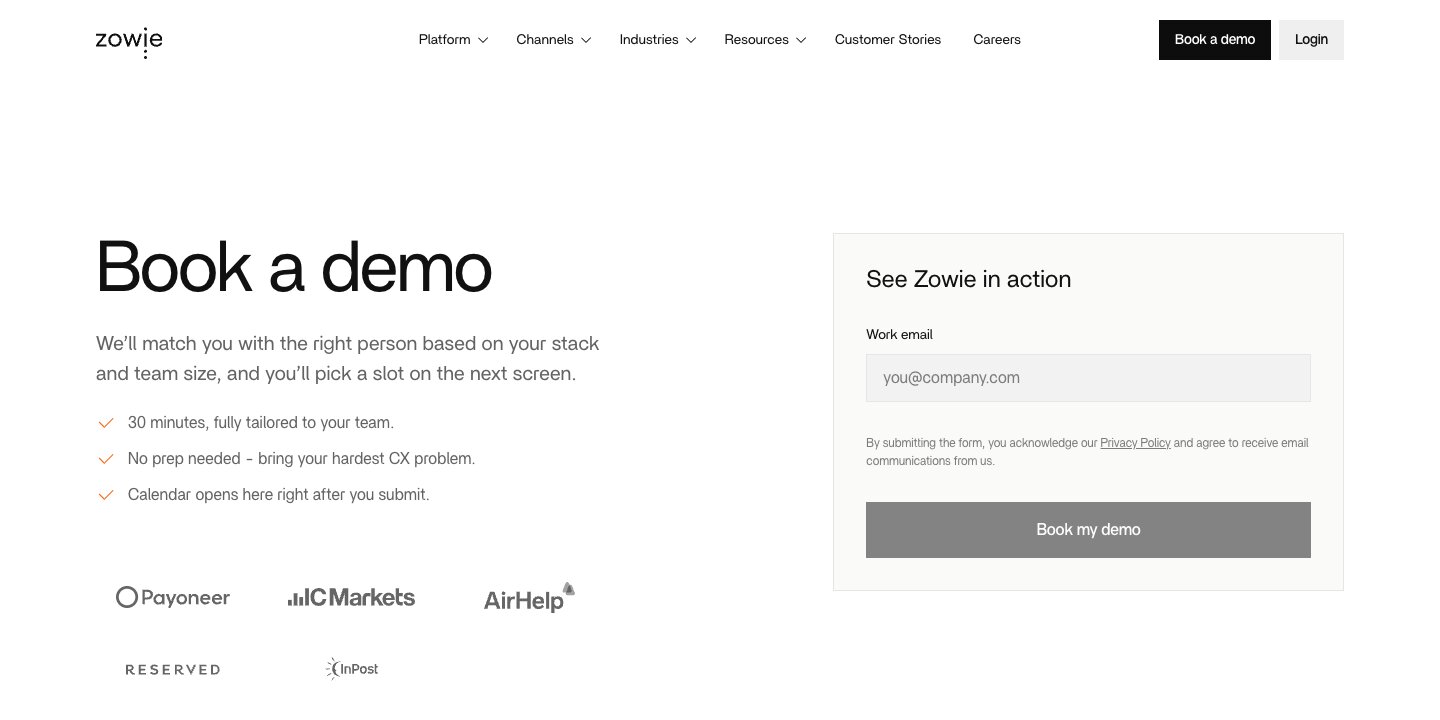
Zowie publishes no prices. Its pricing address opens a form to book a 30-minute demo.
Vendr, a service that buys software on behalf of companies, reports what its buyers paid for Zowie. Its page shows a median of $158,000 a year, in a range from $84,400 to $158,000. Those figures come from three purchases by two buyers, and the page does not say what they covered. Treat them as a sign of scale, not as Zowie's price.
How Algomo bills
Algomo starts free, with 100 credits a month, roughly twenty conversations that helped someone, and no card. Above that you choose a single monthly amount, which buys 40 credits per dollar or more. Plans step up from $50 for 2,000 credits to $200 for 8,000, $1,400 for 60,000 and $4,300 for 200,000.
Each helpful conversation uses 5 credits, and 5 more per extra ten replies. Spam and dead-end chats are free. You pay nothing per seat, and if the credits run out the agent stops until you renew.
Here is a worked sum. A month of 1,000 helped conversations uses 5,000 credits, so you would buy the $200 plan, and twelve months come to $2,400. A month of 10,000 uses 50,000 credits, which is the $1,400 plan, or $16,800 over a year.
How the two are bought
| Algomo | Zowie | |
|---|---|---|
| A price you can read first | ✓ On the pricing page | ✗ Quoted after a demo |
| A free way to start | ✓ Free plan, no card, no end date | ✗ None listed |
| A charge per person on your team | ✓ None | Not published |
| A busier month than planned | ✓ The agent pauses at your amount | Not published |
| Run in your own cloud or servers | ✗ EU-hosted by Algomo | ✓ Private cloud or on-prem |
Our take: ask Zowie for a written quote at your real monthly volume, and set it beside the Algomo plan that covers the same number of helped conversations.
What to ask any vendor selling you an AI agent
TL;DRFive questions to put to every vendor, each with a check you run live.
- Who writes the connection to our order or account system, and when does it go live? Ask for a name and a date.
- Does the answer come from our live page or from an imported copy? Ask when the copy last changed.
- What does it say ten minutes after we edit a policy? Edit one and ask.
- Can it complete the step on our own page, such as adding to the basket? Ask it to, then reload.
- Can it do work our systems do not, such as sending a two-factor code? Ask it to send one.
Run every test on your own website, with the vendor watching, not on a prepared demo.
Which one should your team choose?
Choose Zowie if
- A large share of your contacts arrive by phone or email, and you want one agent configuration across all of them.
- Your security team requires SOC 2 or HIPAA on the vendor's side today.
- The agent has to run inside your own cloud or on your own servers.
Don't choose Zowie if
- Most of your questions begin on your website, about things its pages and back-end systems already know.
- Nobody on your side has weeks to write the calls to your order, stock or account system.
- An answer that lags behind a policy you just edited is a risk you will not carry.
- You want to read the price and try the agent on your own site before any sales call.
- You want the agent to do the step on your page with the visitor: the basket, the code, the right page.
Conclusion
TL;DRChoose Zowie for one governed agent across phone, email and chat in a large contact centre, and pick Algomo when the conversation starts on your website and you want it wired in for you and reading live pages.
On the first risk, Zowie gives your side a Decision Engine and JavaScript blocks, with an AI assistant to help write them. Algomo finds the systems behind your pages and connects to them itself, with a first version the same day.
On the second, Zowie answers from policies it imports and re-syncs. Algomo reads the live page for each question and puts a month's fee behind it. The builder, the channels and the price follow from those two.
Questions buyers ask about Algomo and Zowie
Is Algomo a good Zowie alternative?
Yes, if your customers come to you through your website. Algomo wires itself to the systems behind your pages, answers from the live page, and shows its price up front with a free plan. If most of your contacts come by phone or email, Zowie covers those channels from one setup.
How much does Zowie cost?
Zowie publishes no prices, and its pricing address books a demo. Vendr reports a median of $158,000 a year paid by its buyers, in a range of $84,400 to $158,000, from three purchases by two buyers. Algomo is free to start, then one monthly amount from $50 to $4,300 on its pricing page.
Who owns Zowie?
Zowie, Inc. is independent. Its last announced round was a $14 million Series A in May 2022, led by Tiger Global, which brought its total raised to $20 million. We found no sale, merger or rename since.
Is Zowie the same company as ZOWIE gaming?
No. ZOWIE gaming mice and monitors are a BenQ brand. The Zowie on this page is the customer service AI company at getzowie.com, run by Zowie, Inc.
Does Zowie have an MCP server?
Yes. Zowie's MCP server has been available since September 2026, and its docs cover Claude, Claude Code, Codex, VS Code and Gemini CLI. Its docs say ChatGPT cannot connect yet. Algomo is built and changed over MCP from Claude Code, Codex, Cursor, ChatGPT or the Claude app.
Does Zowie work with Shopify?
Zowie's widget tracks product visits and the cart on Shopify, BigCommerce, Magento and nopCommerce, and its technical account manager sets that up. Algomo works on any website, Shopify included, with no platform app.
Can I try either one without paying?
Algomo has a free plan with no card and no end date, worth 100 credits a month, or about twenty helped conversations. Zowie lists no free plan or trial, and starts with a demo call.
Which AI model does Algomo use?
OpenAI provides the default model. Enterprise customers can pick another provider, and the application, database and files stay hosted in the EU.
Where these facts come from
All the information on this page was available in November 2026. The sources are:
- Zowie's homepage: the products, the customers, the compliance badges and the six-week figure for an insurer.
- Zowie's site summary: the deployment options, the compliance list and the industry timelines.
- Zowie's knowledge page: how quickly help centre edits sync, and how website crawls run.
- Zowie's product updates: the MCP server release and staging changes.
- Zowie's customer stories page: Monos and the other named customers.
- Zowie's pricing page: the demo form.
- Zowie's Series A post: the funding round and its investors.
- Zowie docs articles, each named under the screen it belongs to, plus the Decision Engine, handoff, phone, tester and e-commerce articles.
- Vendr's Zowie page: the median, the range and the number of purchases.
- Algomo's pricing page, Algomo's compliance page and the guarantee page.
- The demo library, for the Blinds 2go demo, the Nike demo and the Nationwide demo named above.