
Summarize withChatGPTPerplexityClaudeGrokAlgomo vs Voiceflow
TL;DRTwo risks stall most AI agent rollouts: the build before the agent can reach real data, and answers that stop matching your site. Voiceflow gives your team a strong workbench for both, and your team does the wiring and keeps the knowledge base in sync. Algomo connects itself to the calls your pages already make, and reads the live page for each answer, with a free month if a reviewed agent contradicts your site.
Algomo vs Voiceflow at a glance
| Algomo | Voiceflow | |
|---|---|---|
| What it is | An AI agent on your website for support and inbound sales, with an inbox your team takes over from. | A platform to build, test and ship chat and voice agents, from its studio, its API, its CLI or over MCP. |
| Owner | Algomo | Voiceflow, Inc., independent and venture-backed |
| Who wires it to your systems | Algomo's AI, from the requests your pages already send. | Your team, with integrations, API tools, functions or MCP servers, each described so the agent knows when to call it. |
| Where answers come from | The page as it reads now, and the data behind it. | Imported pages, files and tables, refreshed never, daily, weekly or monthly, plus web search. |
| Published pricing | Free, then one monthly amount from $50 to $4,300. | None on the pricing page. Businesses request a price after a demo. |
| Channels | Chat on your website, plus a follow-up email. | Web chat, phone, SMS and API. |
| Biggest limitation | No phone and no incoming email. | Every connection and every knowledge sync is your team's to build and keep current. |
What part of Voiceflow do you need?
TL;DRVoiceflow suits a team that wants to design its own chat and phone agents in detail, and Algomo suits a team whose questions arrive on its website and depend on live data.
A platform like this can do a lot, so start from the job. Your answer to one question usually settles it. Pick the line that sounds like your team:
- You run a contact centre and want an agent that answers the phone: Voiceflow.
- You have conversation designers who want playbooks, workflows and A/B tests in one studio: Voiceflow.
- Your visitors ask about prices, stock, bookings or their own order on your site: Algomo.
- Your developers have no spare weeks for API tools: Algomo, which builds its tools from what your pages call.
The two risks come first below. The builder, the page, the channels, testing, handoff, security and price follow.
Who connects the agent to your order and stock systems?
TL;DRIn Voiceflow your team creates each API tool or integration and writes when the agent should use it, while Algomo records the calls your pages already make and turns them into tools itself, with a first version running the same day.
Most of the questions worth automating need your data. Where is my order, is this in stock, is Thursday free. Until the agent can reach those systems, it can only point people at a page, and the project sits in your developers' queue.
Voiceflow tools
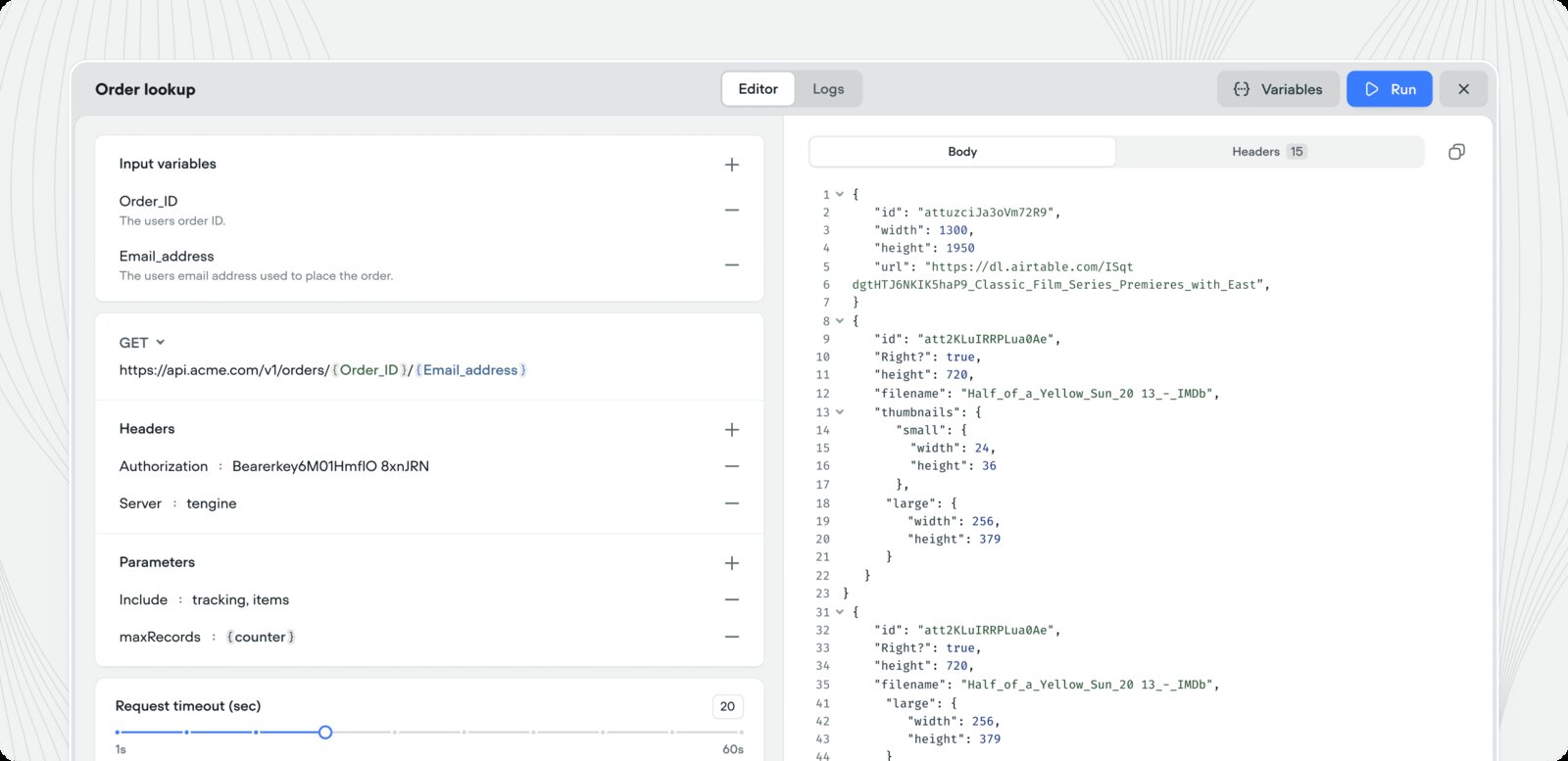
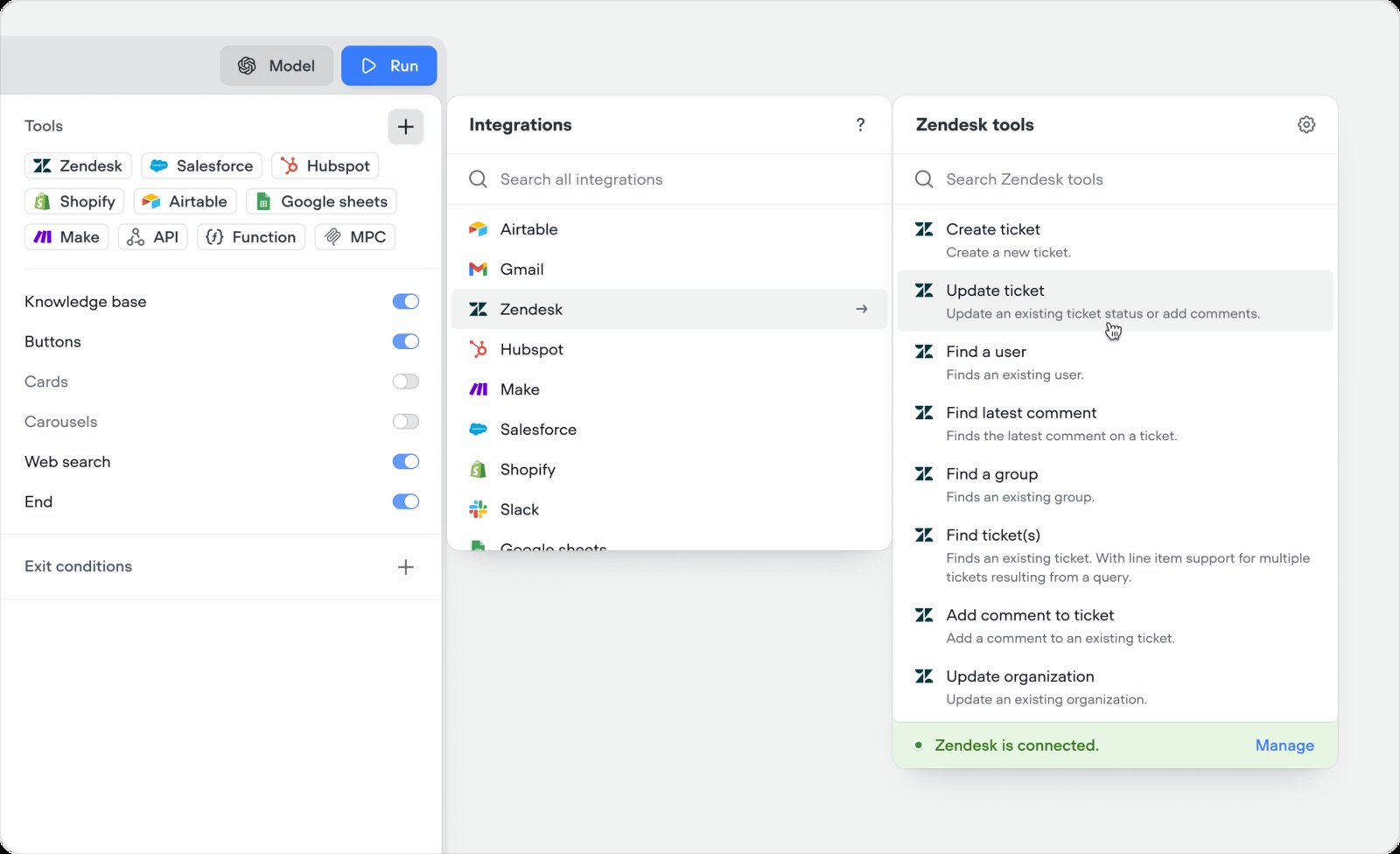
Voiceflow gives builders four kinds of tool. There are ready integrations for Airtable, Gmail, Google Sheets, HubSpot, Make, Salesforce, Shopify, Twilio and Zendesk. An API tool calls any HTTP endpoint with no code. A function tool runs JavaScript you write, and an MCP tool, MCP being the open protocol that lets an AI call another program's tools, connects an MCP server.
The API tool is well made. You set the method, the URL, the headers and the parameters, pull keys from encrypted secrets, and press Run to see the real response. Voiceflow's docs then ask you to give each tool a name and description that say when the agent should call it. Every system without a ready integration is a tool someone on your team builds this way.
Algomo self-integration
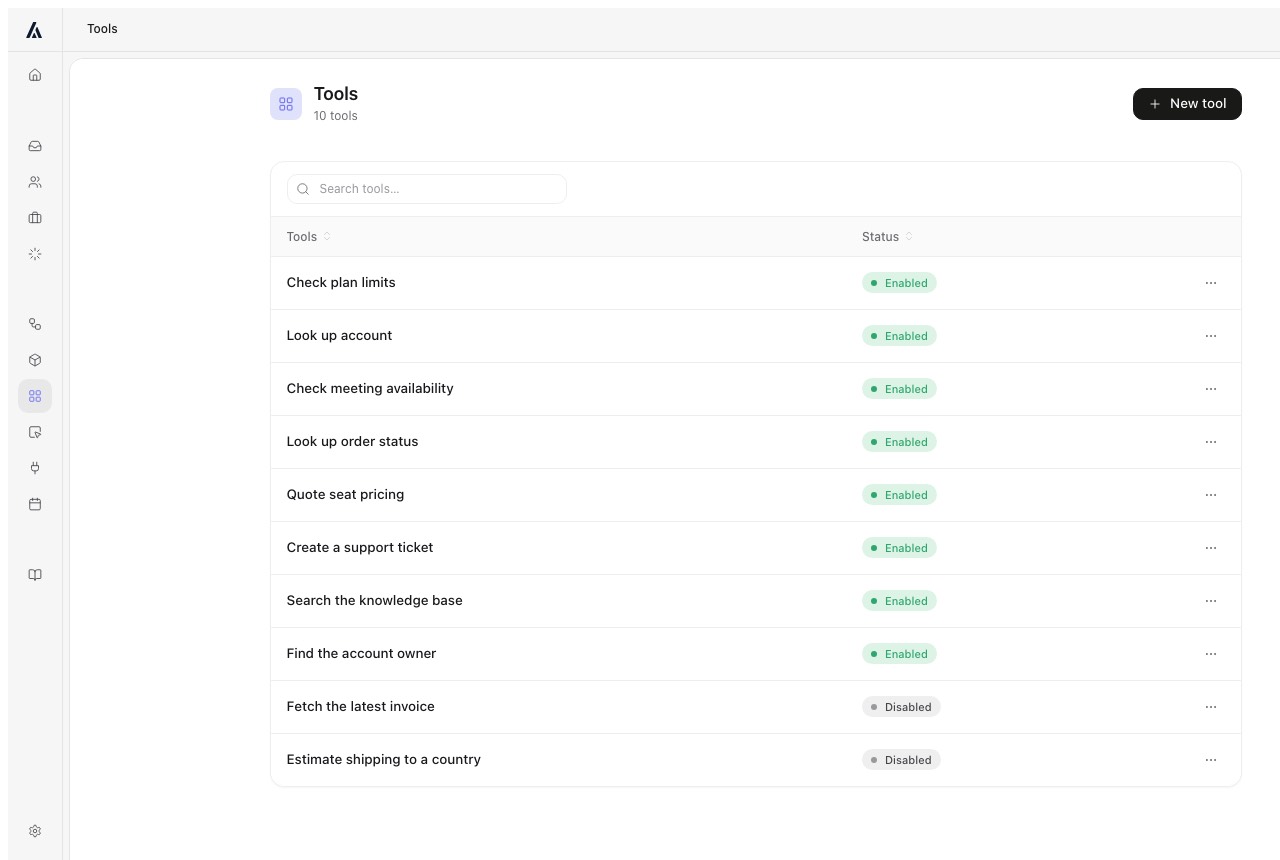
Algomo begins with your website instead of a tool editor. It records the requests your pages send, such as the stock check, the order lookup and the booking search, and each one becomes a tool the agent can call. Algomo's AI deployment engineer does that discovery, the wiring and the upkeep. The first version runs on the day you start.
The gain is largest on an unusual stack, such as an in-house booking engine or an older ERP with no marketplace app. If a redesign breaks a connection, Algomo flags it so the mapping can be rebuilt. Systems only your staff can open, like a CRM, use a connector from the Business plan.
The demo library shows it on big brands' own systems, with no project on their side. The Blinds 2go demo prices three made-to-measure windows in one card with the site's own price engine. The Nike demo reads live price and UK 9.5 stock. The Qualtrics demo sits beside the chat Qualtrics built on Qualified, whose site puts implementation at 30 to 60 days.
Wiring the agent to your data
| Algomo | Voiceflow | |
|---|---|---|
| Finds the systems behind your site | ✓ From the requests your pages send | ✗ Your team chooses them |
| Builds the tools | ✓ Algomo's AI | ✗ Your team, in the API tool editor or in code |
| Ready-made connectors | Connectors for staff-only systems, from Business | ✓ Nine integrations, plus MCP servers |
| Tells the agent when to call each tool | ✓ Set up with the tool | Your team writes it in each tool's description |
| Done for you | ✓ Same day, by the AI | Fully managed implementation, on request |
Our take: give both products the one lookup your customers ask for most, and count the hours until each answers it with real data on your site.
Will the agent quote last month's price?
TL;DRVoiceflow answers from a knowledge base that re-syncs never, daily, weekly or monthly and goes live when you publish, while Algomo opens the live page for each question and backs a reviewed agent with a free month if it contradicts your site.
Prices, delivery times and policies move without anyone telling the support team. An agent reading a stored copy keeps the old wording until the copy catches up. The first person to notice is usually a customer holding a screenshot.
Voiceflow knowledge base
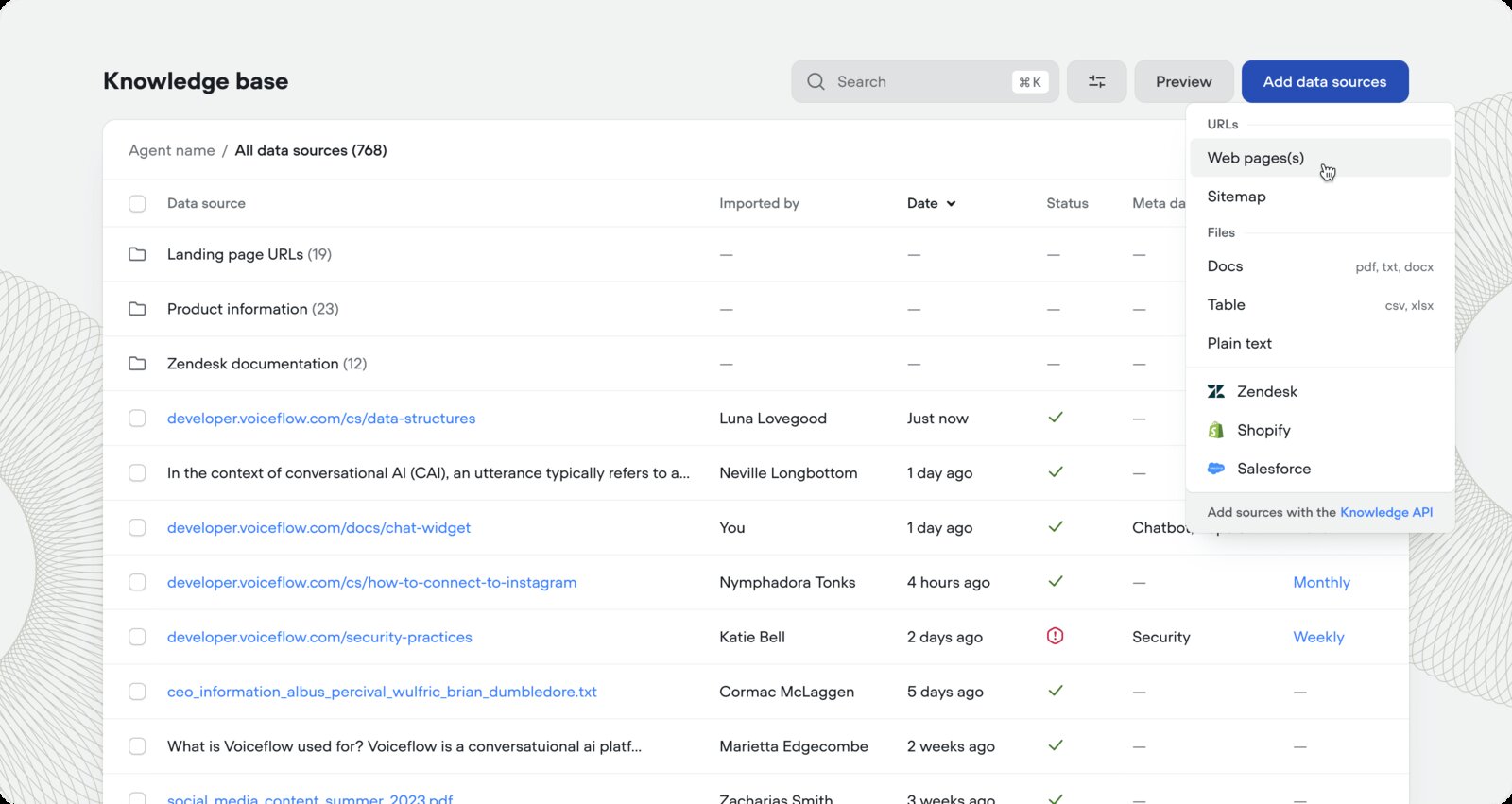
Voiceflow's knowledge base imports web pages, whole sitemaps, files, tables, plain text and articles from Zendesk or Shopify. For pages and integrations you pick a refresh rate: never, daily, weekly or monthly. The docs suggest monthly for policies and pricing pages, and you can press Re-sync at any time.
Two details matter for accuracy. Knowledge changes reach customers when you publish the environment, like any other change. Syncs that use an AI chunking strategy spend credits each time, so the docs advise a slower refresh for content that rarely changes. A web search tool is there for current information beyond the knowledge base.
Algomo agentic search
Algomo holds no copy of your site to answer from. It keeps a map of where your pages are, opens the one that fits the question while the visitor waits, and answers from what that page says now. Change a price at nine, and the answer is right at nine oh one, with nothing to re-sync or publish.
Stock, orders and rates come through the tools from the section above, read at the moment of the question. Algomo reviews each agent before it goes live. If a reviewed agent ever contradicts your website, your next month is free, on the terms in the guarantee page.
Where answers come from
| Algomo | Voiceflow | |
|---|---|---|
| Your web pages | ✓ The live page, for every question | ✓ An imported copy, refreshed on the rate you set |
| When a change reaches customers | ✓ As soon as the page changes | At the next sync, then the next publish |
| Prices and stock | ✓ The requests your pages send | ✓ A table you import, or a tool |
| A promise on accuracy | ✓ Next month free if a reviewed agent contradicts your site | Not listed on its pricing page |
Our take: change one delivery charge on your site, ask both agents ten minutes later, and keep the one that quotes the new figure.
What happened when we asked Voiceflow agents on live sites?
TL;DRWe tried 81 websites that load a Voiceflow agent on 21 and 22 November 2026, 39 of them answered typed questions, and on 9 of those sites the agent gave a wrong answer that a second, fresh visitor heard again.
On 21 November 2026 we visited 25 websites that load Voiceflow's chat widget. On 14 of them an agent answered typed questions. The other sites never replied, ran a button quiz or showed no chat. We asked 104 questions, each one written from a line the site prints, and 51 answers matched the site. Most of the rest were hedges such as "I don't have that", refusals or questions with no reply. An answer counted as wrong only when it contradicted the site for one visitor and again for a fresh visitor with no cookies, and when a search of the site found no page that supports it. That left 4 wrong answers on 3 sites: Outback Cobber, Medal and IXTAbox, with 2 of the 4 on IXTAbox. The same day, a third new visitor asked each of the first three questions below on the page that prints the fact, and got the wrong answer again.
On 22 November we tried 56 more websites that load the widget. On 25 of them an agent answered typed questions. Most of the others never replied, and a few had an unpaid account, a deleted project or only a menu of buttons. We asked 254 questions and 132 answers matched the site. 6 more sites gave a confirmed wrong answer: Käse Looman, Macchine Aroma, Elysian Collective, Runder, NIC.UA and Crystal Golf Resort. Macchine Aroma's agent priced the E.GO espresso machine at €129, where the shop sells it at €113,30. NIC.UA's agent quoted 909.87 UAH to register a .com domain, where the price page says 995.00 ₴. Crystal Golf Resort's agent gave last year's New Year's Eve prices to two visitors, and later visitors were told it had no 2026 prices.
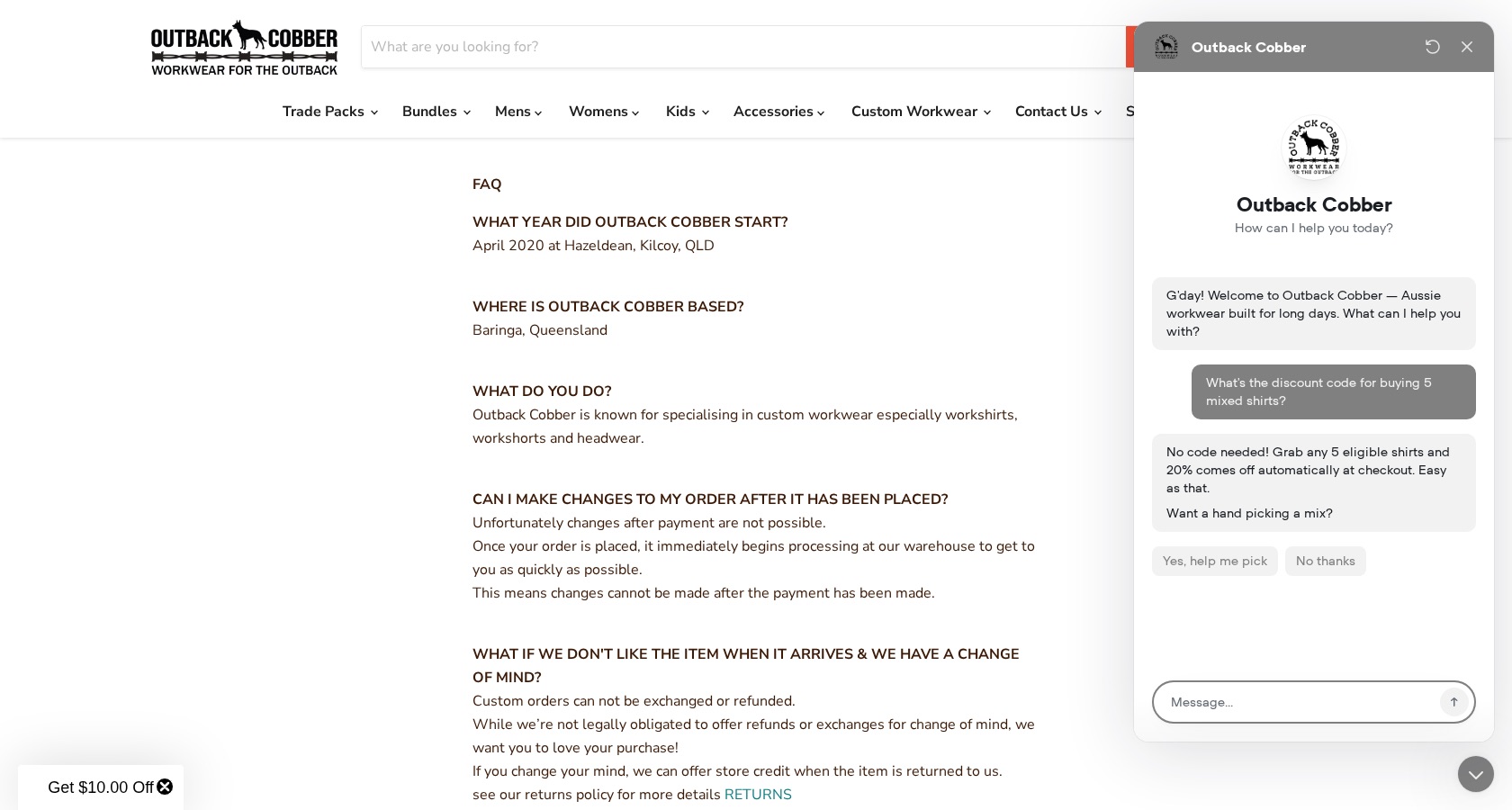
Outback Cobber: the code for a 5-shirt mix
On 21 November 2026, the chat was open on the FAQ page of outbackcobber.com. We asked: "What's the discount code for buying 5 mixed shirts?"
The agent said: "No code needed! Grab any 5 eligible shirts and 20% comes off automatically at checkout." The first visitor had also heard that no code was needed, with a different discount: $40 a shirt.
The same FAQ page answers "CAN I BUY MULTI COLOURED 5PACKS?" with: "as long as you buy 5 shirts you can get a big discount. Use the code 5PACKMULTI at check out." No page on the site says the discount applies without a code. The chat loads from Voiceflow's servers under the shop's own Voiceflow project.
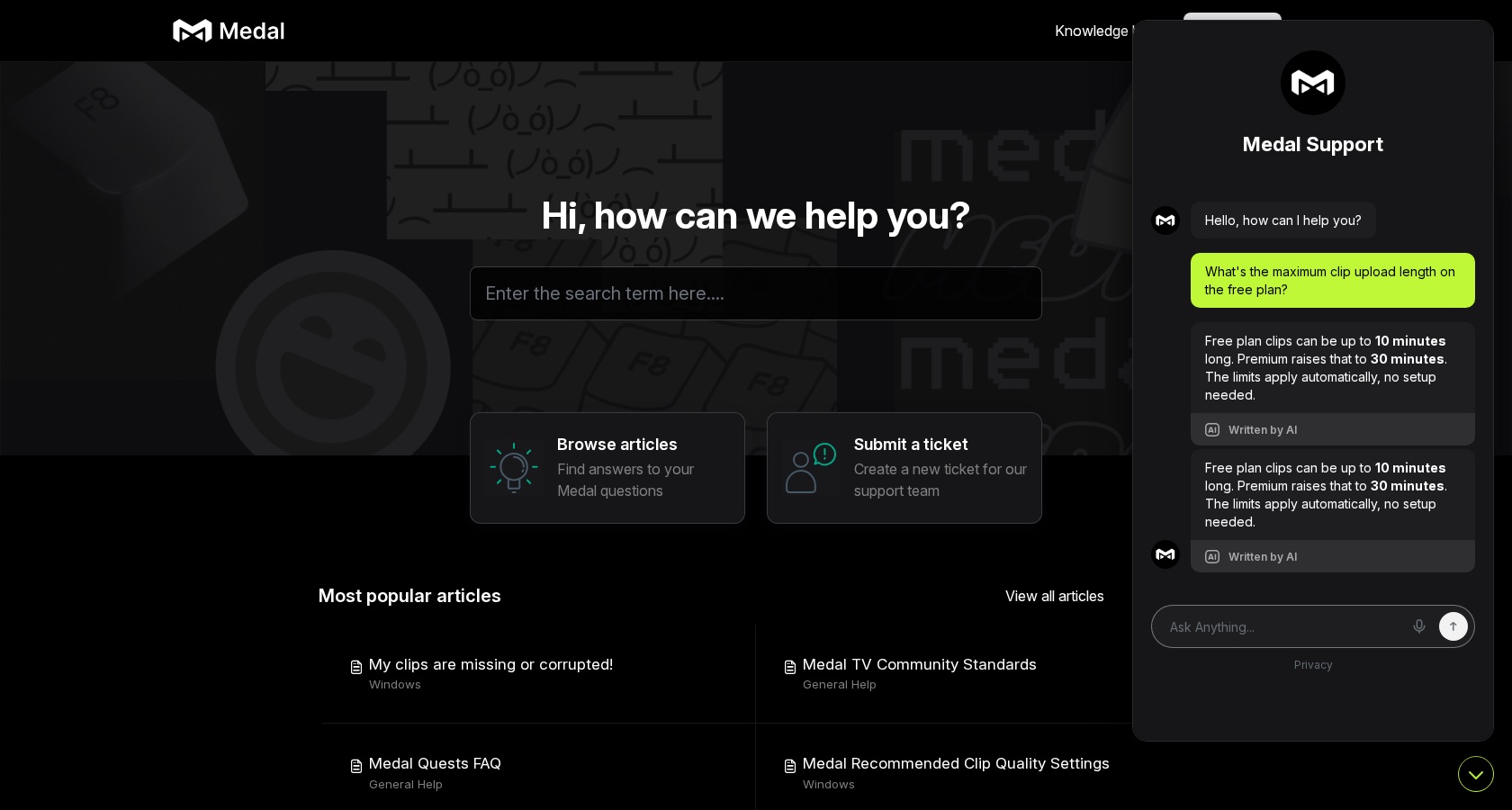
Medal: how long a clip a free account can upload
On 21 November 2026, the chat was open in the Medal help centre at support.medal.tv. We asked: "What's the maximum clip upload length on the free plan?"
The agent said: "On the free plan, clip uploads are limited to 10 minutes. Premium raises that to 30 minutes." A fresh visitor heard: "Free plan clips can be up to 10 minutes long. Premium raises that to 30 minutes."
The help centre article Medal Premium FAQ has a features chart. Its Clip Upload Limit row reads "Up to 20 minutes" for free users. Medal's Premium page says Premium removes the limit, and the Medal Cloud article gives up to 24 hours. No page gives 30 minutes. The help centre loads the agent from Voiceflow's servers, and Medal's site requests a Voiceflow chat token.
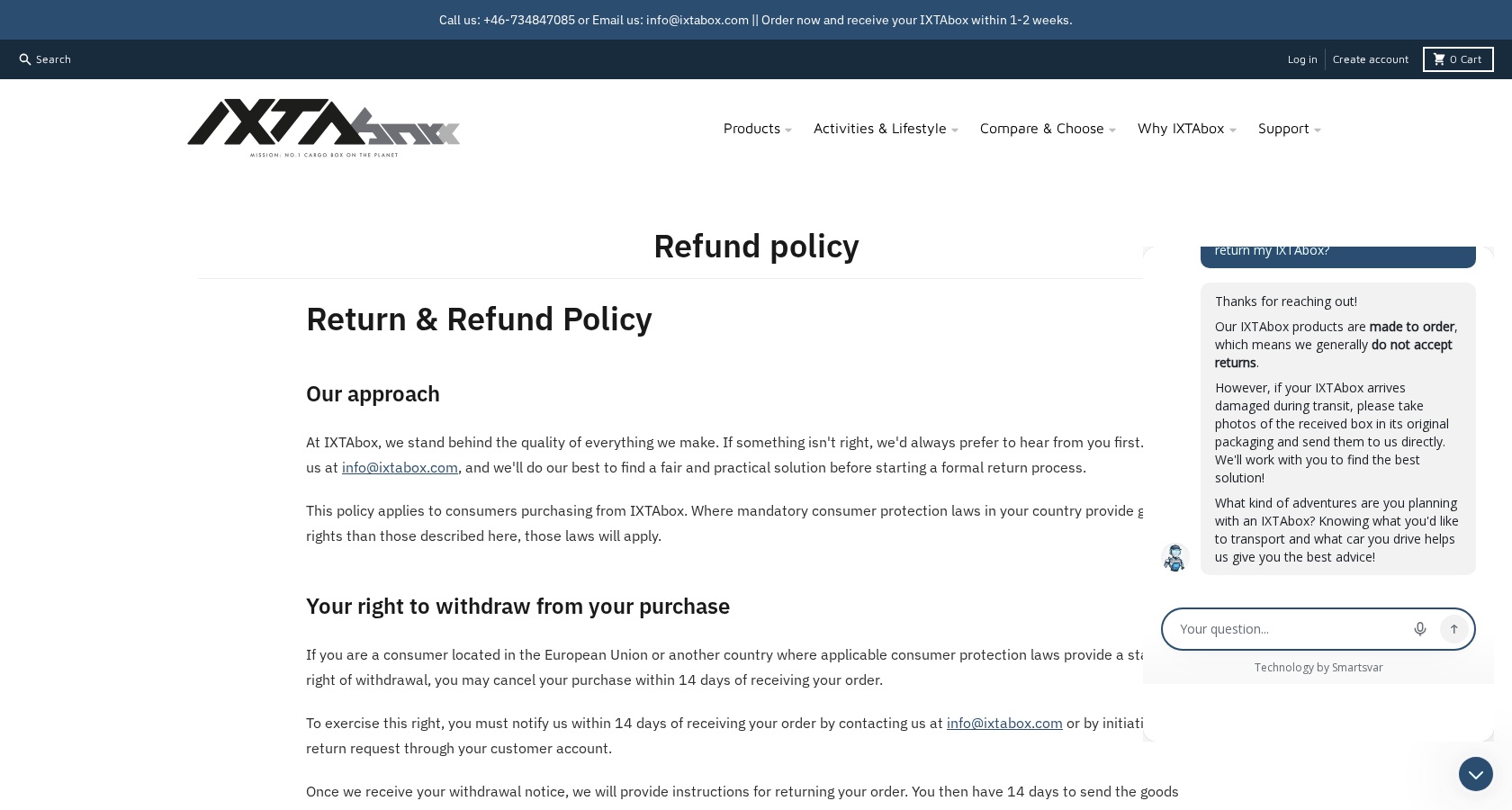
IXTAbox: the 14 days to cancel an order
On 21 November 2026, the chat was open on the Return & Refund Policy page of ixtabox.com. We asked: "How many days do I have to cancel and return my IXTAbox?"
The agent said: "Since each IXTAbox is made to order, we generally do not accept returns." The first visitor, on another page, heard: "Our IXTAbox products are custom-made to order, which means we do not accept returns."
The page beside the chat says that a consumer with a statutory right of withdrawal "may cancel your purchase within 14 days of receiving your order", and then has "14 days to send the goods back." A search of the site found no page that says made to order. The chat footer names an agency, Smartsvar, and the agent runs on a Voiceflow project. The second wrong answer on this site said "we absolutely ship to the United Kingdom", where the shipping policy lists 14 countries and the UK is not one of them.
Runder: a Black Friday offer with eight days still to run
On 22 November 2026, the chat was open on the Black Friday Biltong Challenge page of runder.nl. We asked: "Is the chance to win 6 months of biltong still running?"
The agent, Roxy, said: "No, that giveaway has ended. The Black Friday promotion, including the chance to win six months of biltong, is no longer running." Asked what free gift comes with a €75 order, it said the offer "has now ended". A fresh visitor heard: "No, that promotion has ended. The page states: 'Black Friday's done. Thanks for being part of it!'"
The page says: "From 16 to 30 November 2026, every order comes with free extras once your products hit these amounts", and the banner on every page counts down to 30 November. The line the agent quoted is not visible on the page. The banner's code holds it as the message to show once the countdown ends. The chat footer names an agency, Northcliff AI, and the agent runs on a Voiceflow project.
Käse Looman: the shipping cost for cheese
On 22 November 2026, the chat was open on the shipping policy page of kaese-looman.de. We asked, in German, what shipping costs for an order of cheese only: "Was kostet der Versand, wenn ich nur Käse bestelle?"
The agent, Julia, said: "Wenn du ausschließlich Käse bestellst, betragen die Versandkosten 17,50 €." (If you order only cheese, shipping costs 17,50 €.) A fresh visitor heard the same sentence, and a third, hours later, heard: "Bei einer reinen Käsebestellung betragen die Versandkosten 17,50 €."
The page beside the chat says cheese ships by DHL Express in an insulated box, and: "Die Versandkosten betragen hierfür pauschal 15€." (The shipping cost for this is a flat 15€.) We searched all 434 products and the 15 pages of the shop, and none prints 17,50 €. We did not check the rates at checkout.
We keep the full record behind every answer above: the transcript, a capture of the page at the time, the screenshots and the time stamps. If you work at Voiceflow or at a site named here and want that record, write to support@algomo.com.
Can you build and change it from Claude Code or Cursor?
TL;DRBoth can, since Voiceflow and Algomo each connect to Claude Code, Codex and Cursor over MCP, and the difference is what your assistant has to build, which in Voiceflow means playbooks, workflows and tools, and in Algomo a configuration on top of tools Algomo already made.
The agent changes every week after launch. A new product, a new rule, an exception for one country. Whoever owns it needs to make each change quickly and see exactly what will go live.
Voiceflow studio, Atlas and MCP
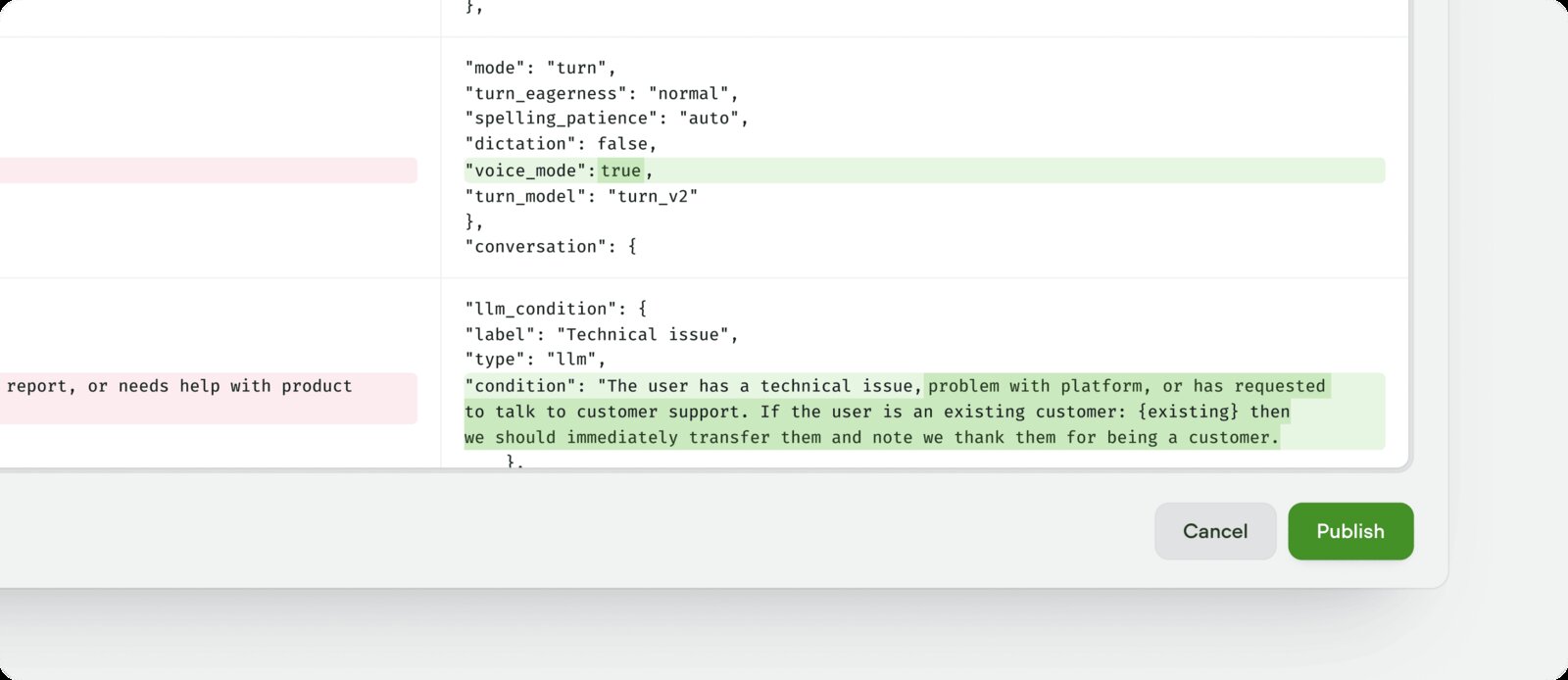
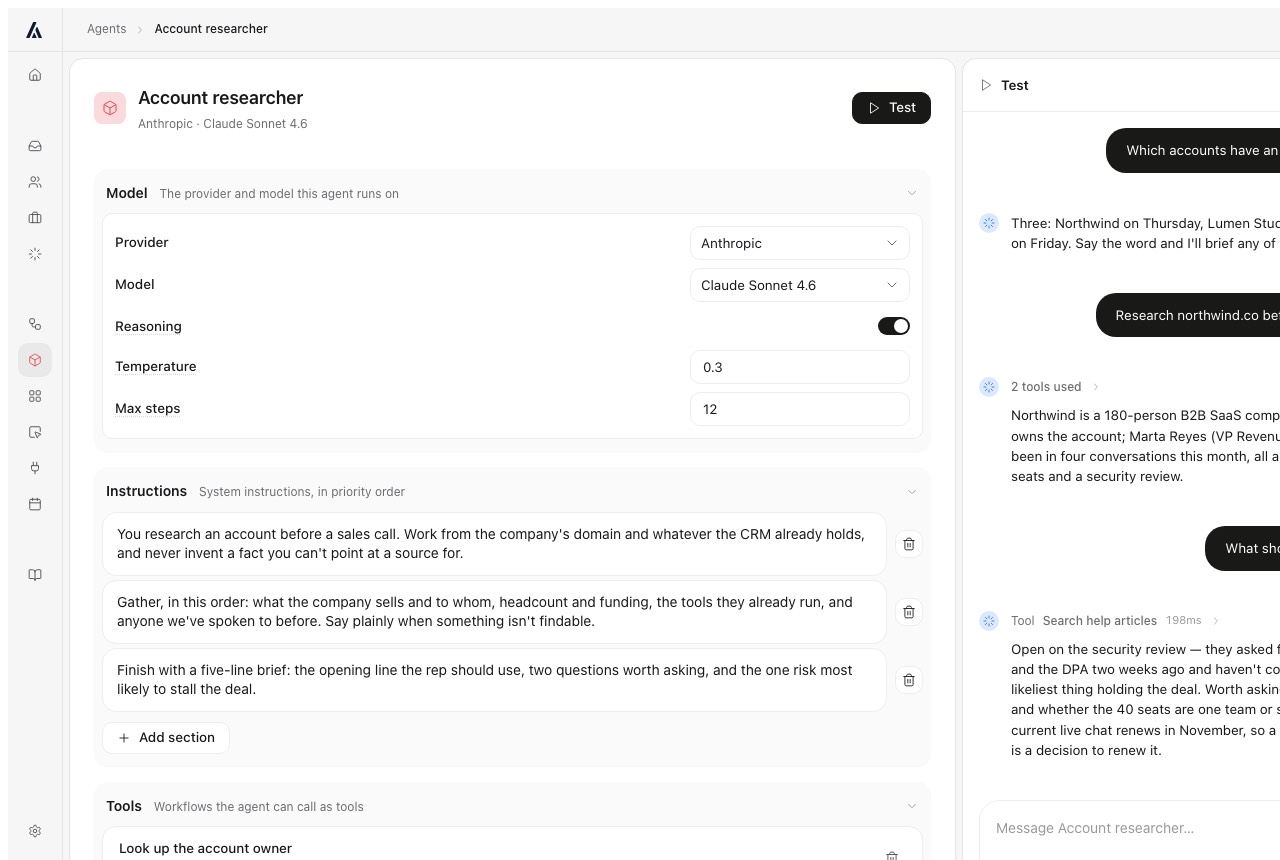
Voiceflow gives your team a lot of control. Playbooks handle open conversations toward a goal, and workflows fix a process step by step. Atlas, its built-in AI helper, reads transcripts, proposes edits to the instructions as a diff and writes tests. Claude Code, Codex and Cursor can also read and change your projects through Voiceflow's MCP server or its CLI.
Releases are careful. Each environment keeps a draft that saves as you work, and Publish shows the live and draft versions side by side before you confirm. Every publish lands in a version history you can roll back, and traffic splits let you A/B test two versions.
Algomo from your coding assistant
Algomo is run from ChatGPT, Claude Code, Cursor, Codex or the Claude app over MCP. You tell your assistant what the agent should answer and hand over, and it writes the configuration. Because Algomo already built the tools from your site, the assistant has less to make from scratch.
Every change is staged. You preview it on your own site, read what changed, then put it live, and Algomo keeps a history of each change and why it was made.
Building and changing the agent
| Algomo | Voiceflow | |
|---|---|---|
| Works from Claude Code, Codex, Cursor | ✓ Over MCP | ✓ Over MCP or the CLI |
| Built-in AI helper | ✓ Your own assistant does the work | ✓ Atlas |
| Review before going live | ✓ Staged, with a history | ✓ Diff on publish, version history |
Our take: ask each assistant to apply your last policy change end to end, and note how many separate pieces it had to touch.
Can the agent do things on the page for a visitor?
TL;DRVoiceflow lets your developers write extensions that render custom UI in the chat or run scripts on your site, while Algomo works in the visitor's own browser session, applying a code or filling the basket, with every step visible.
A shopper who asks for a size in stock wants it in the basket, not a set of instructions. An agent that can act on the page turns that question into an order.
Voiceflow widget extensions
Voiceflow's chat widget shows cards, carousels and buttons. Extensions go further. A response extension draws your own element in the chat, such as a date picker or a payment form. An effect extension runs code elsewhere on your site, such as a deep link or a page update. Your developers write each one in your site's JavaScript, register it when the widget loads, and trigger it from a step in a workflow.
Algomo co-navigation and workflows
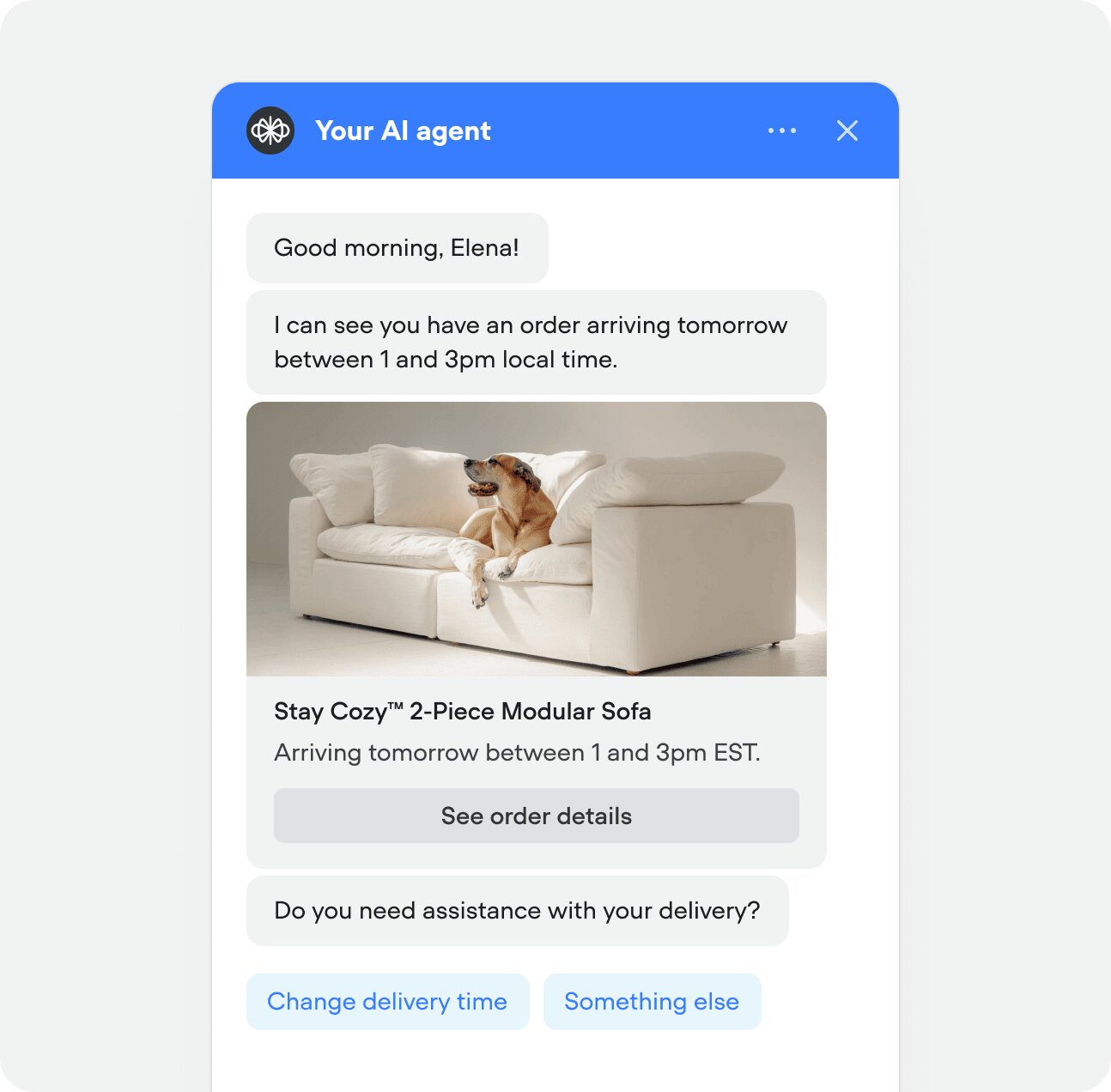
Algomo's agent runs in the visitor's browser, on your page, in the session that browser already has, with their prices, region and basket. It can filter a list, apply a code, add an item to the basket or check that visitor's own order, and the visitor watches each step. Nobody writes page scripts for it.
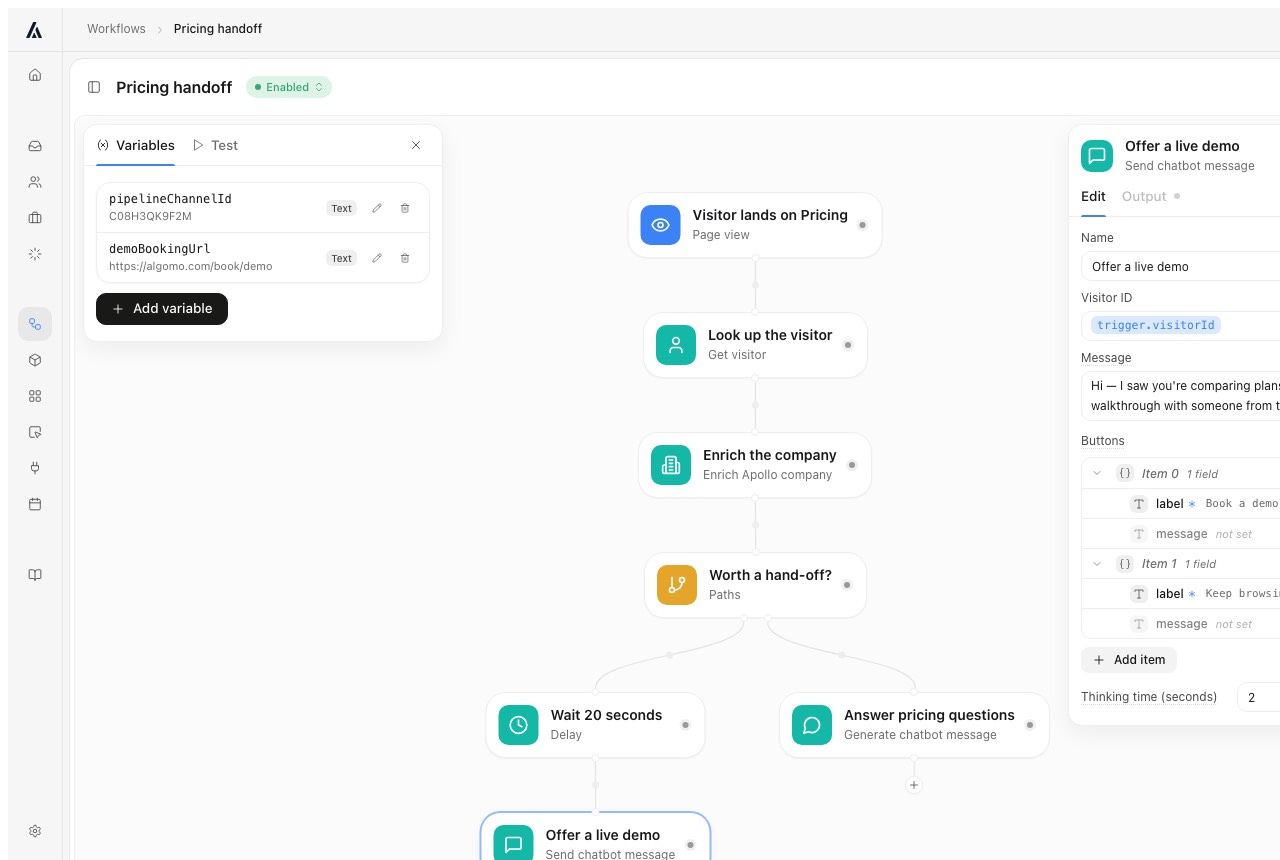
Workflows run during and after the chat. One can send a two-factor code before showing account details, and another can research the visitor's company and email a memo to sales. Describe a quote calculator to your coding assistant, and visitors use it as a widget inside the chat.
Our take: ask each agent to add one named product to your basket, and see whether it happens or whether a developer would need to build it first.
Do you need an agent that answers the phone?
TL;DRVoiceflow covers phone, SMS, web chat and API, and Algomo covers chat on your website with a follow-up email after the visitor leaves.
Your customers choose how they reach you. If half your volume is phone calls, a website agent leaves half the work untouched. Check last month's split by channel before anything else on this page.
Voiceflow channels
Voiceflow started in voice and still treats the phone as a main channel. An agent can answer an imported Twilio number or connect to a contact centre over SIP, and a call forward tool passes callers to a person. Each workspace includes one Voiceflow phone number, and phone time costs $0.05 a minute on self-serve. SMS runs through Twilio, and the web widget takes typed or spoken input.
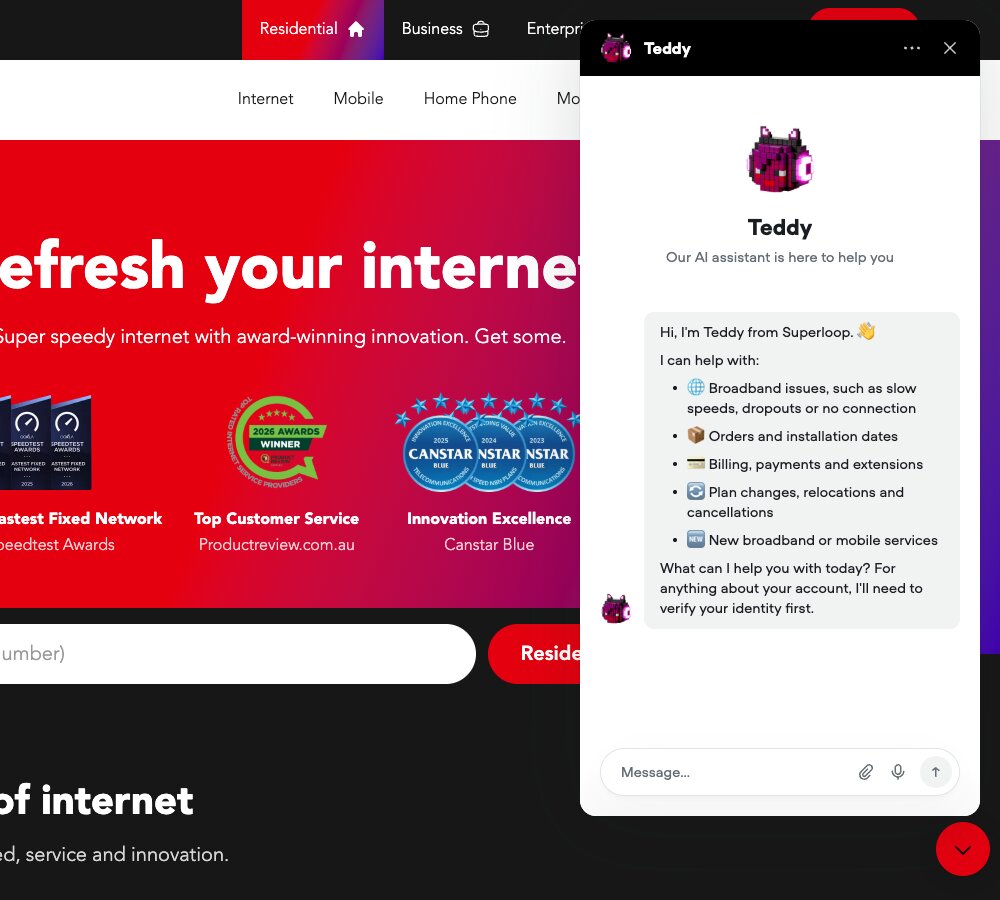
Voiceflow names Superloop, an Australian internet provider, among its customers. Its agent, Teddy, runs in a Voiceflow chat on superloop.com.
Algomo channels
Algomo answers in a chat on your website. When the visitor has gone, it can send a follow-up email. It does not take phone calls or answer incoming email.
Our take: if calls carry most of your questions, Voiceflow covers them and Algomo does not.
How do you check answers before customers see them?
TL;DRVoiceflow runs scripted tests and AI-played simulations with checks on answers, routing and tool calls, while Algomo previews the agent on your live site before any code goes in and logs every tool call behind each answer.
A wrong answer caught in testing costs a minute. One caught by a customer costs a refund or a sale. You want to run your real questions first and see why any answer came out wrong.
Voiceflow tests and simulations
Voiceflow has a full testing suite. A test scripts the user's messages and checks each agent turn: the response, where it routed and which tool it called, with an AI judge where meaning matters. A simulation lets AI play the customer toward a goal and reports pass or fail with a reason. You can run them in batches, and Atlas can turn a real conversation into a test. Tests spend credits like real conversations.
Algomo testing
Algomo's browser extension shows the agent on your live site before you add any code. Tests draw on their own allowance, 200 credits a month on Free and 1,000 on Business, so they never touch the live budget.
Once live, every answer records the tools it called, their inputs and outputs, the time and the cost. Every workflow run keeps a step-by-step trace.
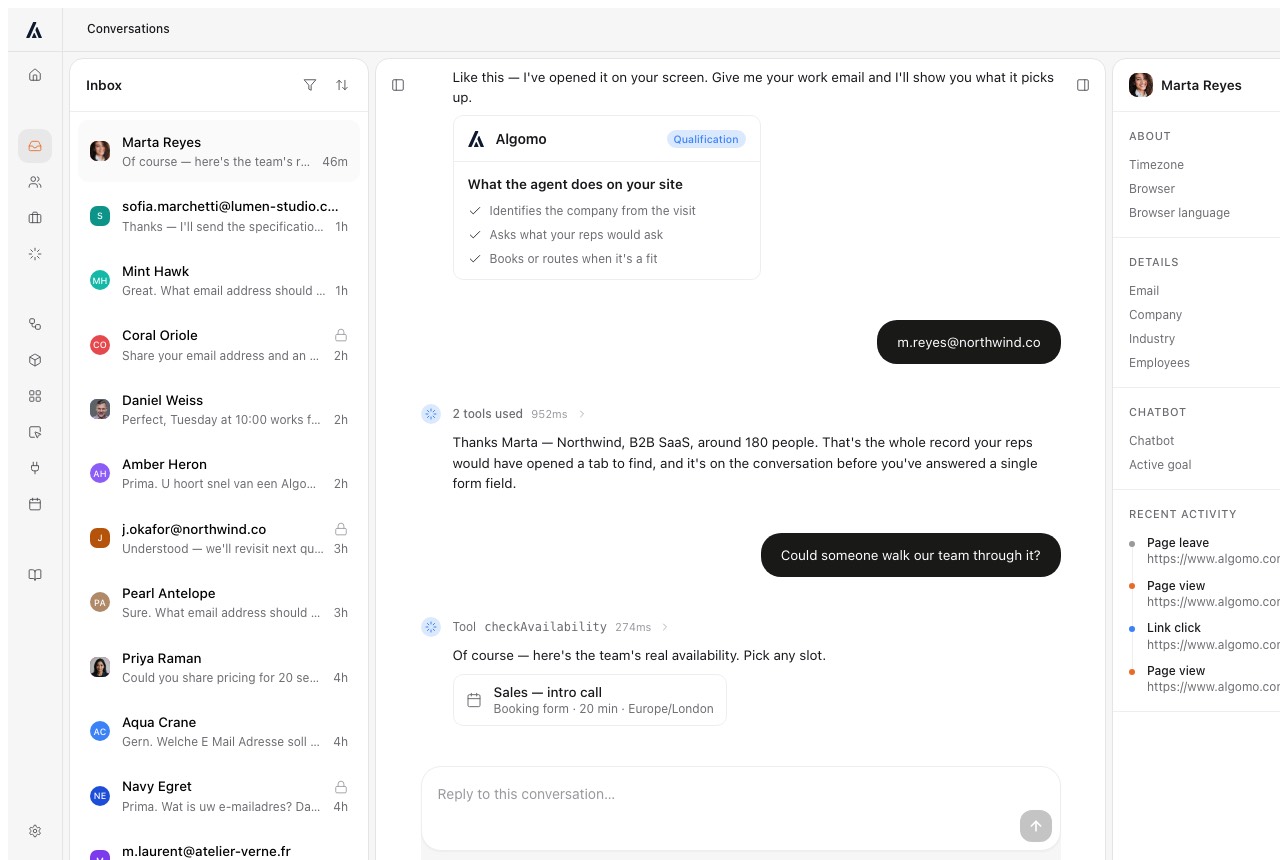
Our take: run your ten hardest questions on both, on your own pages, and open the record behind any answer you doubt.
How does a person take over the conversation?
TL;DRVoiceflow hands a chat to Genesys, UJET, Kustomer, Dixa, Zendesk or a platform you connect yourself, while Algomo alerts the right person by email and Slack and they join the live chat on your site with the transcript.
Some chats need a person: a refund exception, an upset customer, a buyer ready to talk. The test is whether that person starts with the whole story.
Voiceflow handoff
Voiceflow has no inbox of its own. A Handoff step in a workflow passes the chat to your support platform, with the full transcript, a summary your workflow prepared, or nothing. Genesys, UJET, Kustomer, Dixa and Zendesk are built in, and other platforms need a service your team builds against Voiceflow's connection API. When the person is done, the chat can return to the AI.
Algomo handoff
Algomo hands over on rules you set: a topic, a page, or a visitor asking for a person. The right teammate is told by email and Slack and joins the live chat with the transcript, from Algomo's inbox. If your team works in a helpdesk such as Zendesk, a connector can open the ticket there.
Our take: ask each agent for a person, and look at what that person sees before they type a word.
What does each one hold to reach your systems?
TL;DRVoiceflow keeps the API keys your team puts in its secrets and lists SOC 2, ISO 27001, GDPR and HIPAA, while Algomo's agent sends requests from the visitor's browser and stores no token for anything your website already does.
Every agent that reads orders needs a way into your systems. Your security team will ask what the vendor keeps to get in, and where.
Voiceflow security
Voiceflow's site lists SOC 2, ISO 27001, GDPR and HIPAA, with a trust centre behind them. API keys live in secrets, which are encrypted, hidden from view and set separately for each environment. Enterprise adds single sign-on and private cloud hosting.
Algomo security
Algomo is secure by design. The agent runs in the visitor's browser, so a stock check or an order lookup is sent by that browser, the same way your page sends it. Algomo receives and stores no token or credential for those requests.
A staff-only system, like billing, needs a connector, and Algomo does keep that login, encrypted with AES-256-GCM and revocable at any time. Algomo holds Cyber Essentials and works to UK and EU GDPR, the EU AI Act and DORA, with its application, database and files in the EU. Algomo's trust and compliance page and the data processing agreement have the detail.
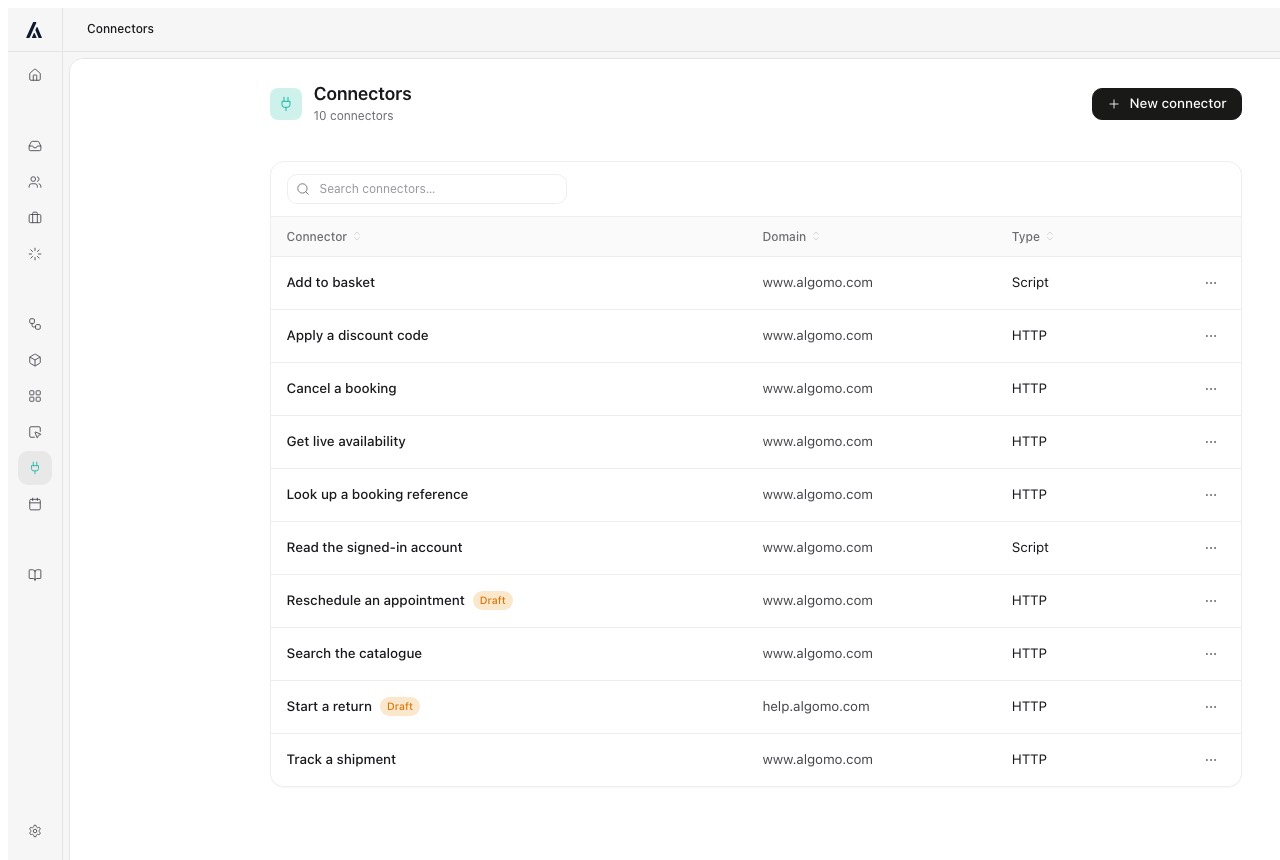
Our take: ask each vendor for a list of every key it would hold for your systems after launch.
How much does Voiceflow cost compared with Algomo?
TL;DRVoiceflow publishes no plan prices and Vendr's buyer data puts its median contract at $299,750 a year, an estimate from 7 purchases, while Algomo's plans run from free to $4,300 a month on its own pricing page.
A price you cannot see makes a budget hard to defend. Your finance team will want a monthly figure, a ceiling, and a say over what happens in a busy month.
How Voiceflow bills
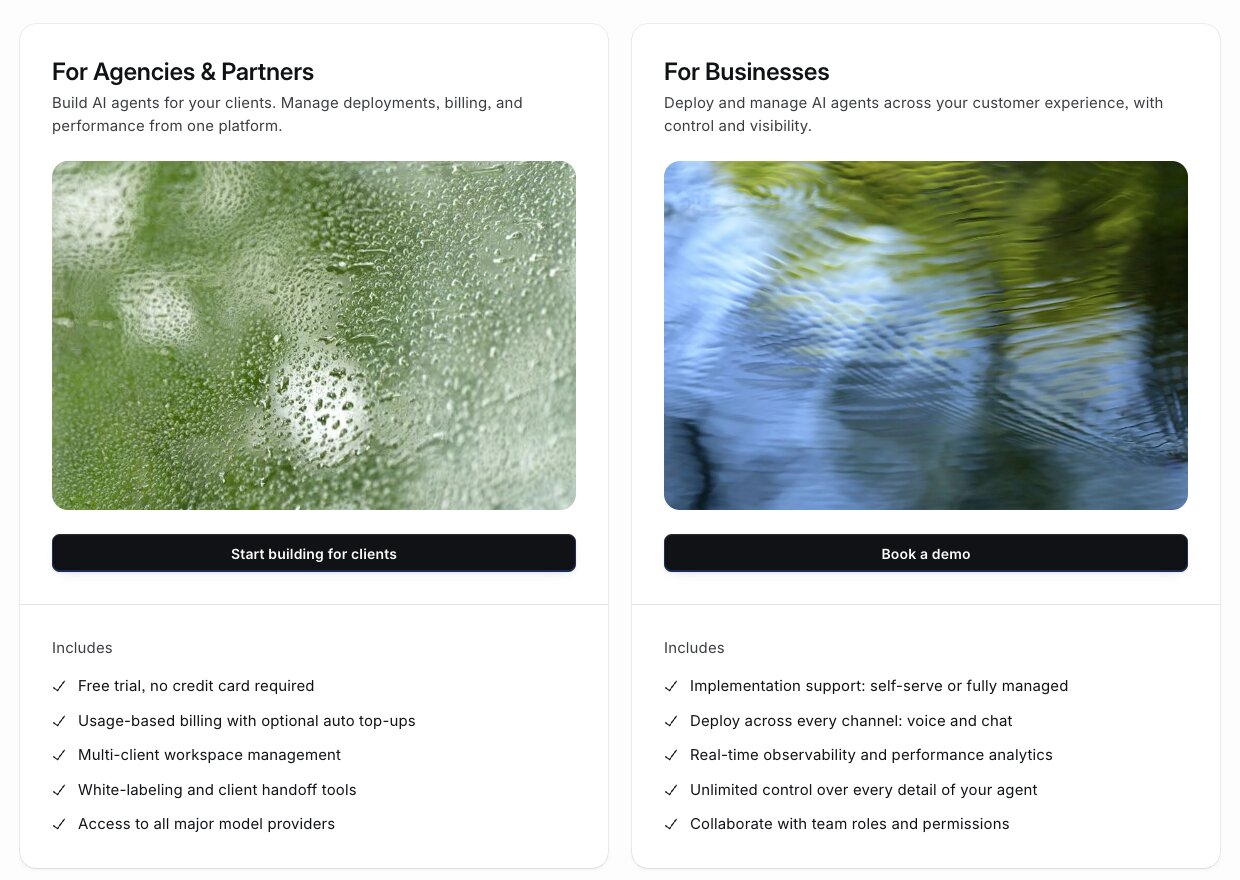
Voiceflow's pricing page shows two cards and no figures. Agencies get a free trial with usage-based billing. Businesses book a demo and request a price. The billing docs name four plans, Free, Pro, Business and Enterprise, and say current prices are shown inside the product.
The bill has three parts: a monthly plan fee, add-ons such as editor seats and phone numbers, and credits. On self-serve, each message a user sends costs $0.005, phone time costs $0.05 a minute, and the AI model's tokens are charged on top at a rate per model. Paid credits reset each cycle. Optional auto top-ups buy more when the balance hits zero.
What buyers report paying
These are estimates, not Voiceflow's prices. Vendr, a software buying marketplace, shows a median of $299,750 a year, with a range of $109,860 to $717,375. Its figures come from 7 purchases by 3 buyers, so treat them as a rough guide. Vendr also describes Pro from $60 and Business from $150 per editor per month, and an Enterprise platform fee of $34,500 a year with credits priced separately.
How Algomo bills
Algomo's free plan needs no card and includes 100 credits a month, about twenty helped conversations. After that you pick one monthly amount, from $50 for 2,000 credits up to $4,300 for 200,000. A helped conversation uses 5 credits, plus 5 for every further ten replies. Spam and gibberish cost nothing, and there are no seats.
The amount you choose is the most you can be charged. Unused credits roll over. If they run out, the agent pauses until you renew. The full ladder is on Algomo's pricing page.
How the two bills work
| Algomo | Voiceflow | |
|---|---|---|
| Price on the website | ✓ Every plan | ✗ Request pricing |
| Unit you pay for | Credits per helped conversation | Plan fee, seats, messages and model tokens |
| Seats | ✓ None | Editor seats, an add-on |
| When the allowance runs out | ✓ The agent pauses | Optional auto top-ups |
| Unused allowance | ✓ Rolls over | Resets each billing cycle |
| A free way to start | ✓ Free plan, no card | ✓ Free plan, one-time credits |
Here is a sum for 1,000 conversations a month. If each has five visitor messages, Voiceflow's message charge is 5,000 times $0.005, which is $25. The model's tokens, the plan fee and any extra seats come on top, and those are priced inside the product.
On Algomo, 1,000 helped conversations of up to ten replies each use 5,000 credits. The $200 plan holds 8,000, so that is the whole bill.
Our take: ask Voiceflow for a written quote at your real volume, set it beside Algomo's pricing page, and check which one has a ceiling.
What to ask any vendor selling you an AI agent
TL;DRFive questions, each with a test you can run during the demo.
- Who builds the connection to our order or stock system? Ask them to connect it while you watch.
- Does the agent read our live site or a stored copy? Ask when the copy was last synced.
- What does it say five minutes after we change a price? Change one on the call.
- Can it act on the page, like adding to the basket? Ask it to, on your site.
- What is the most we could pay in a busy month? Ask for that number in writing.
Run every test on your own website, never on a sample site the vendor prepared.
Which one fits your team?
Choose Voiceflow if
- Most of your customers phone you, or text you by SMS.
- You have conversation designers or developers who want to build every flow themselves.
- You route chats into Genesys, UJET, Kustomer or Dixa today.
Don't choose Voiceflow if
- Your questions start on your website and depend on live prices, stock or orders.
- Nobody on your team has weeks to build and maintain API tools.
- An answer from a copy synced last week is a risk you will not take.
- You want to see the price before you book a demo.
- You want the agent to act on the page with the visitor, in their session.
Conclusion
TL;DRChoose Voiceflow if your team wants to design its own chat and phone agents and has the people to wire them, and choose Algomo if your customers ask on your website and you want the AI to connect itself and answer from the live page.
On the first risk, Voiceflow gives your builders good tools to make each connection. Algomo makes the connections itself from what your site already calls, and the first version runs the same day.
On the second risk, Voiceflow answers from a knowledge base you keep in sync and publish. Algomo reads the live page and puts a month's fee behind it.
Questions buyers ask about Algomo and Voiceflow
Is Algomo a good Voiceflow alternative?
Yes, for questions that arrive on your website. Algomo builds its own tools from the requests your pages send, reads the live page for each answer, and bills one amount you choose. If you need a phone agent or want to design every flow yourself, Voiceflow fits better.
How much does Voiceflow cost?
Voiceflow does not publish its prices. Its pricing page asks businesses to request pricing, and its docs say plan prices appear inside the product. Vendr's buyer data, from 7 purchases, shows a median of $299,750 a year. That is an estimate, not Voiceflow's price.
Who owns Voiceflow?
Voiceflow, Inc., an independent company. Its about page names investors including Felicis Ventures, Craft Ventures, True Ventures and OpenView Partners. We found no acquisition or merger.
Does Voiceflow work with Claude Code?
Yes. Voiceflow has an MCP server and a CLI that let Claude Code, Codex and Cursor read and change your projects. Algomo also runs from those assistants over MCP. The difference is that Algomo has already built the tools from your site, so your assistant writes less.
How often does Voiceflow update its knowledge base?
As often as you set it. Web pages and integrations refresh never, daily, weekly or monthly, or when you press Re-sync, and changes reach customers when you publish. Algomo reads the live page for each question, so there is no schedule to set.
Can I move from Voiceflow to Algomo?
Yes. Point Algomo at your site, and it maps the systems behind your pages and has a first version answering the same day. Your public pages are read live, so there is no knowledge base to move.
Where these facts come from
The sources are:
- Voiceflow's pricing page: the two plan cards and Request pricing.
- Voiceflow's homepage: the product, channels, customer logos and compliance list.
- Voiceflow's about page: investors and leadership.
- The billing docs: plans, add-ons, credits and auto top-ups.
- The credits pricing table: message, phone and model rates.
- The knowledge docs: sources, refresh rates and publishing.
- The tools docs: integrations and the API tool.
- The coding agent docs: MCP and the CLI.
- The handoff docs: providers and context.
- The widget extensions docs: response and effect extensions.
- Vendr's Voiceflow page: buyer price estimates.
- Voiceflow docs articles, each named under the screen it belongs to.
- Algomo's pricing page, the guarantee page, the data processing agreement and Algomo's trust and compliance page.
- Algomo's demos: the Blinds 2go demo, the Nike demo and the Qualtrics demo.
All the information on this page was available in November 2026.