
Summarize withChatGPTPerplexityClaudeGrokAlgomo vs Rep AI
TL;DRRep AI comes ready for standard Shopify orders and learns your site from a scanned copy, while Algomo connects itself to whatever your pages call and reads the live page on every question.
Rep AI calls its agent an AI concierge, and its plans are Sales, Support and Concierge. On this page, the agent means the AI on either product.
Algomo vs Rep AI at a glance
| Algomo | Rep AI | |
|---|---|---|
| Main job | An AI agent for your website that answers, sells and acts in the shopper's own session, with an inbox your team takes over from. | An AI agent for Shopify stores that approaches shoppers, sells from the catalogue and handles order support, with an optional helpdesk called Rep Inbox. |
| Who owns it | Algomo, independent. | REP AI, independent and venture-backed. Zendesk joined its May 2026 round as a strategic investor. |
| Store platform | Any website, with no platform app. | Shopify. A web client for other sites needs your developers to send page events. |
| Who does the integration | Algomo's AI. It records what your pages call and turns those calls into tools. | Built-in skills for Shopify orders. Your team adds API endpoints for anything else, with Expert Zone access. |
| Where the answers come from | The live page and the live data behind it, opened when the question is asked. | Your website, scanned and trained on, plus your catalogue, FAQs, files and added URLs. |
| Published pricing | Free plan, then one monthly amount from $50 to $4,300. | From $19 a month for up to 3,000 store sessions, $46 for sales and support together. |
| Not a fit for | A store whose questions mostly arrive by email or social messages. | A site that is not on Shopify, or a system with no ready skill and nobody to build an endpoint. |
| Biggest limitation | Does not answer phone calls or incoming email. | Answers come from a scanned copy, so a change on your site waits for the next scan. |
Is Rep AI built for your kind of store?
TL;DRRep AI fits a Shopify store that wants a low-cost agent with ready order skills and social messages, and Algomo fits a store on any platform whose answers live on its own pages and systems.
The right tool depends on where your store runs and where your shoppers ask. Find the line that describes you:
- A Shopify store with standard order, return and subscription apps: Rep AI has ready skills for these.
- Shoppers who ask in Instagram, Messenger or WhatsApp as much as on the site: Rep AI.
- A store on another platform, or headless with no spare developer: Algomo, which works on any website.
- A custom price engine, configurator or booking system behind the store: Algomo, which learns it from your own pages.
The two risks come first below. Selling on the page, channels, testing, handover, security and the bill follow.
Who connects the AI to your store's systems?
TL;DRRep AI ships skills for common Shopify orders and leaves your team to add API endpoints for the rest, while Algomo finds the calls your pages already make and connects to them itself, with a first version the same day.
Order status and returns are the easy part on Shopify. The hard part is the system that is yours alone, such as a made-to-order price, a warehouse feed or a fitting service. Someone has to connect it before the AI can use it.
Rep AI integrations
Rep AI comes with Support Skills for Shopify: order status, cancel, change address, swap a size or colour, returns and exchanges through Loop, damaged orders and Recharge subscriptions. Your team sets each one's rules, such as the cancellation window.
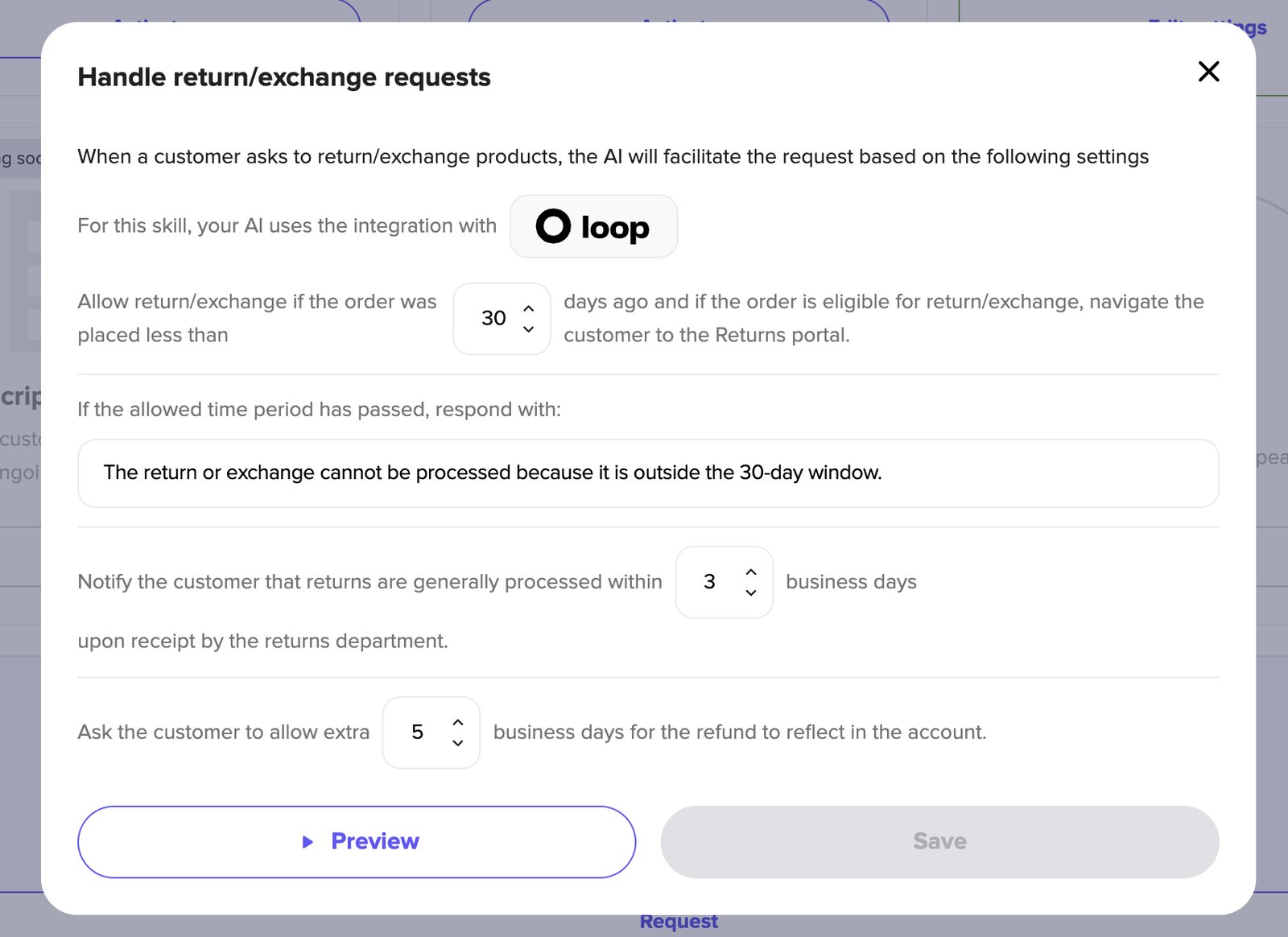
For a system outside those skills, your team adds an API endpoint to a skill's custom policy. You enter its public URL, pick GET, POST or PUT, add the login headers, then write when the AI should call it. Each skill takes up to five endpoints, and the option needs Expert Zone access on your plan.
Rep AI's own article is direct about who carries the risk: you are fully responsible for the APIs you connect and the actions they perform. On a headless or non-Shopify site, your developers also send a page event on every page load so the agent knows what the shopper sees.
Algomo integrations
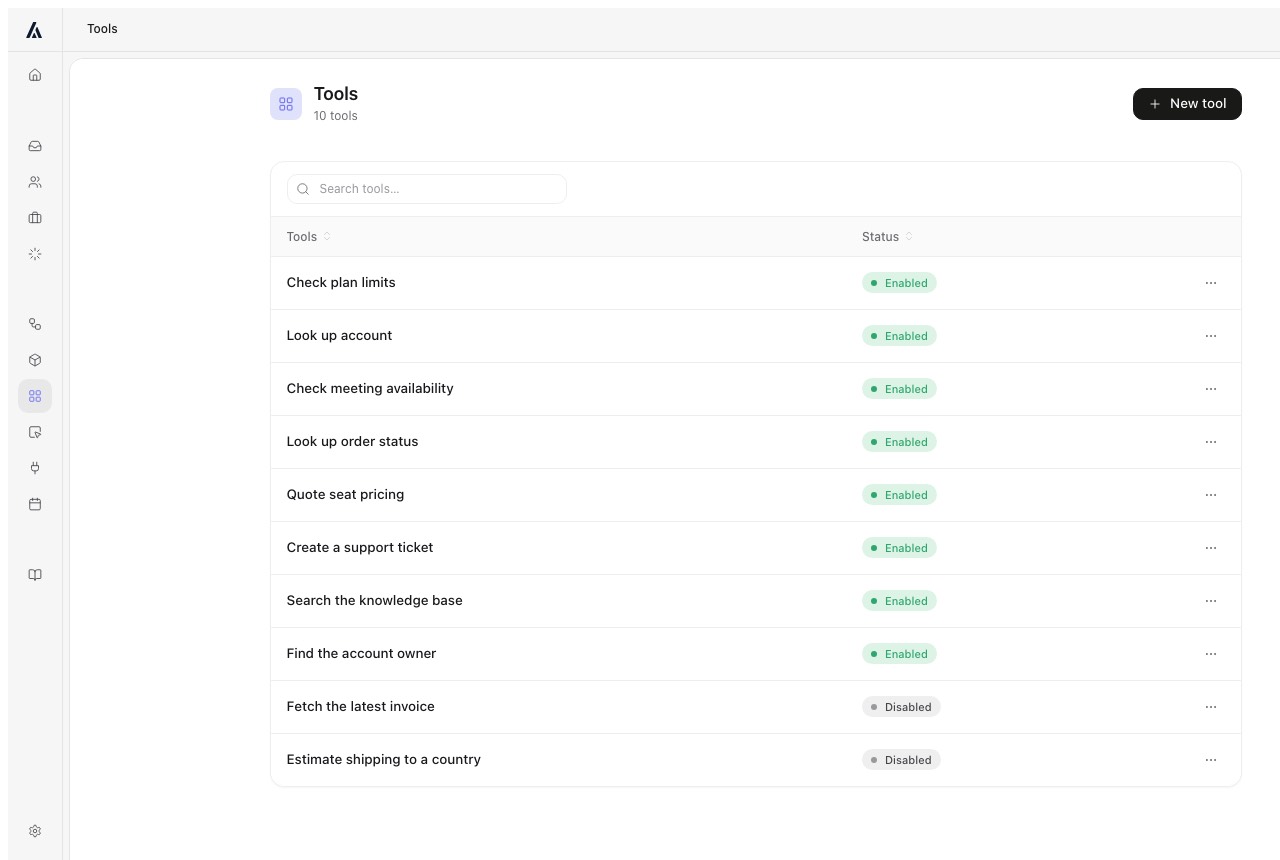
Algomo begins with your storefront. It records what your pages call, the stock check, the price engine, the order lookup, and turns each call into a tool the agent can use. Algomo's AI deployment engineer handles the discovery, the integration and the upkeep. Your first version runs the same day.
Because the source is your own site, Algomo works on any website with no platform app, whether the store runs on Shopify, a headless build or a home-grown checkout. Systems that only staff can reach use a connector, from the Business plan, and a connection broken by a redesign is flagged for rebuild.
The demo library shows this on big brands' own systems with no project on their side. The Blinds 2go demo prices three made-to-measure windows at once through the site's price engine. The Nike demo reads live price and UK 9.5 stock. The Qualtrics demo runs next to a chat Qualtrics built on Qualified.
Getting the AI connected
| Algomo | Rep AI | |
|---|---|---|
| Standard Shopify order tasks | ✓ From the calls your store pages make | ✓ Built-in Support Skills |
| A system unique to your store | ✓ Learnt from your own pages | An API endpoint your team adds, up to five per skill |
| Non-Shopify or headless sites | ✓ Any website | Page events your developers send |
| Systems behind a staff login | A connector, from the Business plan | Endpoints with login headers your team enters |
Our take: pick the one system behind your store that no Shopify app covers, and ask each vendor to show it answering a shopper, with your engineers off the call.
Does the AI answer from your live site or from a copy?
TL;DRRep AI trains on a scanned copy of your whole site and shows when each page was last scanned, while Algomo reads the live page on every question, and a reviewed agent that contradicts your website makes your next month free.
Stores change daily. A discount code ends at midnight, a colour sells out, a shipping cut-off moves before a holiday. An agent working from an earlier scan can repeat the old detail long after you fixed the page.
Rep AI knowledge
Rep AI says it trains automatically on your entire website, except blog pages, and that it is powered by ChatGPT. You can add other URLs, Google Docs and Sheets, files, custom FAQs and promotions. Each URL source lists when it was last scanned.
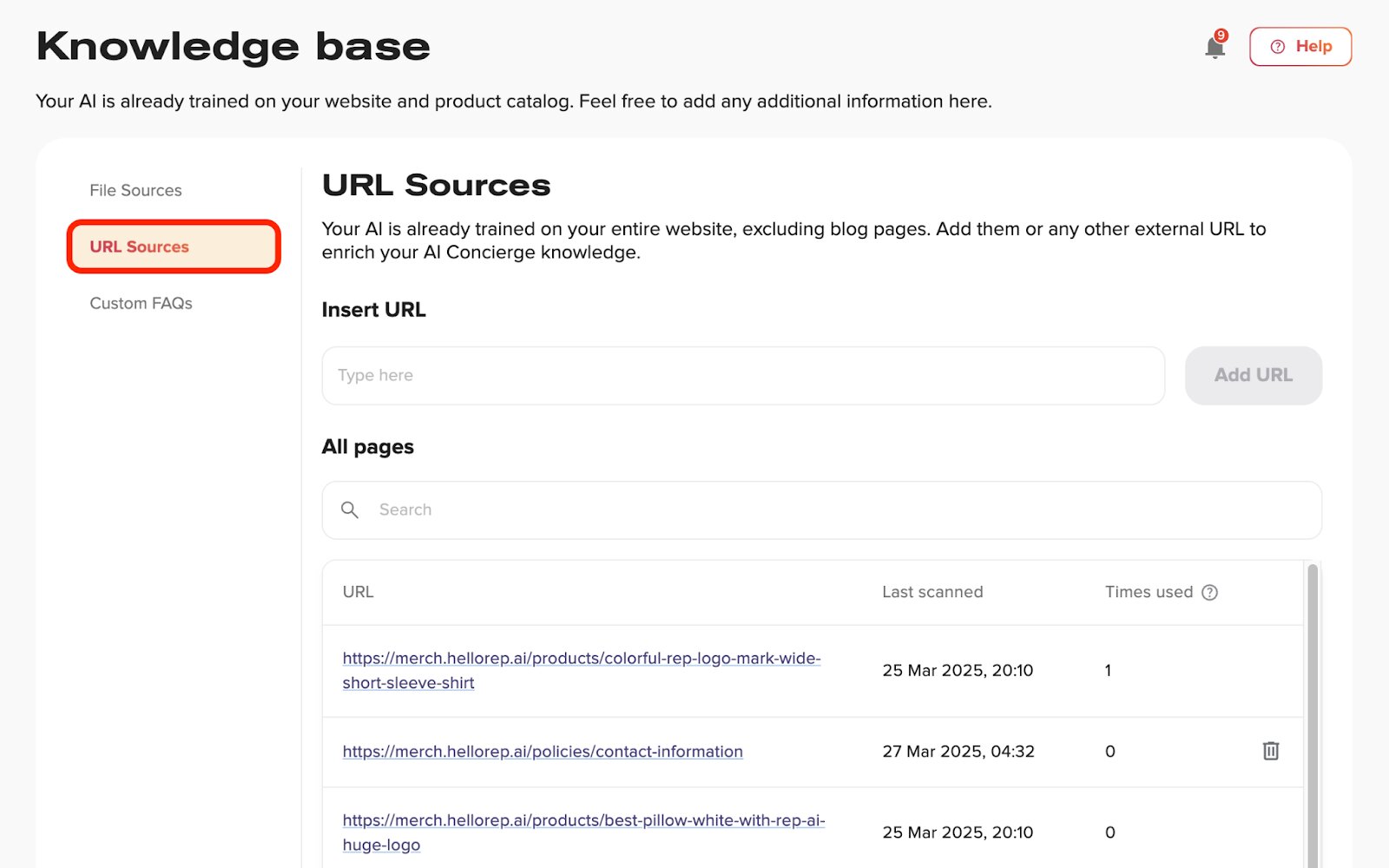
To refresh a Google Doc or Sheet, your team pastes the same link again. If a refresh fails, the article says Rep AI can keep using the previously scanned content. The help centre does not say how often the whole site is scanned again.
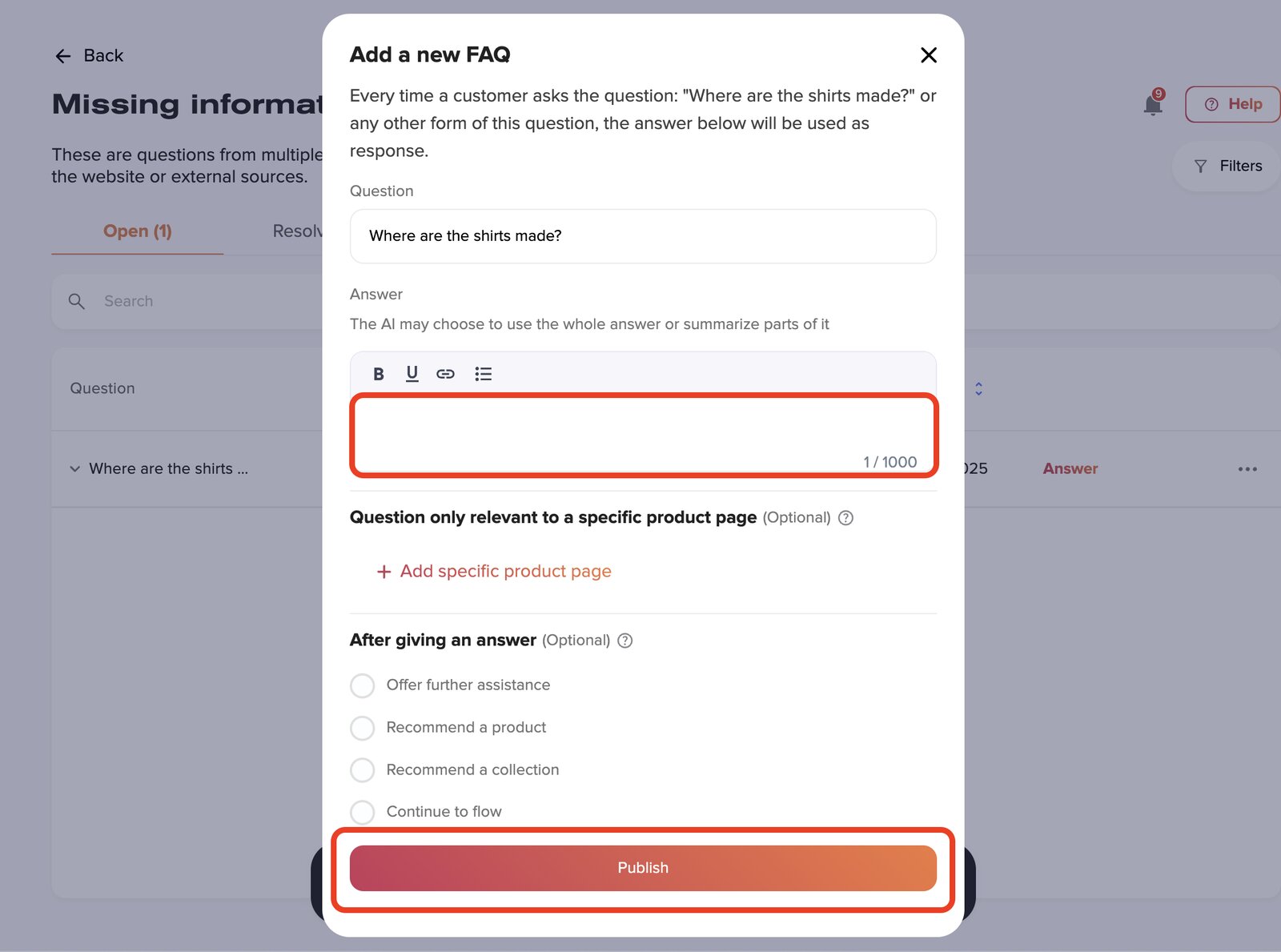
A Missing Information screen lists questions the AI could not answer, and your team writes an FAQ for each.
Algomo agentic search
Algomo holds no scanned copy of your store. When a shopper asks, it opens the right page and answers from what that page and the data behind it say at that moment. A code you end at midnight stops being quoted at midnight.
Stock, prices and order status come through the same calls your page makes, so they are as current as your store.
Algomo reviews each agent before it goes live. If a reviewed agent ever contradicts your website, the next month is free, on the terms in the guarantee page.
Where the answers come from
| Algomo | Rep AI | |
|---|---|---|
| Your website | ✓ The live page, when the question is asked | ✓ A scanned copy, with a Last scanned date |
| Product data | ✓ The calls your product pages make | ✓ Your Shopify catalogue |
| FAQs and documents | ✓ Knowledge base and saved past tickets | ✓ Custom FAQs, files, Google Docs and Sheets |
| A guarantee on accuracy | ✓ Next month free if a reviewed agent contradicts your site | None listed |
Our take: end a discount on your store, then ask both agents about it within the hour, and note which one still offers it.
What did Rep AI say when we asked it on live stores?
TL;DROn 21 and 22 November 2026 we asked Rep AI 615 questions on 60 live stores where its chat answered. 6 stores gave a wrong answer that a second, fresh visitor heard as well, and 4 of those 6 answers were about a sale or a promotion.
On 21 November we checked 98 store homepages for the Rep AI loader and found it on 41. We tried 26 of those stores, and on 19 the chat answered a visitor who had no account. On the other 7 the chat did not open in time, so they were not questioned. Each question came from the store's own policy pages, FAQ, announcement bar or product data.
Of the 214 answers, 179 matched the store, and 21 were refusals or offers to pass the question to a person, which we did not count as wrong. An answer counted as wrong only when a second visitor in a new browser got the same answer and no other page of the store printed it. We searched each store's pages, policies and product data for that. Two answers passed, one on kinnstudio.com and one on clothandpaper.com. Both are about dates.
On 22 November we found 344 more stores that had loaded Rep AI and tried 60 of them. Many print a Black Friday offer in their announcement bar, and we asked about it. The chat answered on 41 stores, and we asked 401 questions there, 8 to 25 per store. Four stores gave a wrong answer that a second visitor heard too: American Home Furniture, Spongellé, DUA and Barn Owl. DUA's agent put its Black Friday gift tiers at $200 and $250, where the store's page says to spend $125 or more. The other 37 stores gave no confirmed wrong answer.
Spongellé: a Black Friday sale printed on every page
On 22 November 2026, the chat was open on the home page of spongelle.com. We asked: "Is there a Black Friday sale right now? Is there a code?"
Rep AI said: "We don't currently have a specific Black Friday promotion running right now." A fresh visitor who asked "Is there a Black Friday promotion running right now?" heard: "We don't currently have a specific Black Friday promotion running." A third was told there was no sitewide discount and no free gift with orders.
The banner at the top of every page says: "BLACK FRIDAY EARLY ACCESS / 50% off sitewide + free gift with $60 order. / Code:BFCM2026", with a countdown beside it. None of the 659 store pages we searched says the sale is over. The chat footer says "Powered by REP".
Barn Owl: the last day of the Black Friday sale
On 22 November 2026, the chat was open on the home page of barnowl.tech. We asked: "When does the current sale end?"
The Barn Owl Bot said: "Our Black Friday Sale ends on November 30, 2026." A fresh visitor heard: "Our current sale ends on November 30, 2026."
The home page says "BLACK FRIDAY SALE · NOV 19 TO 29", and its announcement bar says "ENDS NOV 29". None of the 419 store pages we searched gives November 30. The page loads Rep AI's connector.
American Home Furniture: who pays for shipping
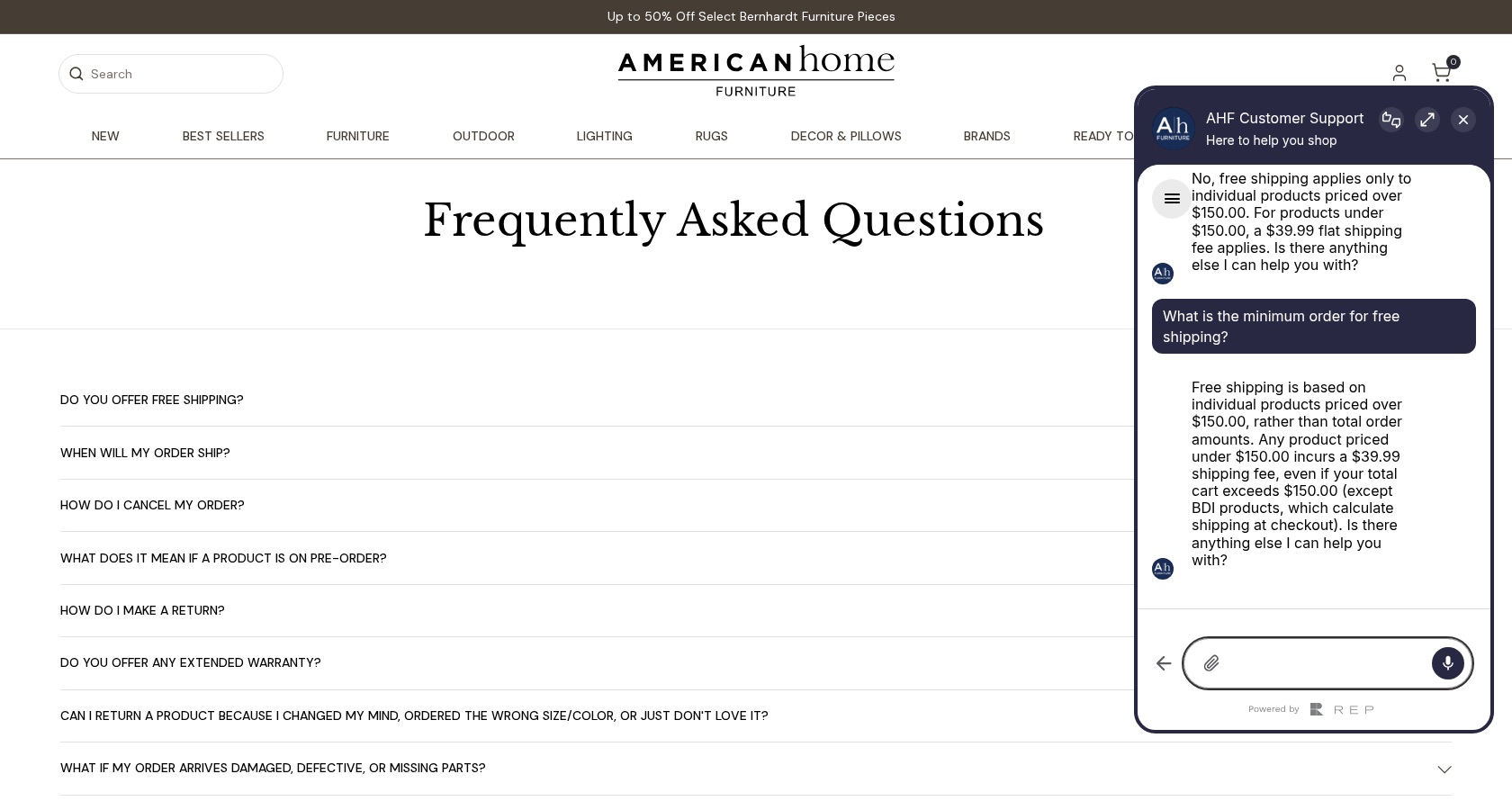
On 22 November 2026, the chat was open on the FAQ page of americanhomefurniture.com. We asked: "Is shipping free on a lamp that costs about $90?"
Rep AI said: "No, free shipping applies only to individual products priced over $150.00. For products under $150.00, a $39.99 flat shipping fee applies." Asked for the minimum order, the same visitor heard that a product under $150.00 "incurs a $39.99 shipping fee, even if your total cart exceeds $150.00". An earlier visitor was told: "All products priced over $150.00 qualify for free shipping (excluding BDI products)."
The FAQ page answers "Do you offer free shipping?" with "Yes. We offer free shipping on all orders." The shipping policy says the same, and the bar at the top of every page reads "Free Shipping on All Orders". We searched 230 pages and 9,750 products and found no $150 threshold and no $39.99 fee.
Kinn: the holiday return window
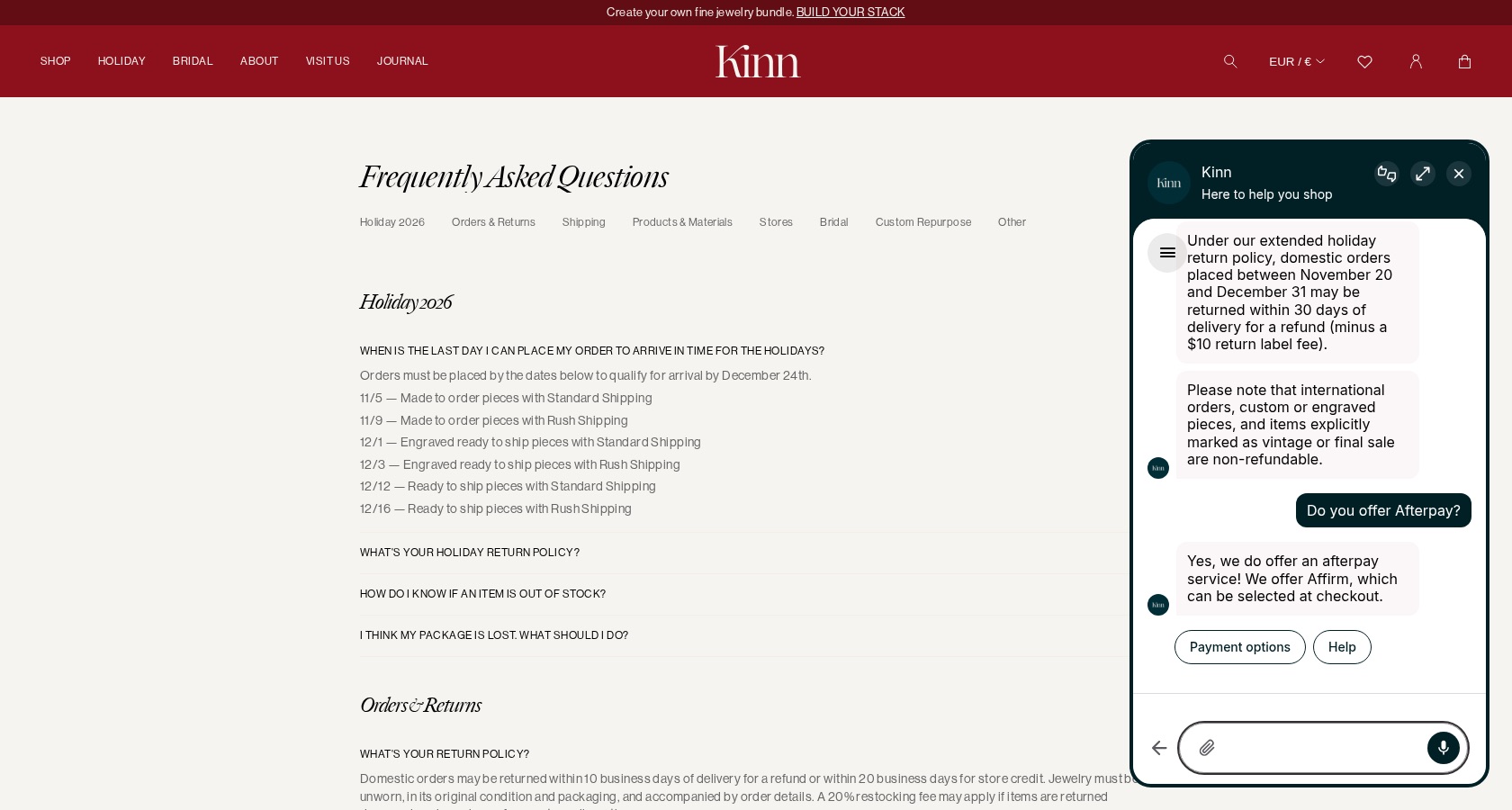
On 21 November 2026, the chat was open on the FAQ page of kinnstudio.com. We asked: "If I buy a necklace on November 25, until what date can I return it for a refund?"
Rep AI said: "Under our holiday return policy, domestic orders placed between November 20 and December 31 may be returned within 30 days of delivery for a refund (to your original payment method, minus a $10 return label fee)." A fresh visitor heard: "Under our extended holiday return policy, domestic orders placed between November 20 and December 31 may be returned within 30 days of delivery for a refund (minus a $10 return label fee)."
The FAQ page beside the chat, in its Holiday 2026 section, says: "All purchases made from Monday, November 23rd through Wednesday, December 16th can be returned through January 15th, 2027 or exchanged by January 22nd, 2027." We searched 1,420 Kinn pages and products and found no other page that gives November 20 to December 31 or 30 days from delivery. Asked three more times later that day, Rep AI kept the same window, and once it gave the years as November 20, 2025 to December 31, 2025. Rep AI publishes a Kinn case study.
Cloth & Paper: the start of Black Friday early access
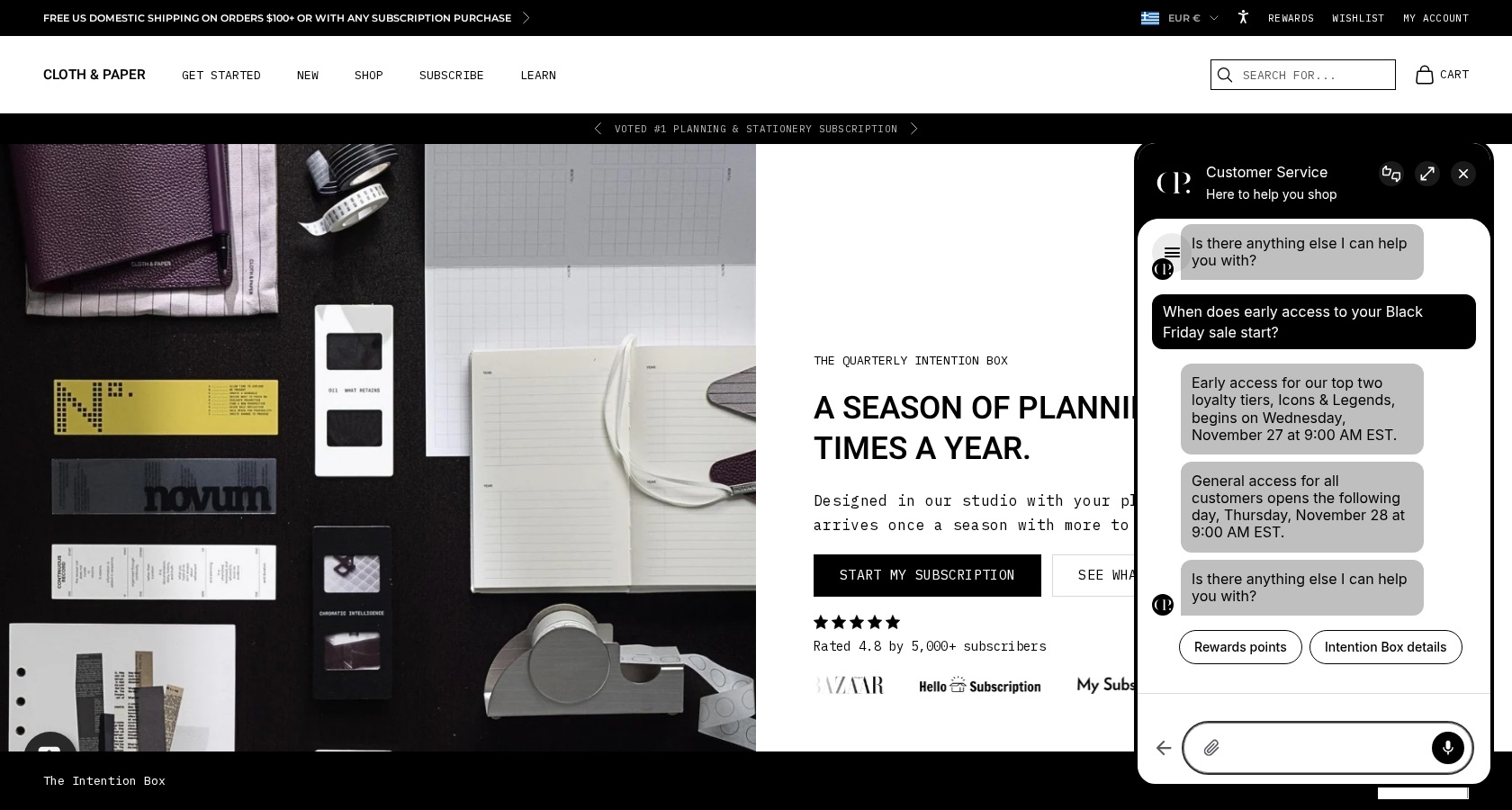
On 21 November 2026, the chat was open on the Intention Box subscription page of clothandpaper.com. We asked: "When does early access to your Black Friday sale start?"
Rep AI said: "Early access for our top two loyalty tiers, Icons & Legends, begins on Wednesday, November 27 at 9:00 AM EST." Earlier that day, a visitor on the homepage asked "Is there a Black Friday sale right now? How much is off and when does it end?" and heard about "early access for our top loyalty tiers (Icons & Legends) starting Wednesday, November 27 at 9:00 AM EST, and general access for all customers beginning Thursday, November 28 at 9:00 AM EST."
The Intention Box page says: "As a subscriber, you also get early access to our Black Friday sale, starting Thursday, November 26". In 2026, November 26 is a Thursday and November 27 is a Friday. None of the 826 Cloth & Paper pages and products we searched gives November 27 or November 28 for the sale.
We keep the full record behind every answer above: the transcript, a capture of the page at the time, the screenshots and the time stamps. If you work at Rep AI or at a site named here and want that record, write to support@algomo.com.
Can you run it from Claude, ChatGPT or Claude Code?
TL;DRRep AI's MCP server lets an assistant read your results and propose changes to instructions, FAQs and skill instructions, while Algomo is built and changed entirely over MCP, from the first configuration to tools and workflows, with every change staged first.
Most owners already ask an AI assistant about their business. Whether that assistant can also change the agent decides how much time your team spends in another console.
Rep AI MCP server
Rep AI runs an MCP server, the open protocol that lets an AI assistant work with another product. From Claude, ChatGPT, Claude Code or another MCP client, an admin can ask how the AI performed, what shoppers asked, and where they got stuck.
The assistant can also propose a change to your global AI instructions, your custom FAQs or the instructions of a skill. Change permissions are off until you turn them on, each change waits for your yes in the chat, and the audit log can revert it. Skills, endpoints and the widget are set in the Rep AI console.
Algomo AI-first platform
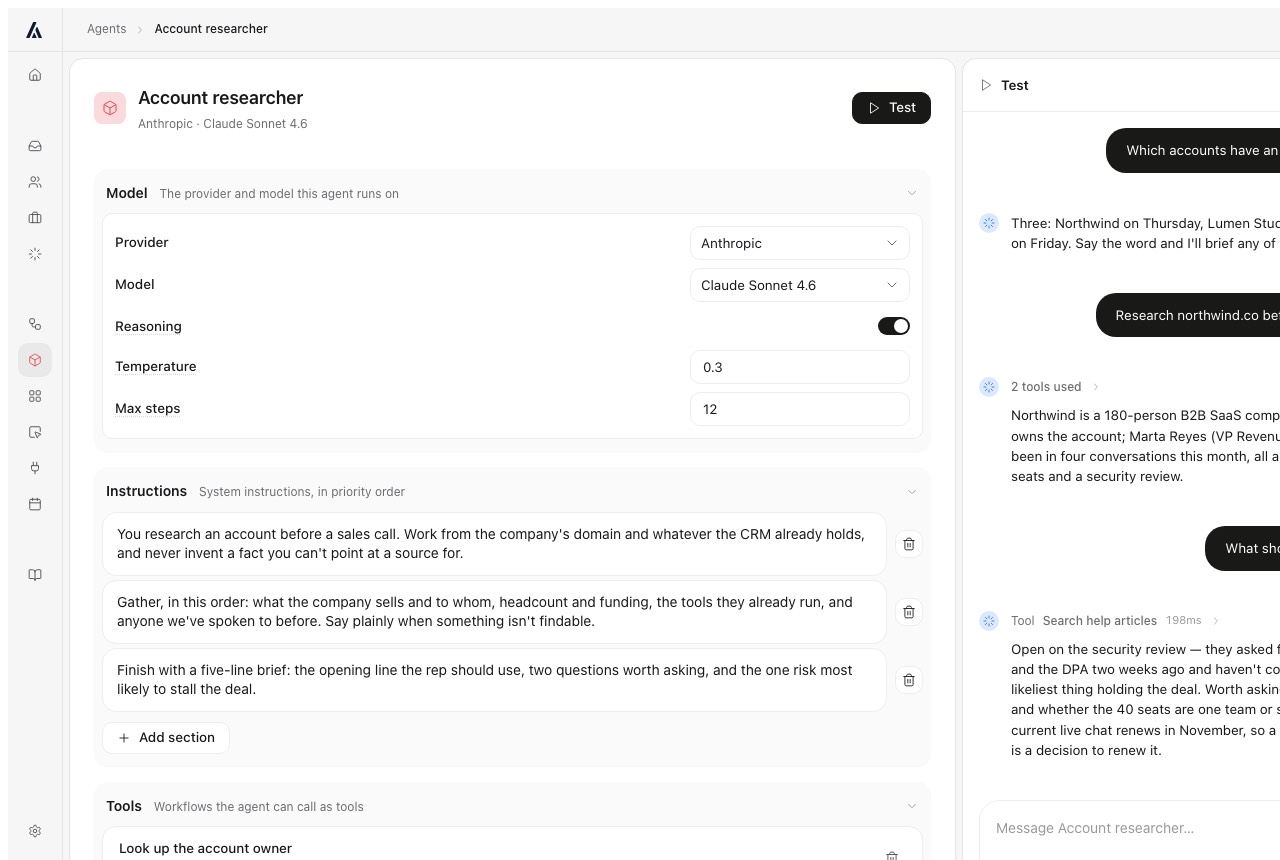
Algomo is built from Claude Code, Codex, Cursor, ChatGPT or the Claude app, over MCP. The assistant writes the agent's instructions, its tools, its workflows and its widgets, not only its wording.
Every change is staged. You preview it on your own site, read the difference, then ship it, and the history records why. Moving a returns window for the holidays is one sentence and one approval.
Building and changing the agent
| Algomo | Rep AI | |
|---|---|---|
| Read results from your assistant | ✓ Over MCP | ✓ Over MCP |
| Change instructions and FAQs | ✓ Staged, then shipped | ✓ Proposed, approved in the chat |
| Build tools, workflows and widgets | ✓ From your coding assistant | In the Rep AI console |
Our take: ask your assistant to add one new rule to each agent and check how far it gets before you have to open a console.
Can it sell on the page, not just answer?
TL;DRRep AI approaches shoppers it judges are about to leave and edits their Shopify cart from the chat, while Algomo works in the shopper's own browser session on any website and does the steps on the page in plain sight.
Most of your visitors leave without asking anything. The agent that turns a question into an order, and the moment it speaks up, decides what the chat is worth to you.
Rep AI sales skills
Rep AI's Sales Skills approach shoppers on the home page, a product page, a collection page or after they viewed the cart, based on behaviour that suggests they are about to leave. Rep AI calls this drop-off detection.
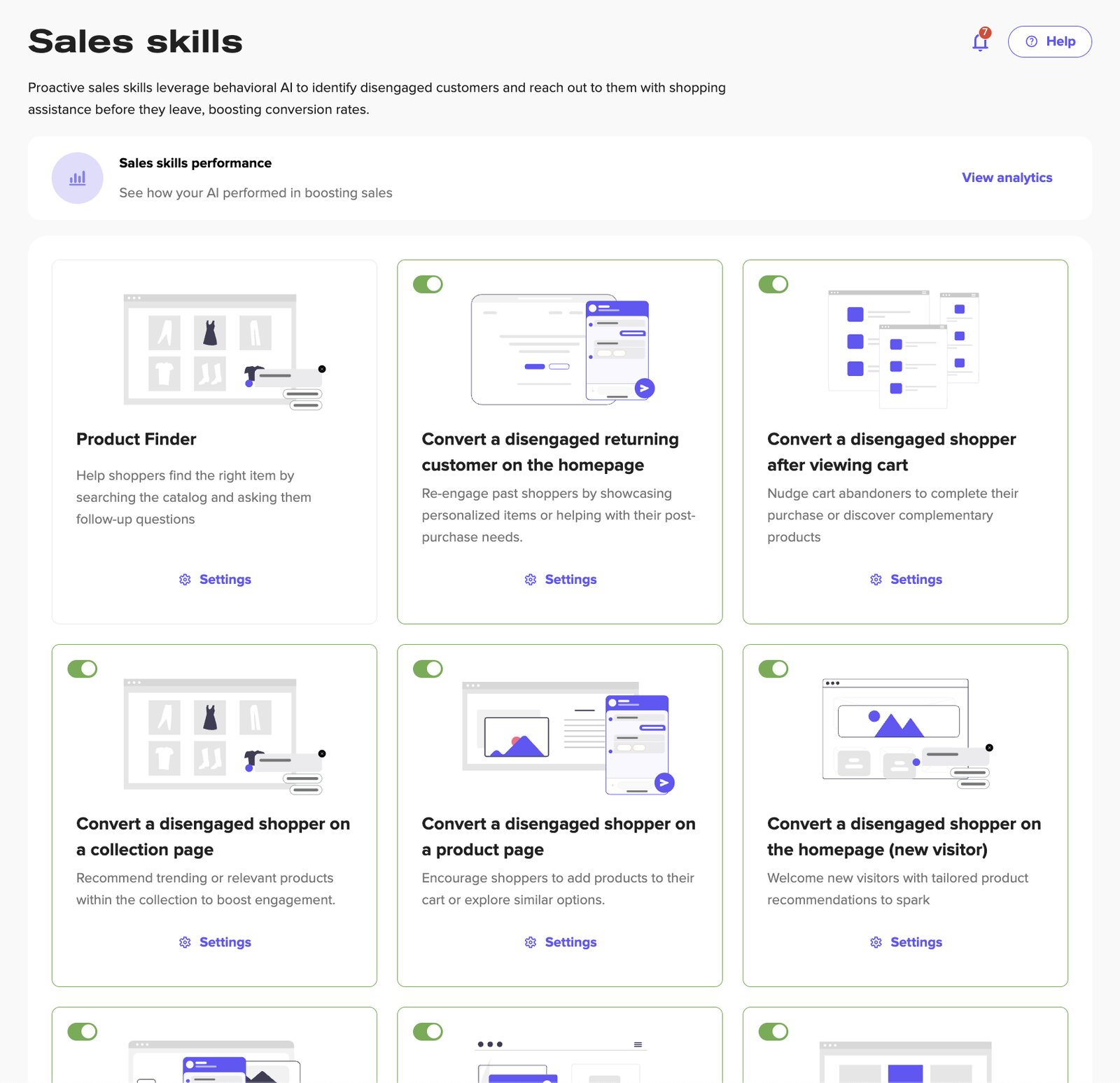
In Shopify web chat, the agent can add or remove items, change quantities, switch a size or colour, apply a discount code and choose a subscription. Each change is made in the shopper's real storefront cart, and the shopper pays at your checkout.
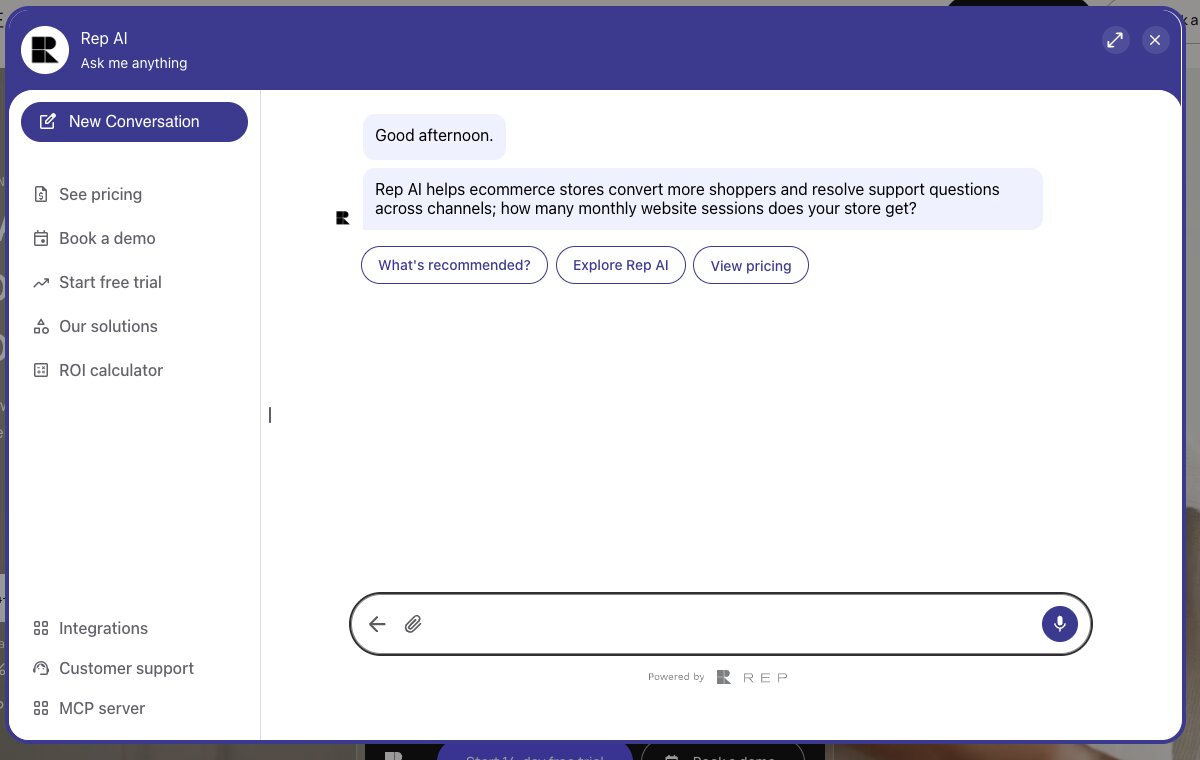
Algomo co-navigation
Algomo runs in the shopper's own browser, on your page, inside the session the browser already has, with their prices, region and basket. It can filter a collection, apply a code, add to the basket, open a page beside the chat or look up their order, and the shopper sees every step.
It knows the page the shopper is on and what they viewed this visit, so it can talk about that product without being told. It works the same on Shopify and on any other website, and acts only through the tools you allowed.
Our take: ask each agent to put a named product in your size into the basket with a live code, on a store page, and watch whether it completes the order path.
What can run alongside the conversation?
TL;DRRep AI connects to marketing tools such as Klaviyo to follow up by email, while Algomo can run any function you describe during and after the chat, from a two-factor code to a Slack alert.
Some work happens outside the chat window. Confirm who a shopper is, alert a manager, send tomorrow's follow-up.
Rep AI integrations around the chat
Rep AI lists more than 35 integrations, among them Klaviyo, Attentive, Postscript, Yotpo, Loox and Okendo for email, SMS, reviews and loyalty. A Klaviyo integration turns shopper conversations into follow-up emails.
Algomo workflows and widgets
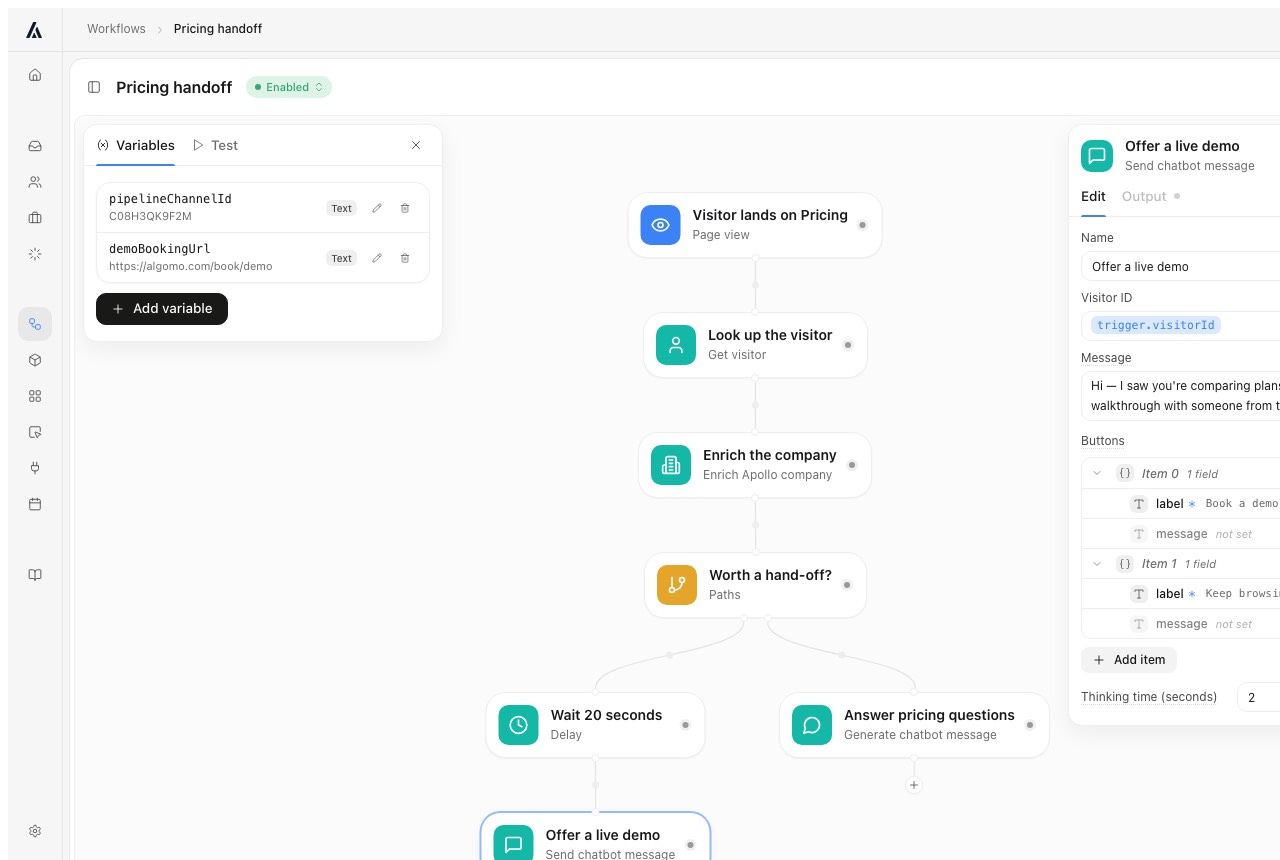
Algomo puts a workflow engine behind every agent. During the chat it can send a two-factor code before it shows an order, apply your routing rules or alert a manager in Slack. After it, the agent can email a summary or research a wholesale buyer and send your team a memo.
In the chat, describe a mini-app such as a product comparison or a quote calculator to your coding assistant, and Algomo builds it as a widget the shopper uses there.
Our take: name one step your team does by hand after a chat, and ask each vendor to run it while you watch.
Which channels does each AI answer on?
TL;DRRep AI's agent answers on your website, email through a connected helpdesk, Instagram, Messenger and WhatsApp, while Algomo answers in chat on your website and sends a follow-up email when a shopper leaves.
Shoppers ask in different places. Count last month's questions by channel, because an agent covers only the ones it is connected to.
Rep AI channels
Rep AI answers on the website widget, and on email through a connected helpdesk such as Gorgias, Zendesk, Kustomer or its own Rep Inbox. Instagram, Messenger and WhatsApp are an add-on billed per resolved conversation. Rep Inbox also lets your team take phone calls in the browser, with a recording and an AI summary, for people rather than the AI.
Algomo channels
Algomo is chat on your website, plus a follow-up email to a shopper who left. It does not answer phone calls or incoming email.
Our take: if a large share of your questions arrive in Instagram or WhatsApp, choose Rep AI for those, and test Algomo where shoppers ask on the product page.
How do you test it before shoppers see it?
TL;DRRep AI's Test & Train page simulates each channel and lets you fix an answer on the spot, while Algomo previews the agent on your live store before any code is added and logs every tool call behind every answer.
You want to see the bad answer before a shopper does. When one slips through, your team needs to know what the agent read.
Rep AI Test & Train
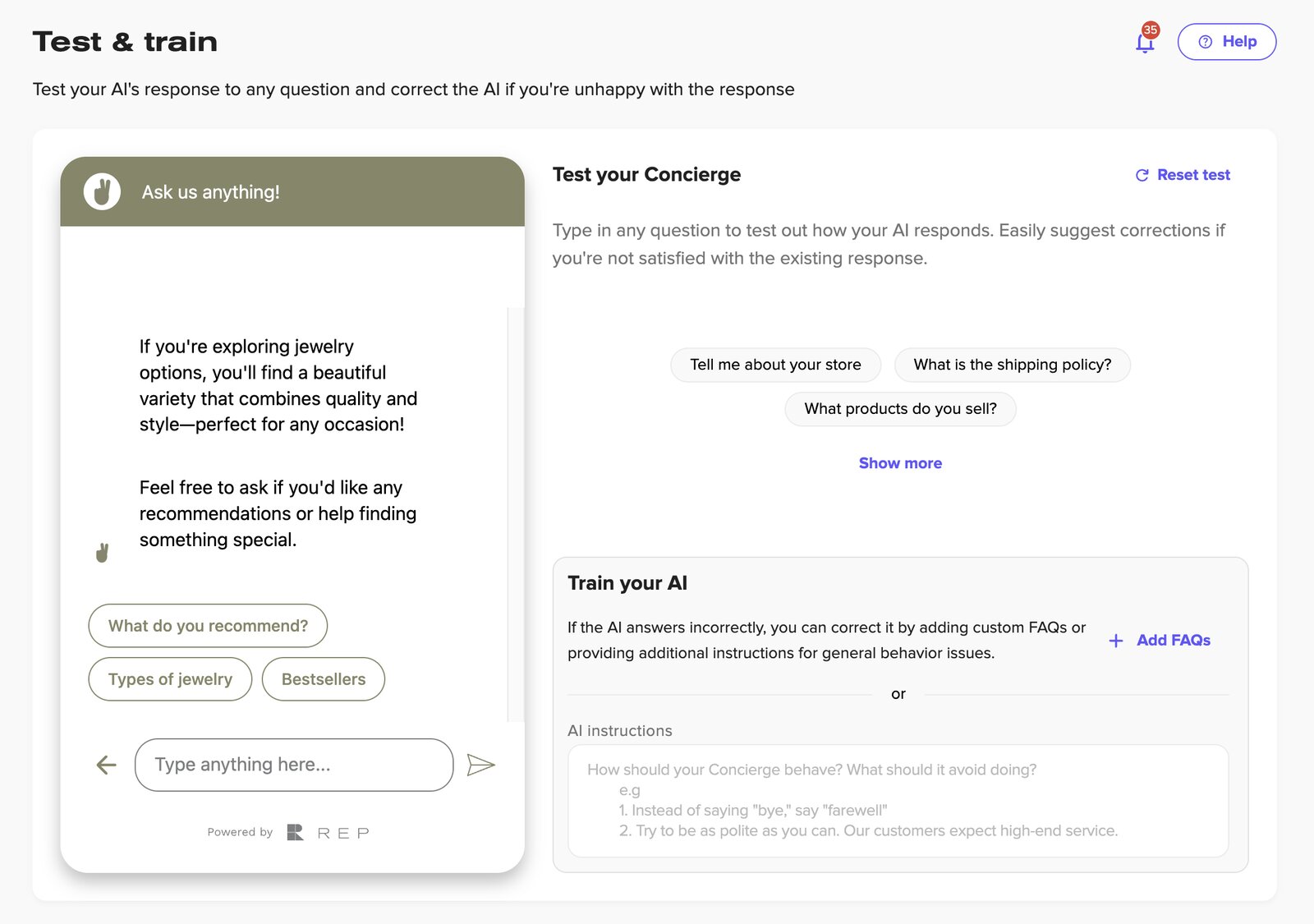
Rep AI's Test & Train page shows a simulator for the chat widget, email and Meta messages. You send a sample question, read the reply as a shopper would see it, and correct it by adding an FAQ or changing the AI's instructions.
Algomo testing and audit
Algomo lets you preview the agent on your real store from its browser extension before any code goes on the site. Testing uses a separate allowance, 200 credits a month on Free and 1,000 on Business, so tests never spend the live budget.
Once live, every answer logs the tools it called, with inputs, outputs, time and cost, and every workflow run keeps a step-by-step trace.
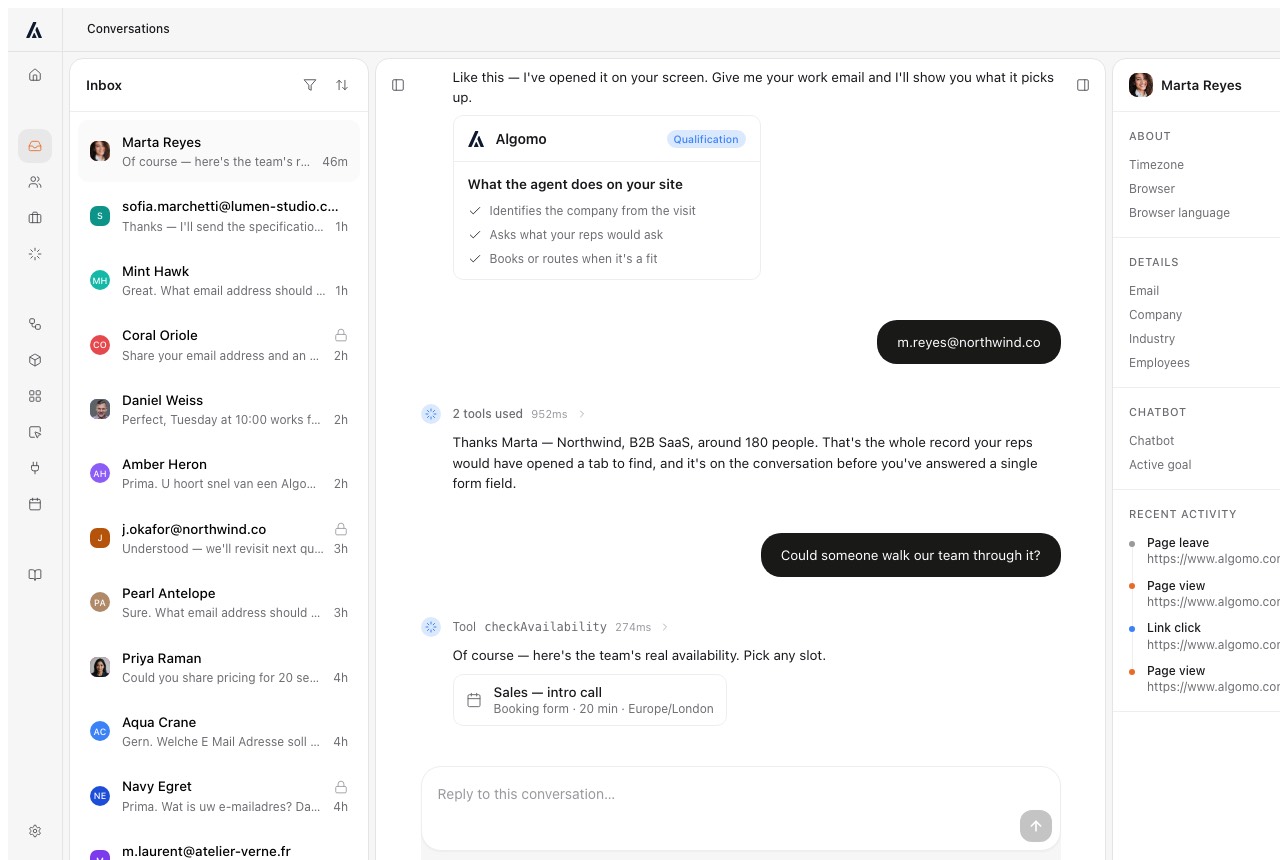
Our take: ask each agent a question about a product page you changed yesterday, and check whether you can see where the reply came from.
What happens when a person needs to step in?
TL;DRRep AI emails your team a summary and a link, or opens a ticket in your helpdesk, while Algomo alerts the right person by email and Slack and they join the live chat on your site with the transcript.
A broken item, a late gift or a wholesale enquiry needs a person. What reaches that person, and how fast, decides whether the shopper waits or leaves.
Rep AI handoff
When a shopper asks for a person, Rep AI collects their contact details and emails your team a summary, the transcript and a link. A teammate can drop into the live chat from the console. With a helpdesk connected, the request becomes a ticket, and a reply sent while the shopper is still on site appears as live chat. Escalating to a person cannot be switched off.
Algomo handoff
Algomo hands over on rules you set, by topic, by page, or when the shopper asks. The right person is told by email and Slack and joins the conversation on your site, with the full transcript and the tools the agent called. With a connector, Algomo can create the ticket in your helpdesk, such as Gorgias or Zendesk.
Our take: ask for a person on each agent at a busy hour, and time how long until someone with the transcript replies.
What does the first week look like?
TL;DRRep AI offers a 14-day trial with no card once your Shopify store is connected, while Algomo's free plan puts an agent on any website the same day, with no card and no end date.
The first week is when you decide. Your team wants to see the agent answer about your own products before anyone commits.
Setting up Rep AI
Rep AI's onboarding asks you to connect your Shopify store, which gives the AI your catalogue and site content. Every plan has a 14-day free trial with no card, and onboarding is self-led below 80,000 sessions a month.
Setting up Algomo
Algomo's free plan is self-serve with no card. You give it your URL, it finds the systems your pages call, and the first version runs the same day. You tell it what to say and collect in plain language, and test it beside the settings.
Connectors for staff-only systems come with the Business plan. You set them up from your coding assistant, or in a session with Algomo's team, usually a day or two.
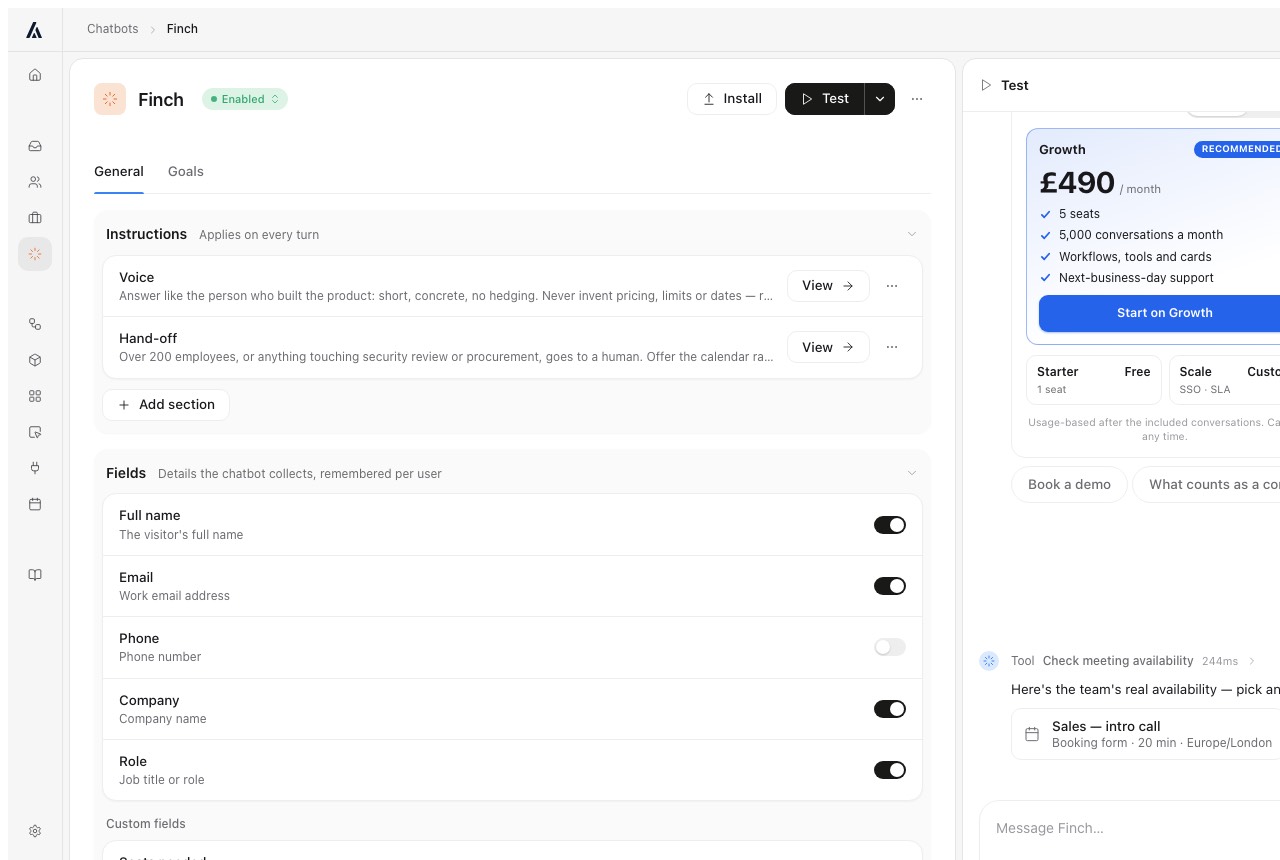
Our take: start both on the same morning and judge them on the same ten questions from last week's inbox.
What does each one hold that could open a shopper's account?
TL;DRRep AI is SOC 2 Type II certified and checks the order email before it shares order details, while Algomo works from the shopper's browser and stores no token for anything your website already does.
An agent that shows order details holds access to order data. Your security review will ask what the vendor keeps to get it, and how it checks who is asking.
Rep AI security
Rep AI states that it is SOC 2 Type II certified. Before sharing an order, it asks for the order number and the email used at checkout, or a second detail such as a phone number or zip code. For order changes, details appear only when the email matches the order.
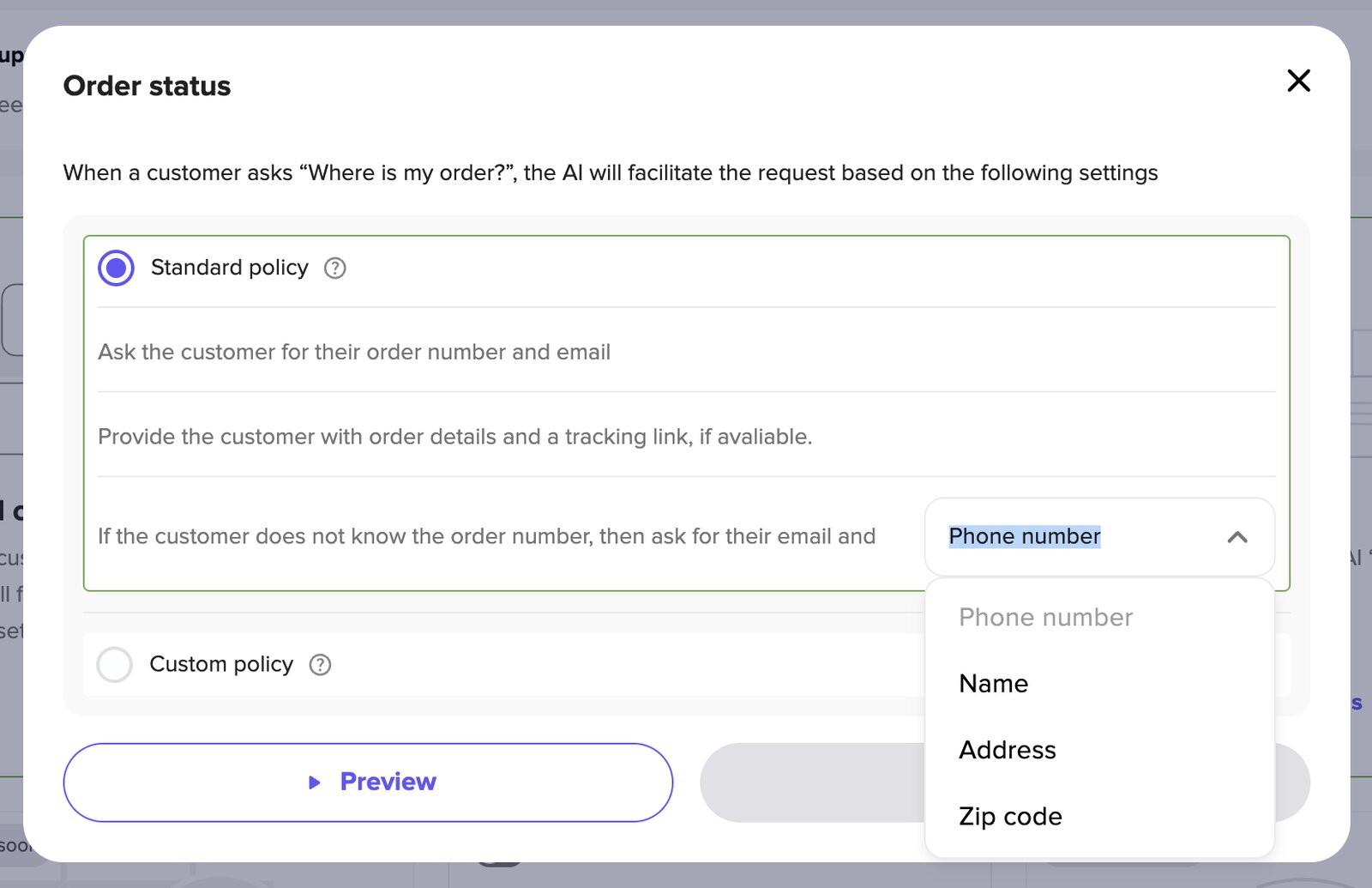
Algomo security
Algomo is secure by design. When it checks stock, a price or the shopper's own order, the request goes from that shopper's browser, the same way your page sends it. For all of that, Algomo stores no token or credential.
A staff-only system such as a CRM or billing needs a connector, and Algomo does store that login, encrypted with AES-256-GCM and revocable at any time. A workflow can also send a two-factor code before it shows account details. Algomo holds Cyber Essentials and hosts its application, database and files in the EU.
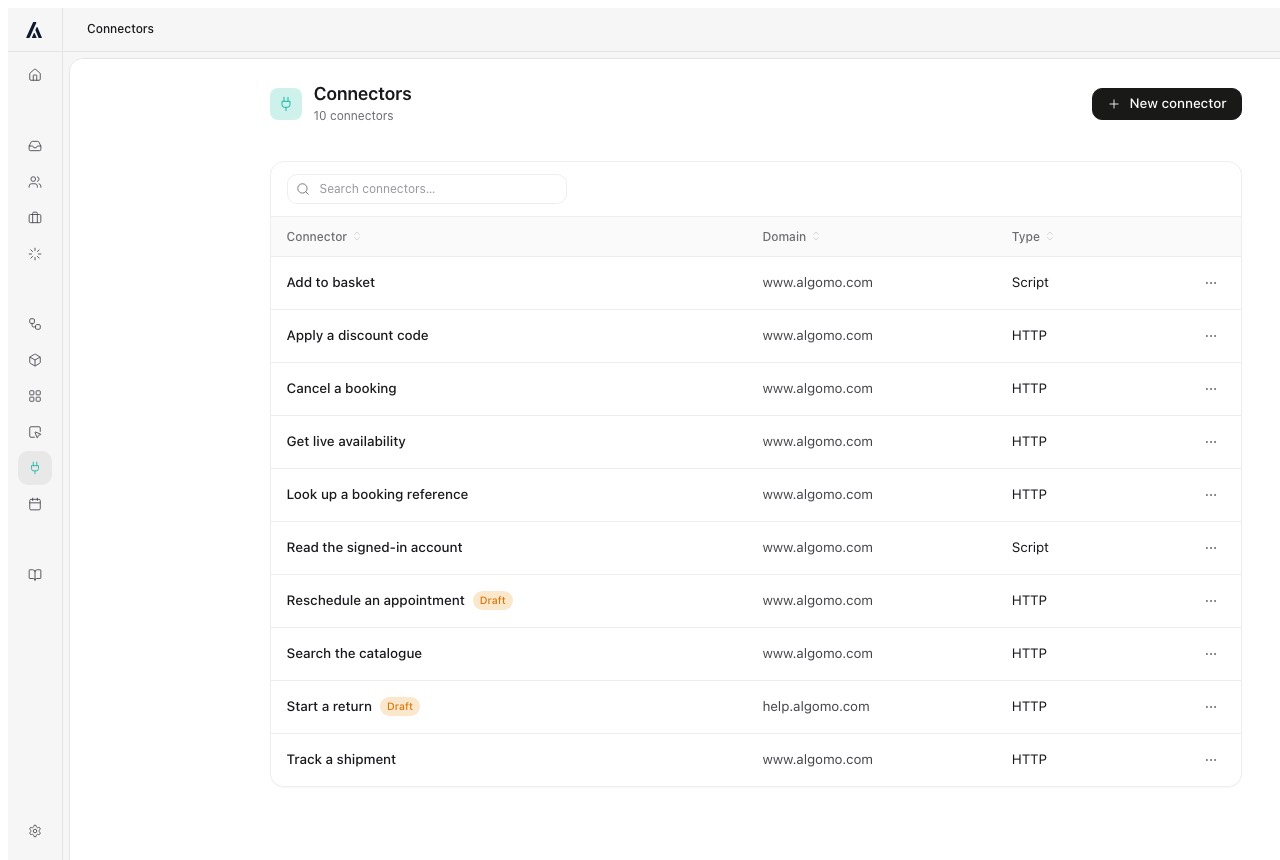
Our take: ask each vendor which logins it stores to answer one shopper's order question.
How much does Rep AI cost compared with Algomo?
TL;DRRep AI starts at $19 a month for up to 3,000 store sessions, counted whether or not anyone chats, while Algomo has a free plan and then bills only conversations that helped someone, from $50 a month.
Two stores with the same traffic can get very different value from a chat. Your finance team should know what the bill counts before it sees the number.
How Rep AI bills
Rep AI prices its website plans by sessions. A session is one shopper's device visiting your store on one calendar day while the chat is shown, and the shopper does not need to open it. Bots and very short visits are excluded.
At up to 3,000 sessions a month, Sales is $39, Support is $19 and Concierge, both together, is $46, or $29, $15 and $37 a month billed yearly. Plans rise in tiers with sessions, and stores above 500,000 sessions get custom pricing.
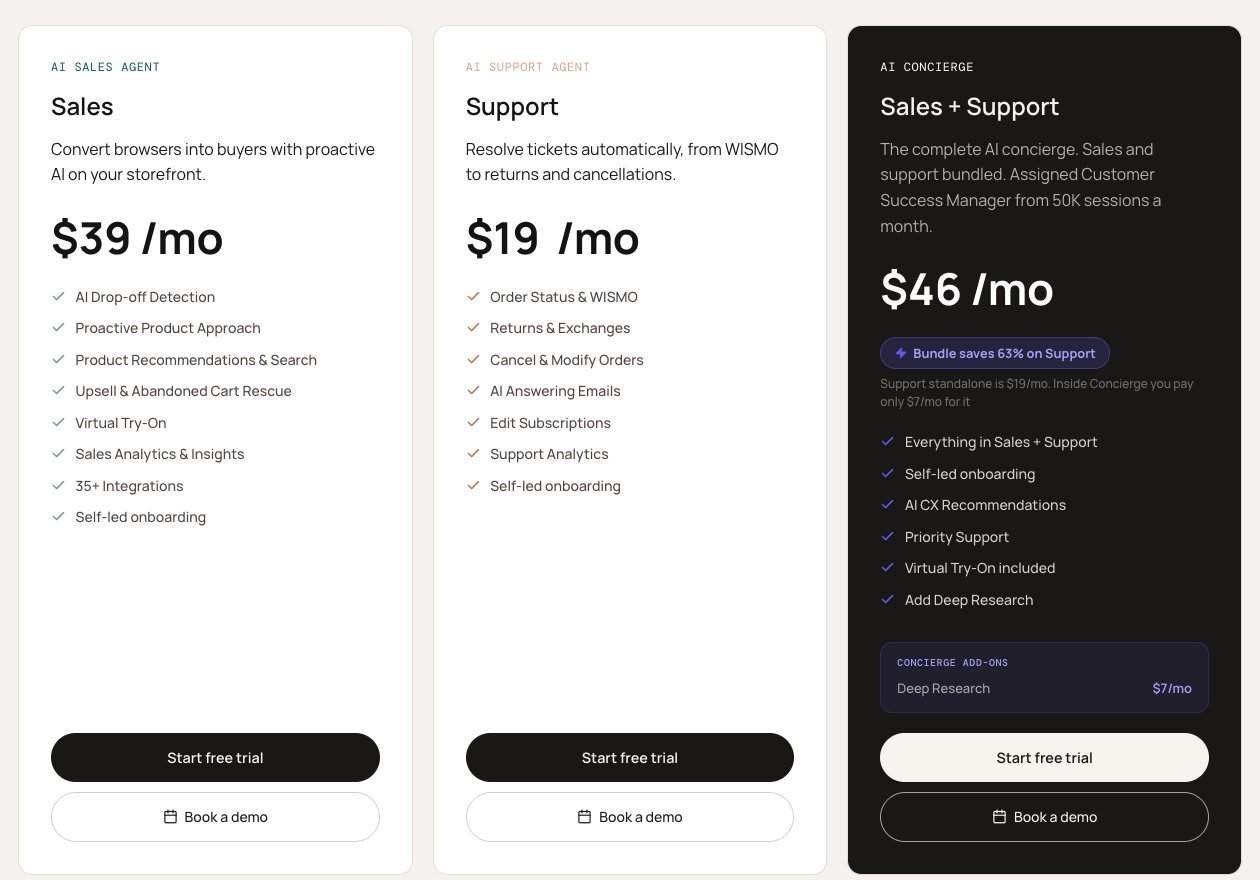
Email, Instagram, Messenger and WhatsApp are an add-on at $0.75 per AI-resolved conversation, or $0.50 billed yearly. Past the bundled amount, overage is $1.20 a resolution, on by default for new subscribers, up to a $1,000 reserve a cycle. Rep Inbox, the helpdesk, adds $8 to $675 a month by tickets, plus $20 per agent.
How Algomo bills
Algomo's free plan is self-serve, with 100 credits a month, about twenty helped conversations, and no card. After that you choose one monthly amount: $50 for 2,000 credits, $100 for 4,000, $200 for 8,000, up to $4,300 for 200,000, with Enterprise above.
A conversation that helped someone costs 5 credits, plus 5 for every further ten replies, and one that went nowhere costs nothing. Visits where nobody chats cost nothing. There are no seats, the amount you picked is the most any charge can be, unused credits roll over, and when they run out the agent pauses until you renew.
How the two bills behave
| Algomo | Rep AI | |
|---|---|---|
| What the bill counts | ✓ Conversations that helped someone | Store sessions with the chat shown |
| A visit with no chat | ✓ Free | Counts as a session |
| Cheapest paid start | $50 a month | ✓ $19 a month, $15 billed yearly |
| A busier month than planned | ✓ Capped at the amount you set | Billed by session tier, plus $1.20 overage on messaging |
| A free way to start | ✓ Free plan, no card, no end date | ✓ 14-day trial, no card |
Here is a worked sum for a small store. At 3,000 sessions a month, Rep AI's Concierge is $46, whatever the number of chats. Say 300 of those visits end in a conversation that helped. On Algomo that is 1,500 credits, which fits the $50 plan with 2,000.
Below that volume, Algomo's free plan may cover you. Above it, the two bills grow on different things, traffic on Rep AI and helpful conversations on Algomo.
Our take: take last month's sessions and last month's chats, price each product on its own unit, and see which one moves more when traffic doubles.
What to ask any vendor selling you an AI agent
TL;DRFive questions, each with a test for the demo.
- Can it reach the one system no app covers? Ask them to connect it on the call.
- Where does this answer come from, the live page or a scan? Ask for the last scan date.
- What does the bill count? Ask them to price last month's traffic.
- Can it put the right variant in my basket? Ask it to, on your store.
- Can it run a step my store does not have, like a two-factor code? Ask it to send one.
Run each test on your own store, not on the vendor's demo.
Which one fits your store?
Choose Rep AI if
- Your store runs on Shopify with standard order, returns and subscription apps, and the ready skills cover what you need.
- Many of your questions arrive in Instagram, Messenger or WhatsApp, and you want the AI to answer there.
- Your monthly sessions are small and a $15 to $19 starting price matters most.
Don't choose Rep AI if
- Your store is not on Shopify, or is headless with no developer to send page events.
- A price engine, configurator or booking system behind your store has no ready skill.
- A shopper quoted an ended discount is a risk you will not take.
- You want the bill tied to conversations that helped, not to visits.
Conclusion
TL;DRChoose Rep AI for a Shopify store that wants a low entry price, ready order skills and social channels, and choose Algomo when you want the wiring done for you on any website and every answer read from the live page.
On implementation, Rep AI covers standard Shopify orders out of the box, and your team adds endpoints for anything else. Algomo finds the systems behind your pages and connects to them itself, the same day.
On accuracy, Rep AI trains on a scan of your site. Algomo reads the live page every time and puts a month's fee behind it. Selling, channels and the bill follow from those two.
Questions buyers ask about Algomo and Rep AI
Is Algomo a good Rep AI alternative?
Yes, when your store has systems no Shopify app covers, runs on another platform, or changes prices and offers often. Algomo connects itself to what your pages call and answers from the live page. If you mainly need ready Shopify order skills and social messages at the lowest price, Rep AI is built for that.
How much does Rep AI cost?
At up to 3,000 sessions a month, Rep AI is $19 for Support, $39 for Sales and $46 for both, or $15, $29 and $37 a month billed yearly. Plans rise with sessions, messaging channels cost $0.75 per resolved conversation, and every plan has a 14-day trial with no card.
Who owns Rep AI?
REP AI is an independent, venture-backed company founded in 2020, with offices in New York and Tel Aviv. In May 2026 it raised $6.2 million led by Silicon Road Ventures, and Zendesk joined as a strategic investor. Zendesk is an investor, not the owner.
What counts as a session on Rep AI?
One shopper's device visiting your store on one calendar day, in UTC, while the Rep AI chat is shown. The shopper does not need to open the chat. On Algomo, only a conversation that helped someone costs credits.
Does Rep AI work outside Shopify?
Rep AI is built for Shopify. Its help centre describes a web client for headless or non-Shopify sites, where your developers send page events on every page load. Algomo works on any website with no platform app.
Does Rep AI work with Claude or ChatGPT?
Yes. Rep AI has an MCP server that Claude, ChatGPT and Claude Code can connect to, to read results and propose changes to instructions and FAQs. Algomo is built and changed over MCP from Claude Code, Codex, Cursor, ChatGPT or the Claude app.
Which AI model does each one use?
Rep AI's help centre says it is powered by ChatGPT. Algomo's default model is from OpenAI, and on Enterprise you choose the provider, with the application, database and files hosted in the EU.
Where these facts come from
All the information on this page was available in November 2026. The sources are:
- Rep AI's pricing page: plans, session tiers, messaging add-on, overage and Rep Inbox prices.
- Rep AI's home page: channels, integrations and the SOC 2 Type II statement.
- Rep AI's company page: founding year, offices and funding.
- The funding release: the May 2026 round and Zendesk as strategic investor.
- The sessions article: what a session is.
- The training article: training on the whole site and the ChatGPT statement.
- The endpoints article: API endpoints in a skill and Expert Zone.
- The post-purchase article: Support Skills and order verification.
- The cart article: cart edits in chat.
- The MCP article: the MCP server and its permissions.
- The handoff article: email alerts, drop-in and helpdesk tickets.
- The Shopify article: Rep AI works on Shopify-based stores.
- Rep AI help centre articles, each named under its screen.
- Algomo's pricing page, Algomo's compliance page and the guarantee page.
- The demo library, for the Blinds 2go demo, the Nike demo and the Qualtrics demo.