
Summarize withChatGPTPerplexityClaudeGrokAlgomo vs Netomi
TL;DROn the two risks that stall AI projects, a long integration and answers that drift from the truth, Netomi sets up your systems inside a $100,000 pilot month and answers from the knowledge base it configures, while Algomo's AI connects to what your website already calls on day one and reads the live page, with a free month if a reviewed agent contradicts your site.
One term first. Netomi calls its customer-facing AI an agent, and so does this page. The people on your support team are your team.
Algomo vs Netomi at a glance
| Algomo | Netomi | |
|---|---|---|
| Main job | An AI agent for your website, with an inbox your team takes over from. It handles support and inbound sales. | An agentic AI platform for enterprise customer service across chat, voice, email, SMS and social channels. |
| Who does the integration | Algomo's AI. It records the calls your pages make and turns them into the agent's tools. | Netomi, during a one-month pilot that includes setup and integration with your CRM, ticketing, chat, email and voice systems. |
| Where the answers come from | The live page and the data behind it, read when the question is asked. | The knowledge base and workflows Netomi configures, plus your connected systems. |
| Published pricing | Free plan, then one monthly amount from $50 to $4,300. | No price list. A one-month pilot at $100,000 on Netomi's AWS listing. Vendr estimates a median of $85,000 a year. |
| How you buy it | Self-serve, with no card on the free plan. | By referral, then a pilot, then a contract priced for you. |
| Biggest limitation | Does not answer phone calls or incoming email. | No public trial, no public docs and no price until a pilot is signed. |
What part of Netomi do you need?
TL;DRNetomi suits a global brand that wants a vendor to run one AI across phones, messaging and email at very high volume, and Algomo suits any team whose questions start on its website and who wants an agent live there now.
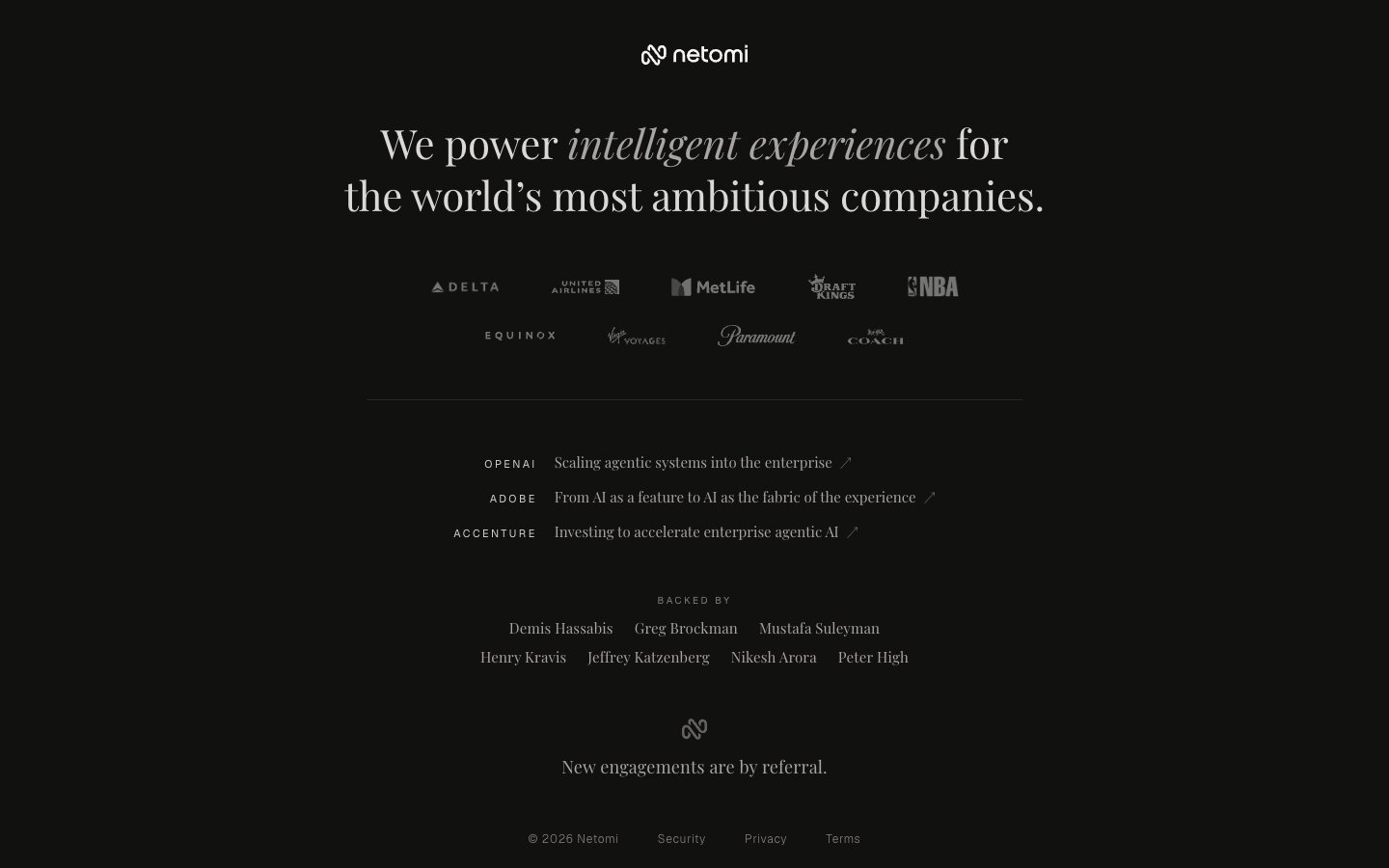
Netomi's customer logos include Delta, United Airlines, MetLife, DraftKings and the NBA. Those are contact centres taking millions of contacts. Before you compare features, decide which of these describes your team:
- A contact centre where most contacts arrive by phone, SMS or social messaging: Netomi.
- Questions that arrive on your website, about products, prices, orders or bookings: Algomo.
- A budget that can carry a $100,000 pilot before production pricing: Netomi.
- A team that wants to try the agent on its own site before any contract: Algomo.
The sections below start with the two risks, then cover building, actions, channels, testing, security and price.
Who connects the AI to your systems, and how long does that take?
TL;DRNetomi's own team integrates your CX stack during a paid one-month pilot, while Algomo's AI finds the systems your website already calls and connects to them itself, so a first version runs the same day.
An AI agent only resolves something once it can reach your order system, your bookings or your accounts. Somebody has to wire that up. Your timeline depends on who that somebody is and how long the queue in front of them is.
Netomi integrations
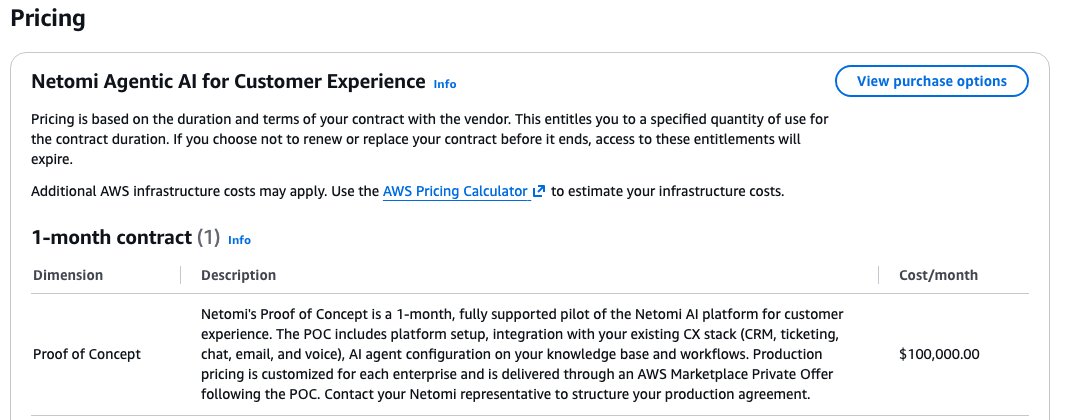
Netomi lists one public way to start: a one-month proof of concept on its AWS Marketplace listing. Netomi says the pilot covers platform setup, integration with your CRM, ticketing, chat, email and voice systems, and configuration of the agent on your knowledge base and workflows. Production pricing comes afterwards, in a private offer.
Netomi connects to booking engines, loyalty databases, CRM systems and payment systems, according to OpenAI's customer story on Netomi. Every tool call is checked against an OpenAPI contract before it runs. An OpenAPI contract is the written description of what a system accepts and returns, so somebody has to have one for each system the agent touches.
Netomi also works through Accenture, which led its latest funding round. Accenture's release says its people get access to Netomi's platform, with playbooks and training for large deployments. Netomi says Paramount went live across chat and voice in two weeks.
Algomo integrations
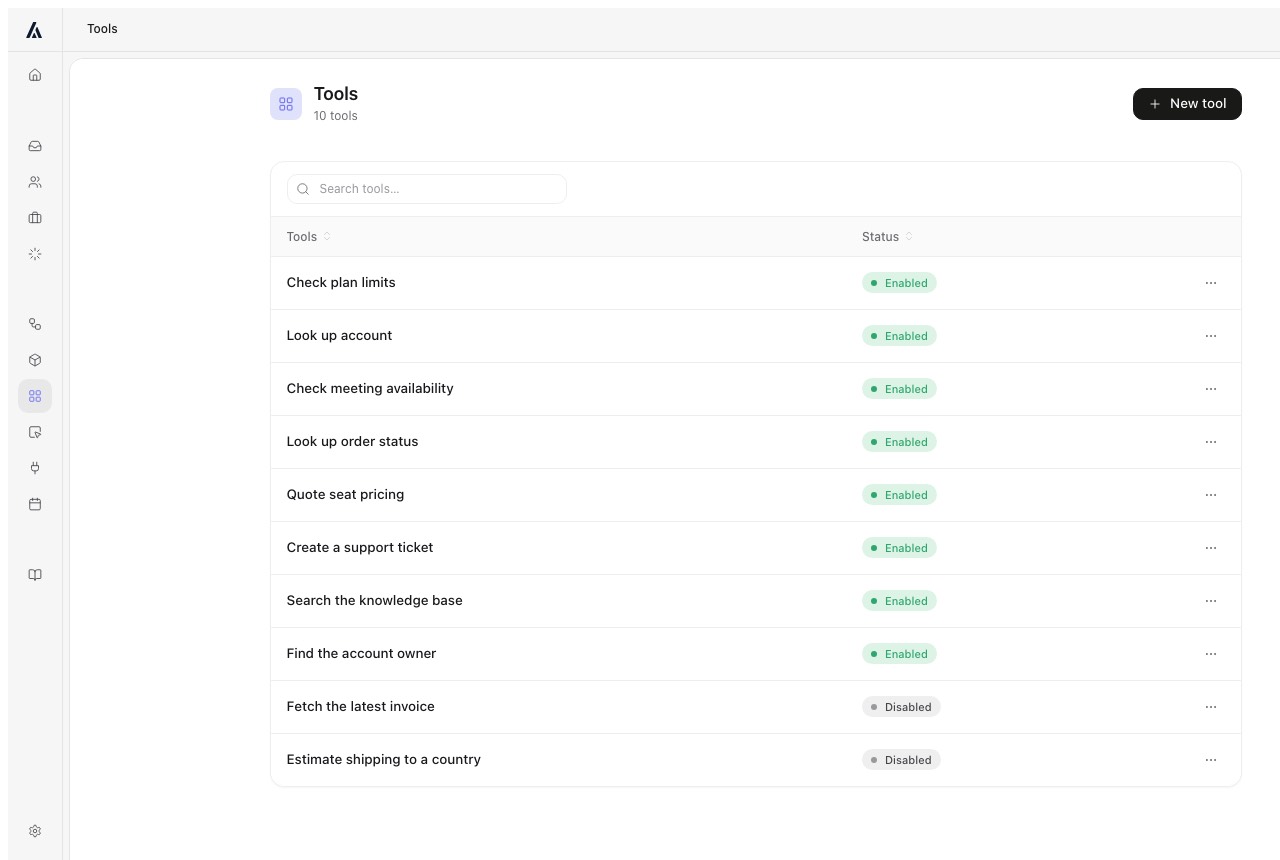
Algomo starts from your website. Point it at your site, and it records what your pages call: the stock check, the order lookup, the booking search. Those calls become the agent's tools. Algomo's AI deployment engineer does the discovery, the wiring and the upkeep, and your first version runs the same day.
This helps most where nobody has written an OpenAPI contract, or where the system is old, in-house or has no marketplace app. Algomo learns it from what your own pages already do with it. Systems only your staff can reach, such as a CRM or billing, use a connector from the Business plan. If a redesign breaks a connection, Algomo flags it so the mapping can be rebuilt.
You can see this on big brands' own systems in the demo library. The Blinds 2go demo prices three made-to-measure windows at once with the site's own price engine. The Nike demo reads live UK 9.5 stock and price from the store. The Qualtrics demo runs beside a chat Qualtrics built on Qualified, whose own site quotes 30 to 60 days to implement.
Getting to a first working agent
| Algomo | Netomi | |
|---|---|---|
| Who finds the systems behind your site | ✓ Algomo's AI, from the calls your pages make | Netomi's team, during the pilot |
| What each connection needs | ✓ Nothing more than the call your page already sends | A system with a described API, checked on every call |
| First version running | ✓ The same day | Inside the pilot month |
| Cost to find out if it works | ✓ Free plan, no card | $100,000 for the one-month pilot |
| Systems behind a staff login | A connector, from the Business plan | Integrated by Netomi, in the pilot |
Our take: before you sign a pilot, put Algomo on your site free and list which of your systems it found on its own, then ask Netomi which of those it would still need you to describe.
Will the AI repeat a policy you changed last week?
TL;DRNetomi answers from a knowledge base it configures for you and keeps aligned with sources such as SharePoint, while Algomo opens your live page while the customer waits, and a reviewed agent that contradicts your site earns you a free month.
Your prices, fees and policies change more often than anyone updates a help article. An AI that answers from a stored copy can be confidently wrong for days. For your team the cost is a complaint about something your website no longer says.
Netomi knowledge
Netomi configures the agent on your knowledge base and workflows during the pilot, its AWS listing says. For Microsoft customers, Netomi describes a feature called Continuous Knowledge Alignment, which pushes policy and knowledge updates from SharePoint into the agent.
Netomi's guardrails control what the agent may do. Specific steps can be locked to fixed rules, and the agent falls back to safe behaviour when it is unsure. Netomi's public pages do not say how knowledge taken from a website is refreshed, and its docs need a login. Ask how often the copy updates, and who triggers it.
Algomo agentic search
Algomo never keeps a copy of your website to answer from. It knows where your pages are, opens the right one when the question comes in, and answers from what that page says now, with the live data behind it. Edit a delivery fee in the morning, and the next answer quotes the new fee.
Stock, an order status or a rate comes through the same call your page makes, at the moment of the question. Algomo reviews an agent before it goes live, and if a reviewed agent ever contradicts your website, your next month is free. The terms are on the guarantee page.
Where an answer comes from
| Algomo | Netomi | |
|---|---|---|
| Your website's pages | ✓ Opened live for each question | Through the knowledge base Netomi configures |
| Documents in SharePoint | Read live when they are pages on your site | ✓ Pushed in by Continuous Knowledge Alignment |
| Live data such as stock or orders | ✓ The calls your pages already make | ✓ Connected systems, through checked tool calls |
| A promise about website accuracy | ✓ A free month if a reviewed agent contradicts the site | Not stated on Netomi's public pages |
Our take: change one fee on your site in the pilot week, ask the agent about it an hour later, and see which answer you get back.
What happened when we asked Netomi's AI on live sites?
TL;DROn 21 and 22 November 2026 we tried 92 websites linked to Netomi, found its AI answering on 15 of them, asked it 371 questions, got 244 correct answers, and confirmed wrong answers on 5 sites.
Many of Netomi's named customers run it inside an app, behind a login or by email, and on the web it often loads only on a help centre. In the first round, on 21 November, 7 of 25 public sites loaded the chat for a visitor with no account, and 5 answered. On 22 November we went back to every site that had not answered, opened their help pages, and searched the help centres of Paramount's brands, which each load the same Netomi chat. That round tried 67 more sites and found 10 more that answered. It stopped when public sources showed no more Netomi chats on the web.
We checked each answer against the site's own pages. An answer counted as wrong only when a second visitor with no cookies got the same wrong answer and no other page on the site backed it. Five sites gave such an answer: Best Price Mattress, Harry Rosen, FinalCut, Pluto TV's help centre and POLYWOOD's help centre. Harry Rosen and FinalCut, its off-price store, run one Netomi bot, and each gave a different wrong fact. On FinalCut the bot said yes to earning CLUB HARRY points there, while the CLUB HARRY FAQ says "you cannot earn and redeem points at Harry Rosen Outlet or shopfinalcut.com." On CompTIA, VH1, CBS Sports, SportsLine, 247Sports and four of the first round's sites, every answer we could check matched the site or declined to answer.
Best Price Mattress: how long a refund takes
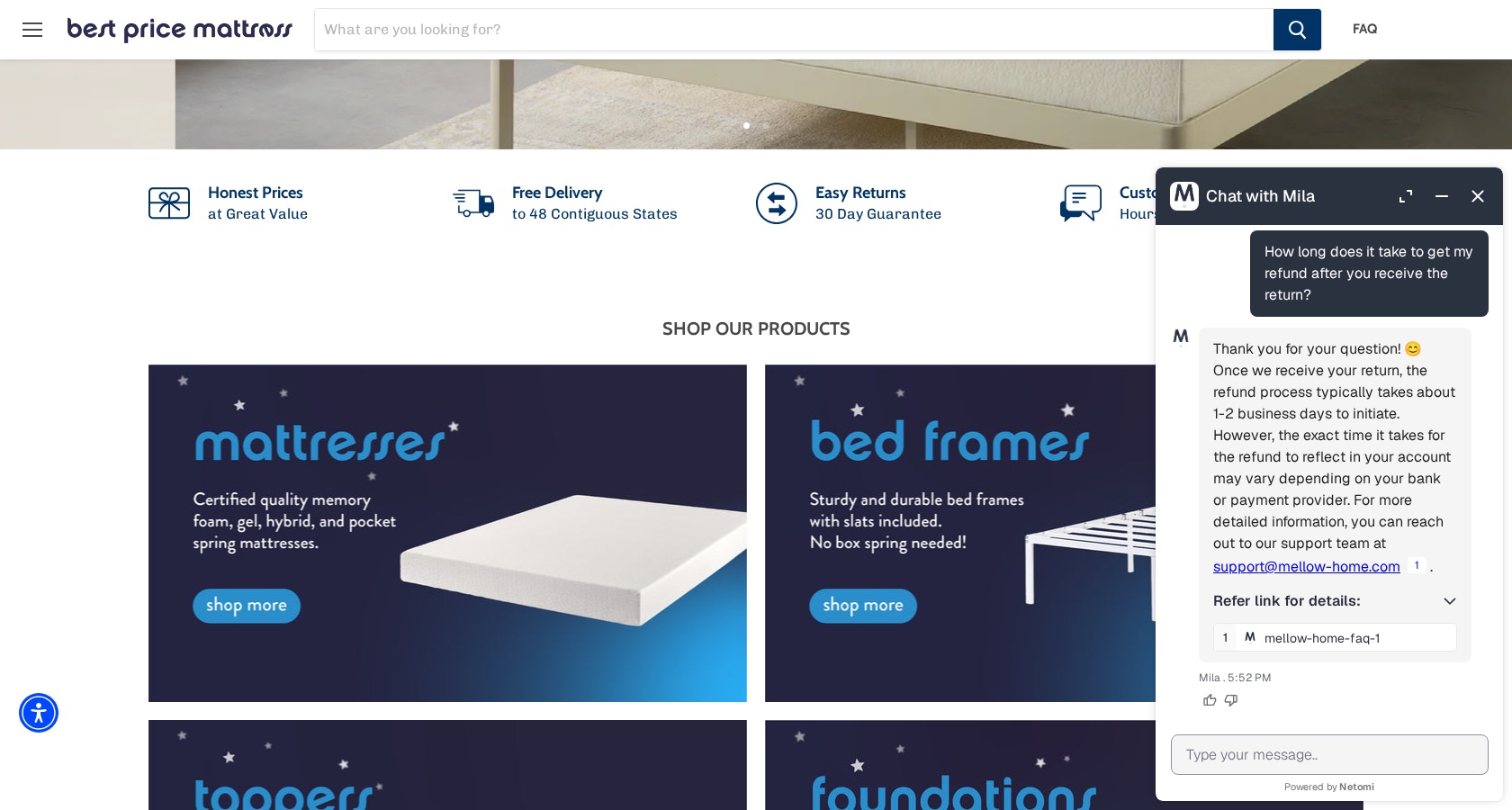
On 21 November 2026, we asked the chat on bpmatt.com: "How long does it take to get my refund after you receive the return?"
Netomi's AI, named Mila, said: "Once we receive your return, the refund process typically takes about 1-2 business days to initiate." A fresh visitor got the same 1-2 business days.
The refund policy page says: "Please allow one week after the returned item has been received and inspected for the refund to be processed." The parent company's refund policy prints the same line. The only 1-2 business days on either site is the time to process an order before it ships. The chat footer reads "Powered by Netomi".
Harry Rosen: last year's holiday return dates
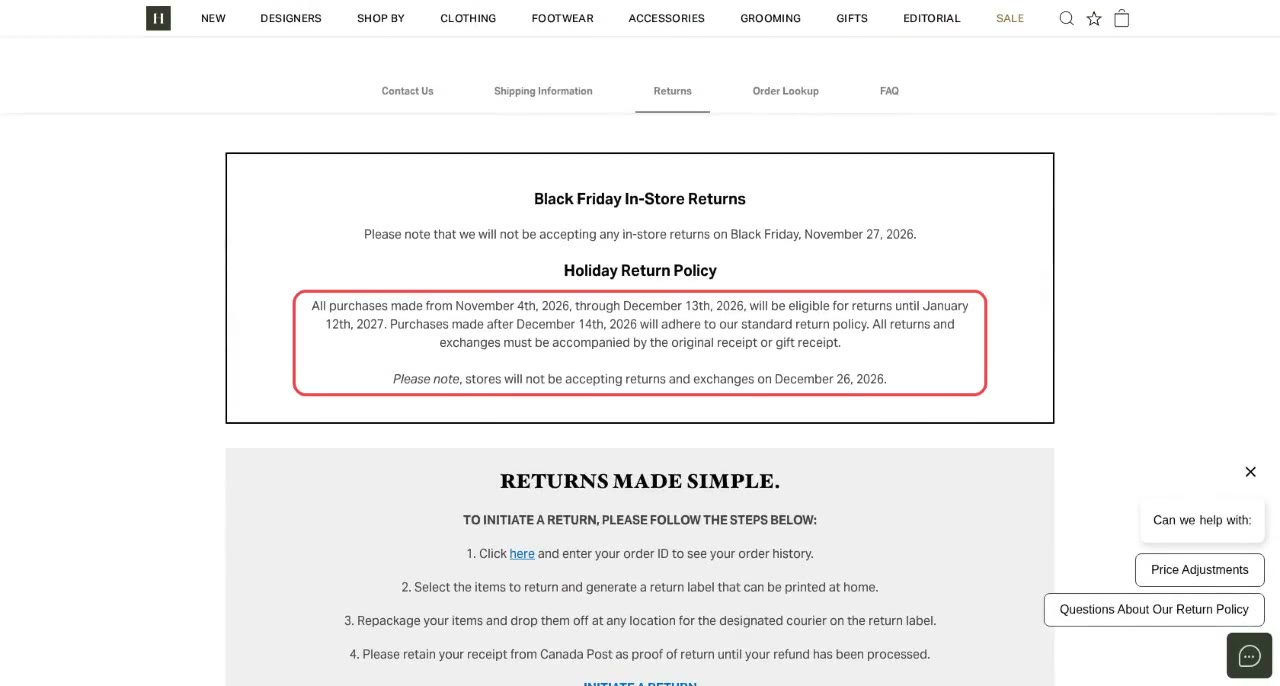
On 22 November 2026, we asked Harry's Assistant on harryrosen.com: "If I buy something online today, what is the last day I can return it?" It replied with a menu, and we pressed its "Holiday Return Policy" button. A fresh visitor asked: "What is your holiday return policy this year?"
Both visitors got the same words: "All purchases made at harryrosen.com between November 5th, 2025 through December 14th, 2025 are eligible for returns up until January 13th, 2026." The chat footer reads "Powered by Netomi".
The returns page says: "All purchases made from November 4th, 2026, through December 13th, 2026, will be eligible for returns until January 12th, 2027." None of the 32 service pages on the site gives a 2025 return window.
Pluto TV: PlayStation 5 in Canada
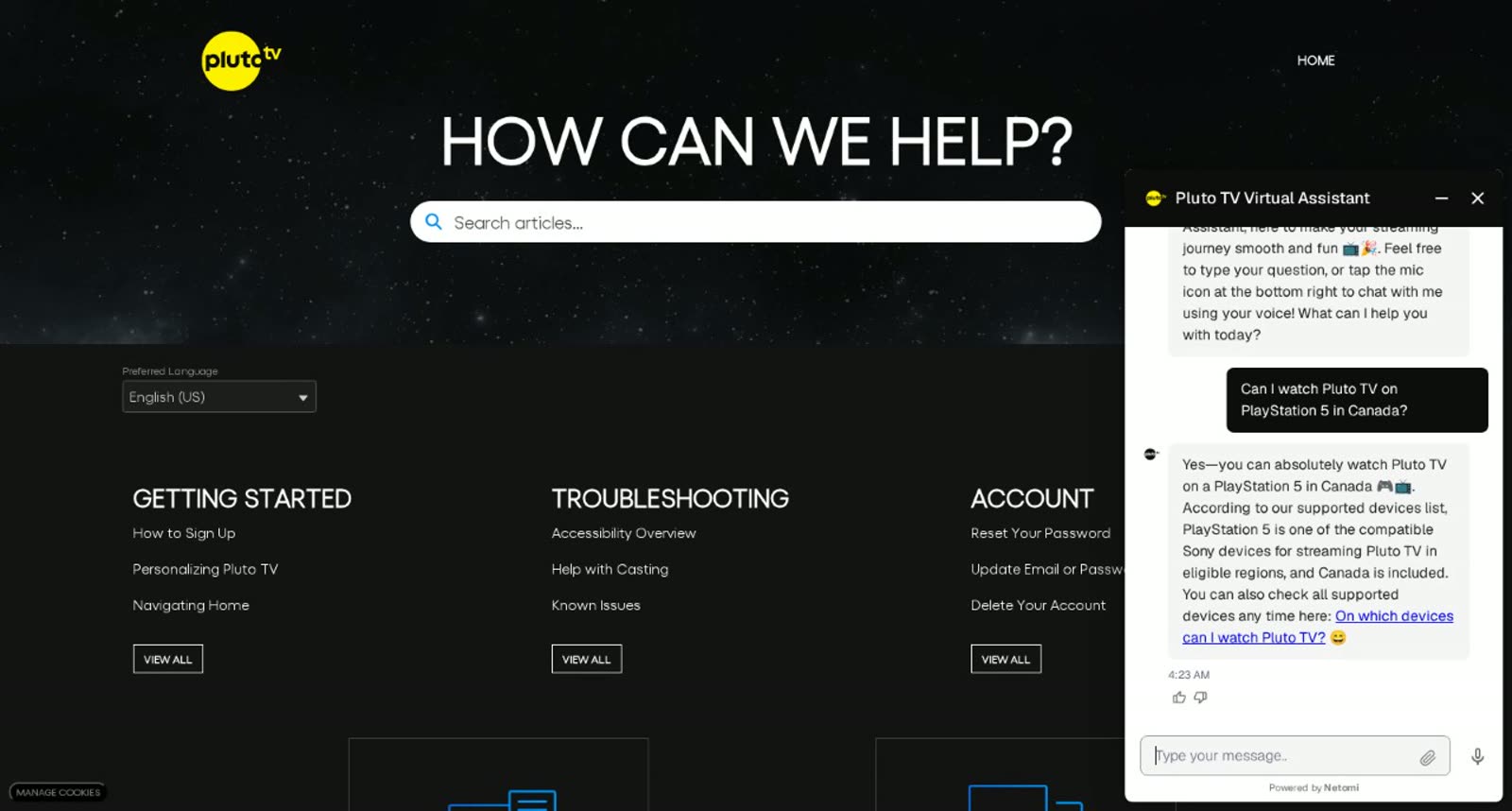
On 22 November 2026, we asked the Pluto TV Virtual Assistant on support.pluto.tv: "Can I watch Pluto TV on PlayStation 5 in Canada?"
It said: "Yes! You can absolutely watch Pluto TV on a PlayStation 5 in Canada." A fresh visitor got the same yes. The chat says it is "powered and provided by Netomi".
The help centre's device article lists Sony "PlayStation 4, PlayStation 5, Sony TV" under the heading "Available only in the United States". No language version of the article puts PlayStation in Canada. The same assistant told two visitors that Pluto TV lists no Rogers cable boxes, while that article names five Rogers models. It also gave two visitors February 26, 2025 as the date of the last privacy policy update, where the help centre says February 16, 2023.
POLYWOOD: the price of a dining set
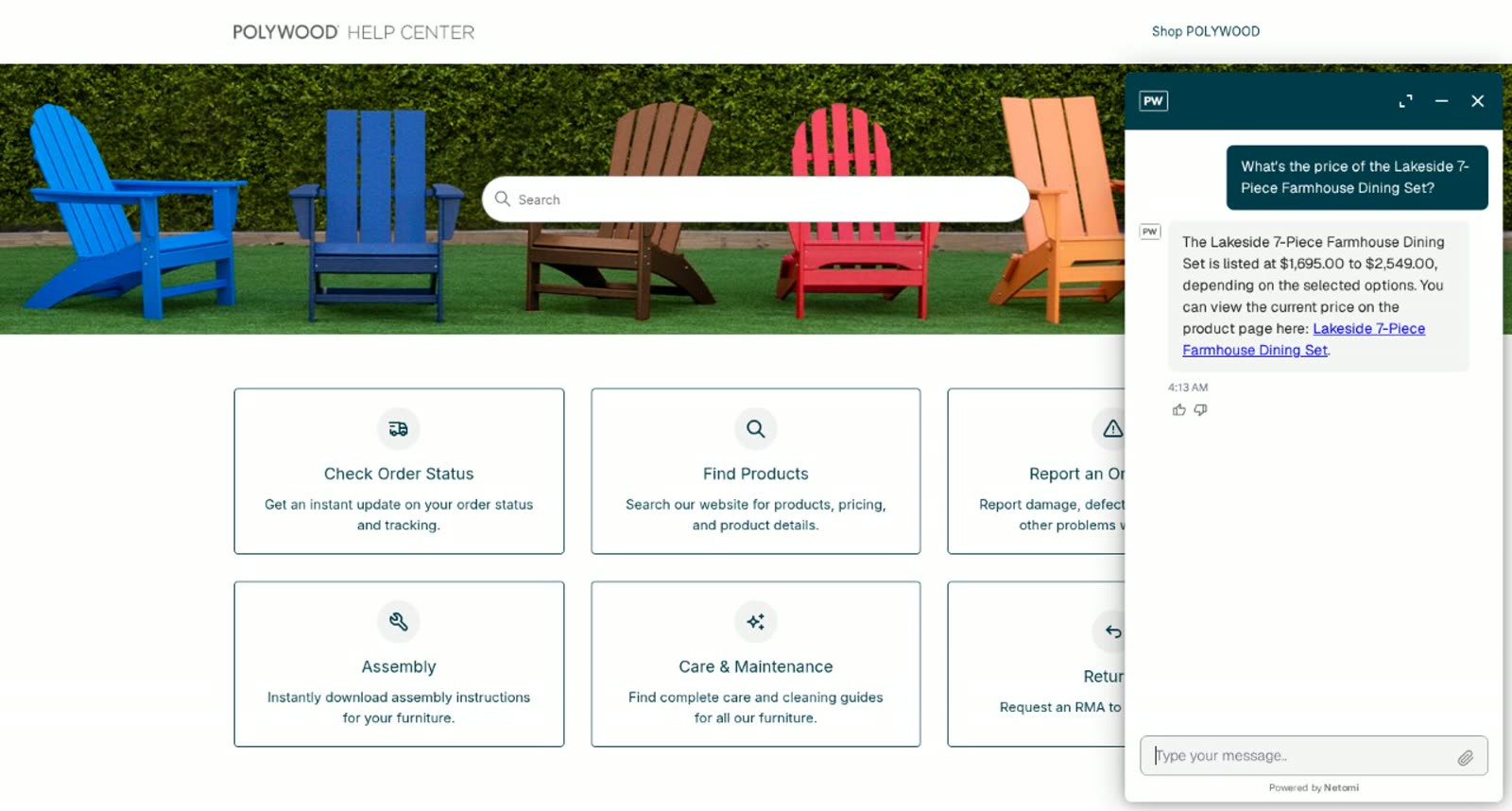
On 22 November 2026, we asked the chat on help.polywood.com, POLYWOOD's help centre: "What's the price of the Lakeside 7-Piece Farmhouse Dining Set?"
Netomi's AI said: "I'm seeing the Lakeside 7-Piece Farmhouse Dining Set listed at $1,695.00 to $2,549.00 (price varies by option)." A fresh visitor got the same range.
The product page on polywood.com shows "From $1,595.00" in its Black Friday sale, and none of the set's 13 options costs $1,695. Asked about the Modern Adirondack Chair, two visitors heard "$259.00 to $389.00". Its product page says "From $229.00", and its options run from $229 to $369.
We keep the full record behind every answer above: the transcript, a capture of the page at the time, the screenshots and the time stamps. If you work at Netomi or at a site named here and want that record, write to support@algomo.com.
Who changes the agent once it is live?
TL;DRNetomi gives your operations team a no-code Agentic Studio and an authority matrix that sets what the AI may do alone, while Algomo is changed from the coding assistant you already use, with each change staged and shown before it goes live.
A launch is the start of the work. Offers end, rules change and new products arrive every month. You want to know how many people and how many days each of those changes costs.
Netomi Agentic Studio
Netomi's AWS listing names a no-code Agentic Studio and an Agent Development Lifecycle, Netomi's process for building, testing and releasing an agent. VentureBeat describes an AI authority matrix. It sets which actions the AI may take on its own and when it must hand over to a person.
Changes are version-controlled, and Netomi keeps the metadata for seven years, according to the same report. Accenture's release adds that Accenture designs, implements and operates customer experience for large companies, so many Netomi clients will change the agent through a partner.
Algomo AI-first platform
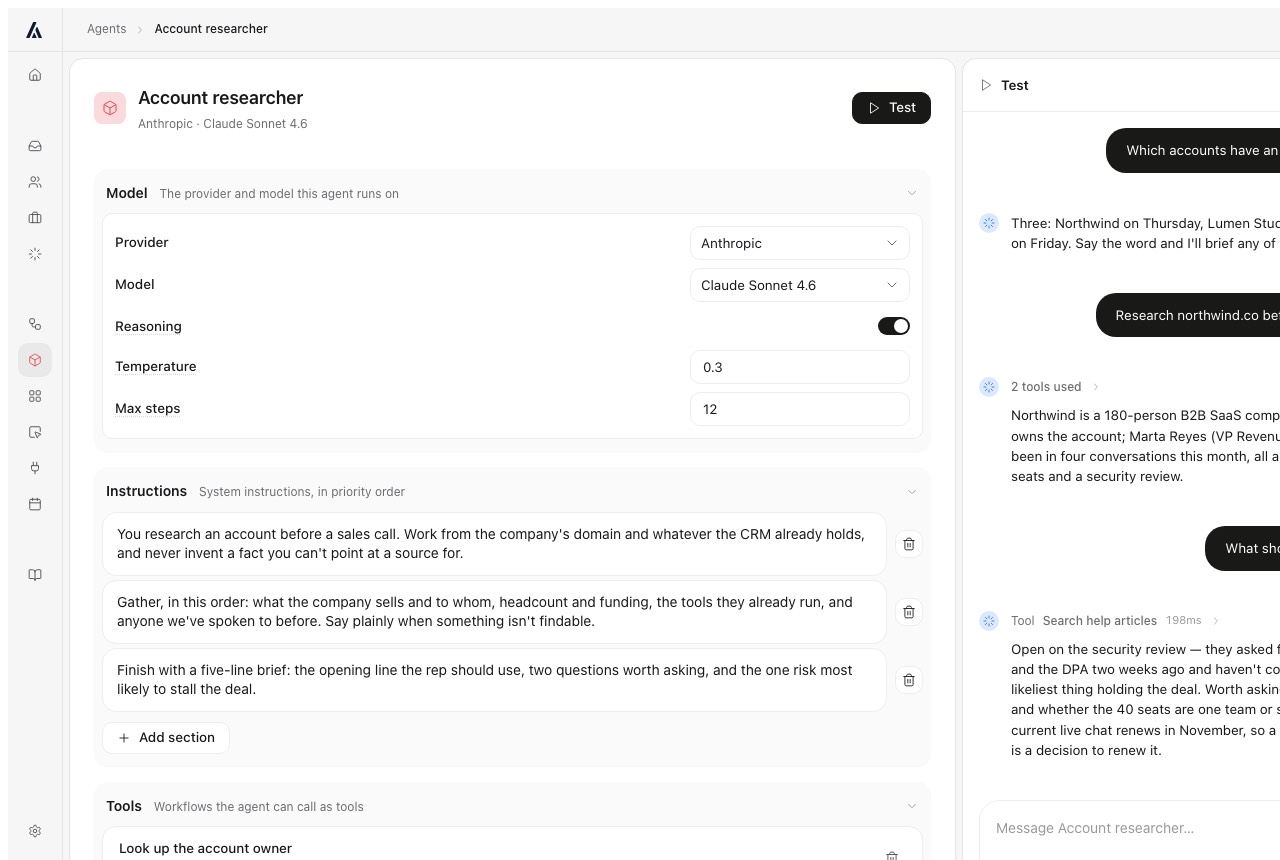
Algomo is operated from Claude Code, Codex, Cursor, ChatGPT or the Claude app, over MCP. MCP is the open protocol that lets one program operate another, so your assistant can read and change the agent for you. You describe what should change in a sentence, and the assistant builds the configuration.
Nothing goes live unseen. Each change is staged, you preview it on your own site, you read what changed, and only then do you ship it. Algomo keeps a history of every change and the reason for it.
Our take: take the last policy change your team made and ask each vendor who would make it, how long it would take, and what you would see before customers did.
What can the AI do for a visitor, not just tell them?
TL;DRNetomi takes actions across booking and CRM systems from the conversation, while Algomo works inside the visitor's own browser session on your site and can run any workflow you describe during or after the chat.
A customer who asks how to change a booking would rather have it changed. What the AI can do on its own decides whether your team still gets the ticket.
Netomi actions
Netomi acts in booking engines, loyalty systems and CRM systems, and runs steps across several systems at the same time, OpenAI's customer story says. Netomi's listing names a task planner for multi-step requests and two modes: Autopilot, where the AI acts alone, and Copilot, where a person approves.
Algomo co-navigation and workflows
Algomo's agent runs in the visitor's browser, on your page, in the session that browser already has. It can filter a list, apply a code, add an item to the basket, open the right page or check that visitor's own order. The visitor watches each step happen, and the agent sees only what that visitor may see.
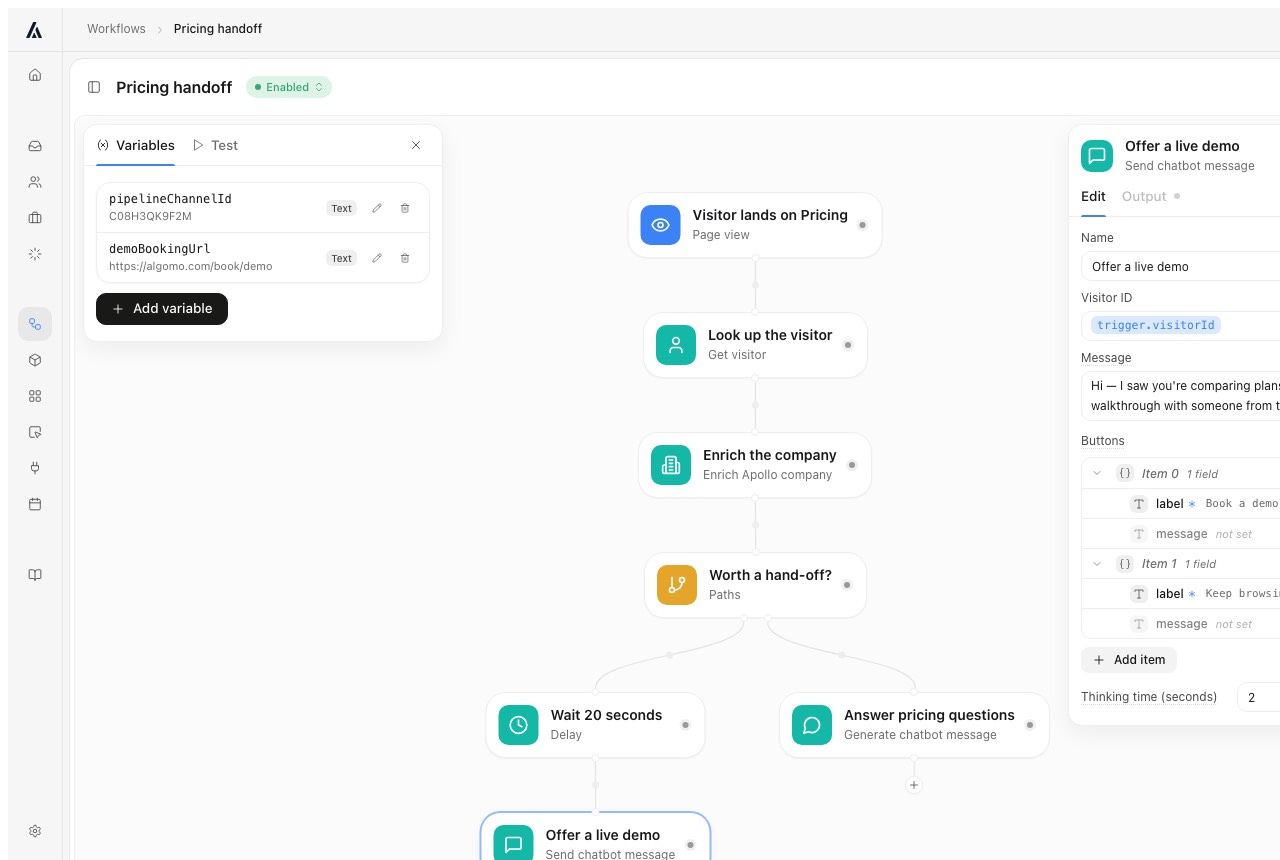
Behind the chat runs a workflow engine. It can send a two-factor code before showing account details, alert a manager in Slack, apply your routing rules, or research a company in the background and email your salesperson a memo. You can also describe a quote calculator or booking panel to your coding assistant, and it appears inside the chat as a widget.
Our take: ask each agent to do one real task on your site, such as adding a specific item to the basket, and note whether it does it or explains how.
Netomi channels
Netomi lists chat, voice, email, SMS and social channels, and integrates with Amazon Connect, Salesforce and Zendesk. Coach also runs it in a flagship store. One platform serves every channel.
Algomo channels
Algomo answers in chat on your website and can send a follow-up email to a visitor who left. It does not answer phone calls or incoming email.
Our take: if phone and SMS carry most of your volume, Netomi covers them and Algomo does not, so count last month's contacts by channel first.
How do you check its work and hand over to a person?
TL;DRNetomi logs token traces, reasoning steps and tool chains and can run with a person approving each action, while Algomo logs every tool call behind every answer and lets you test on your live site before any code goes on it.
Sooner or later the AI will give an answer your team disagrees with. You need to see why, fast, and you need a person to step in without the customer repeating themselves.
Netomi oversight
OpenAI's customer story lists Netomi's runtime observability: token traces, reasoning steps and tool-chain logs. In Copilot mode a person approves what the AI proposes. The authority matrix decides when a conversation must go to a person, and Netomi's listing names a Hypercare period after launch.
Algomo testing and handover
Algomo's browser extension previews the agent on your live site before you add any code. Testing uses its own credit allowance, 200 a month on Free and 1,000 on Business. After launch, every answer records the tools it called, with inputs, outputs, time and cost.
Handover follows rules you set: a topic, a page, or the visitor asking for a person. The right person is told by email and Slack and joins the live conversation with the transcript. With a connector, Algomo can open a ticket in your helpdesk instead.
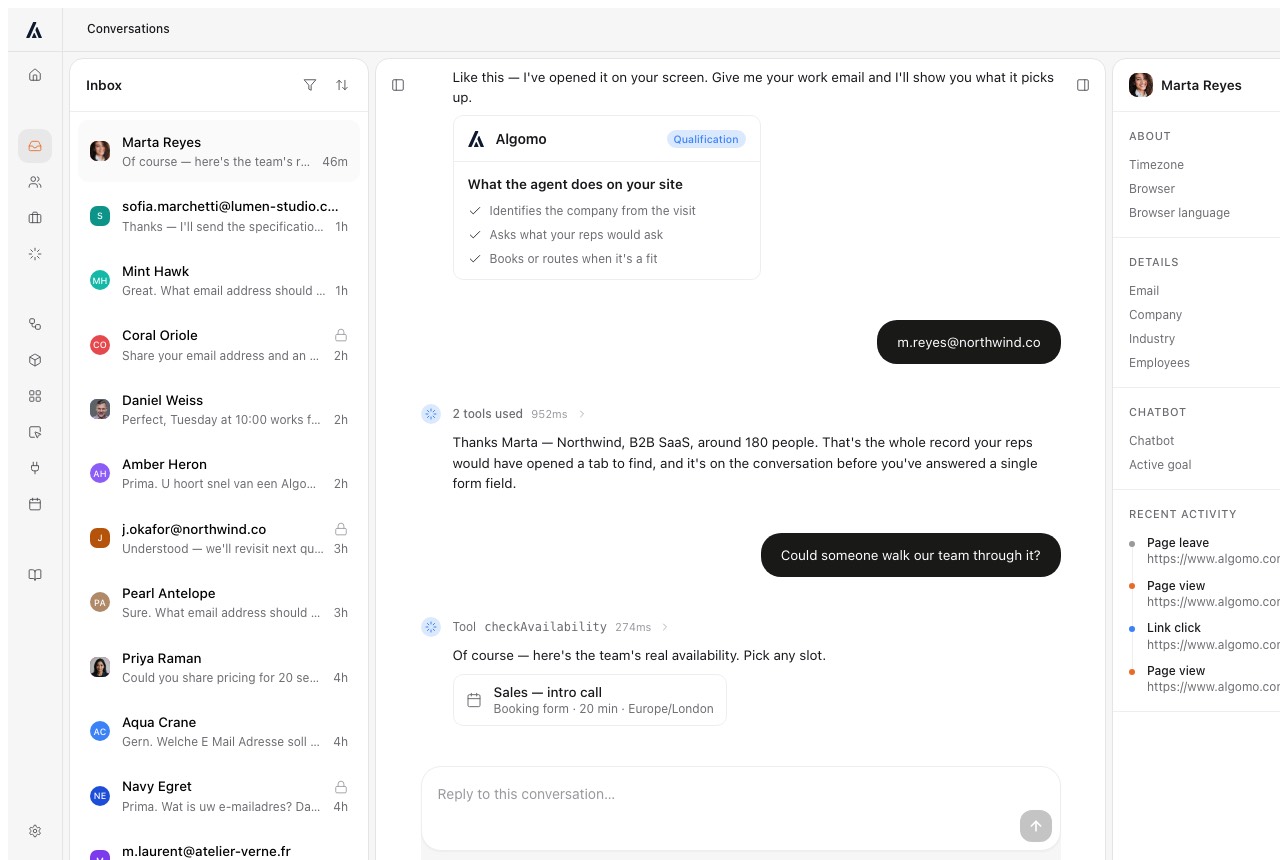
Our take: ask each vendor to open one finished conversation and show you every call behind one answer.
What does each one hold, and who audited it?
TL;DRNetomi lists SOC 2 Type II, ISO 27001, HIPAA and PCI DSS and can run inside your own Azure environment, while Algomo's agent works from the visitor's browser and stores no credential for anything your website already does.
An agent that changes bookings or reads accounts needs access. Your security team will ask what the vendor stores to get it, and which audits back the answer.
Netomi security
Netomi's security page lists SOC 2 Type II, ISO 27001, GDPR, CCPA, PDPA, HIPAA and PCI DSS. Its security and governance documents are shared with customers and active evaluations under NDA, through your Netomi representative.
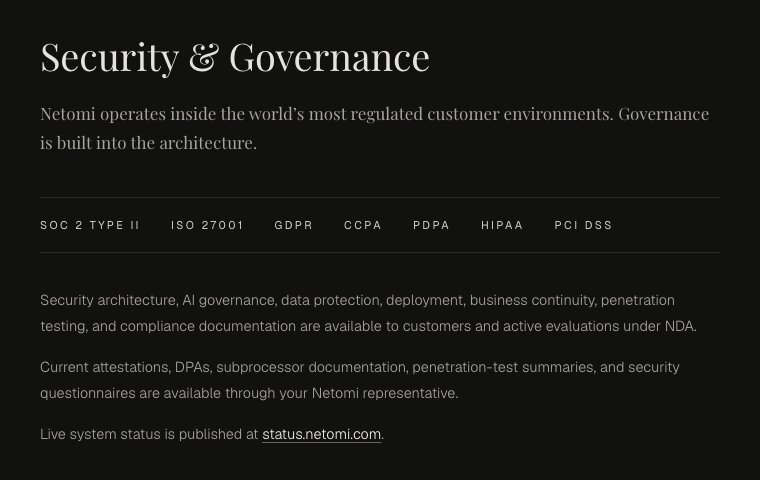
For Microsoft customers, Netomi can host its agents on Azure inside your own security perimeter, Netomi's June 2026 release says. Every tool call is validated against its contract before it runs, and personal data is masked.
Algomo security
Algomo's agent runs in the visitor's browser, on your page. When it checks a price, stock or that visitor's order, the request leaves that browser exactly as your page would send it. Algomo receives and stores no token or credential for any of that.
A system only your staff can reach is different. Its connector holds a login, encrypted with AES-256-GCM, and you can revoke it at any time. Algomo is certified to Cyber Essentials, registered with the ICO, works to UK and EU GDPR, the EU AI Act and DORA, and hosts its data in the EU. The compliance page has the detail.
Our take: ask each vendor to list every secret it would hold for your systems, and where it keeps them.
How much does Netomi cost compared with Algomo?
TL;DRNetomi publishes no price list, its own AWS listing prices a one-month pilot at $100,000, and Vendr's buyer data puts the median contract at $85,000 a year, while 5,000 helped conversations a month on Algomo fit the $600 plan.
Your finance team will want two numbers: what it costs to find out if the agent works, and what a normal year costs after that.
How Netomi charges
Netomi has no pricing page, and netomi.com says new engagements are by referral. The one public price is on Netomi's AWS listing: a one-month proof of concept for $100,000. Production pricing is set per company afterwards.
Netomi's master services agreement sets fees in each order form. The contract renews automatically unless either side gives 30 days' notice, and a renewed term is billed at Netomi's then-current list price.
Vendr, which collects contract data from software buyers, estimates that the median Netomi buyer pays $85,000 a year, in a range of $77,500 to $103,000. Vendr's page does not say how many contracts that covers. It is Vendr's estimate, not a Netomi price, and it may not include a pilot.
How Algomo charges
Algomo's free plan gives 100 credits a month, about twenty helped conversations, with no card. After that you choose one monthly amount, from $50 for 2,000 credits up to $4,300 for 200,000. A conversation that helped someone costs 5 credits, plus 5 for every further ten replies, and spam costs nothing.
There are no seats. The amount you pick is the most you can be charged, unused credits roll over, and the agent pauses if they run out.
The sum for one year. Say 5,000 conversations a month are helped. That is 25,000 credits, which is exactly the $600 plan, so $7,200 a year. The same volume at Vendr's median Netomi figure is $85,000 a year, before any pilot. The two buy different things: Netomi's figure covers phones, messaging and a vendor team, and Algomo's covers the agent on your website.
Our take: ask Netomi for the production price at your real volume before the pilot starts, and run Algomo free on your site during the same weeks.
What to ask any vendor selling you an AI agent
TL;DRFive questions, each with something to try in the meeting.
- Who connects the agent to our booking or order system, and by when? Ask for a date in writing.
- When a page on our site changes, when does the agent's answer change? Edit one and time it.
- What does it cost to find out whether it works on our site? Ask for the number before the demo ends.
- Can it complete a task for the customer, not only describe it? Give it one real task.
- Can we see every call behind one answer? Pick an answer and ask.
Ask for every test on your own site and data.
Which one should your team choose?
Choose Netomi if
- Most of your contacts arrive by phone, SMS or social messaging, at contact-centre volume.
- You want a vendor or a consulting partner to integrate and run the agent for you.
- Your security review needs SOC 2 Type II, ISO 27001 or PCI DSS from the vendor.
- You want the agent hosted inside your own Azure environment.
Don't choose Netomi if
- Your customers' questions start on your website, about products, prices, orders or bookings.
- You want to see the agent working on your own site before you sign anything.
- A $100,000 pilot month is more than the project can carry.
- Answers must follow the live page the moment it changes.
- You want one monthly amount you set, with no seats and no contract to renew.
Conclusion
TL;DRPick Netomi when you need one vendor-run AI across a large contact centre's phones and messaging, and pick Algomo when your customers are on your website and you want the integration done by AI and every answer read from the live page.
On the integration, Netomi's team does the work inside a paid pilot month. Algomo's AI connects itself to what your pages already call, and your first version runs the same day.
On the answers, Netomi works from the knowledge base it configures. Algomo reads the live page every time and backs that with a free month. Building, actions, channels and price follow from those two choices.
Questions buyers ask about Algomo and Netomi
How much does Netomi cost?
Netomi publishes no price list. Its own AWS Marketplace listing offers a one-month proof of concept for $100,000, with production pricing set per company afterwards. Vendr's buyer data estimates a median of $85,000 a year, from $77,500 to $103,000, which is Vendr's estimate and not Netomi's price. Algomo starts free, then costs one monthly amount from $50 to $4,300.
Who owns Netomi?
Netomi, legally AI Netomi, Inc., is independent and venture-backed. In April 2026 it raised $110 million in a round led by Accenture Ventures, with Adobe Ventures, WndrCo and others, and Accenture formed an alliance to deploy it. We found no sale of the company. Netomi was founded in 2016 as msg.ai.
Is Algomo a good Netomi alternative?
Yes, when your customers' questions arrive on your website. Algomo connects itself to the systems your pages call, answers from the live page, and starts free with no referral. If most of your volume is phone, SMS or social messaging, Netomi covers those channels and Algomo does not.
Can I try Netomi without a sales process?
Not on its public pages. netomi.com says new engagements are by referral, the docs need a login, and the public way to start is the $100,000 pilot on Netomi's AWS listing. Algomo's free plan needs no card, and you can preview the agent on your own site from its browser extension.
Does Netomi answer phone calls?
Yes. Netomi lists chat, voice, email, SMS and social channels, and integrates with Amazon Connect. Algomo answers in chat on your website and does not take phone calls or incoming email.
Which AI models do Netomi and Algomo use?
OpenAI's customer story says Netomi uses GPT-4.1 for fast reasoning and tool calls and GPT-5.2 for longer planning, and Netomi's listing describes multi-model orchestration. Algomo's default model is from OpenAI, and on the Enterprise plan you choose the provider.
Where these facts come from
All the information on this page was available in November 2026. The sources are:
- Netomi's home page: the customer logos and the referral line.
- Netomi's security page: the certificate list and the NDA note.
- Netomi's AWS Marketplace listing: the $100,000 pilot, what it includes, the channels, the integrations, the modes and the Agentic Studio.
- Netomi's master services agreement: order forms, renewal and notice.
- OpenAI's customer story on Netomi: the models, the connected systems, the tool-call checks, the logs and the DraftKings figures.
- Accenture's release on its Netomi investment: the alliance and the channels.
- SiliconANGLE's funding report: the $110 million round, its investors and Netomi's history.
- VentureBeat's funding report: the authority matrix, the seven years of metadata, Paramount and Coach.
- Netomi's Azure release, as reprinted by destinationCRM: hosting on Azure, Dynamics 365 and SharePoint.
- Vendr's Netomi page: the buyer-data estimate.
- Algomo's pricing page, Algomo's product page, the compliance page, the data processing agreement and the guarantee page.
- The demo library, for the Blinds 2go demo, the Nike demo and the Qualtrics demo.