Summarize withChatGPTPerplexityClaudeGrokAlgomo vs Maven AGI
TL;DRCompanies hold back on AI agents for two reasons, the integration work and wrong answers, and Maven AGI gives your team an app directory and an action builder and answers from knowledge it imports and recrawls, while Algomo's AI wires itself to what your pages call on the first day and reads the live page, with a free month if a reviewed agent contradicts your site.
A word on names. Maven calls the AI the agent, and so does this page. The people who take over a conversation are your team.
Algomo vs Maven AGI at a glance
| Algomo | Maven AGI | |
|---|---|---|
| Main job | An AI agent for your website, for support and inbound sales, with an inbox your team takes over from. | An enterprise AI agent platform for support and the wider customer journey, on chat, email, voice and messaging. |
| Who does the integration | Algomo's AI, from the calls your pages already make. | Your team installs apps and defines actions in Agent Designer. Unlisted systems need a custom app, built by you or by Maven. |
| Where the answers come from | The live page and its live data, read for each question. | A knowledge layer imported from your help desk, files and URLs. Websites come in through a crawler on a daily, weekly or monthly schedule. |
| Time to go live | A first version the same day. | One to two weeks typically, four to six for complex deployments, in Maven's own words. |
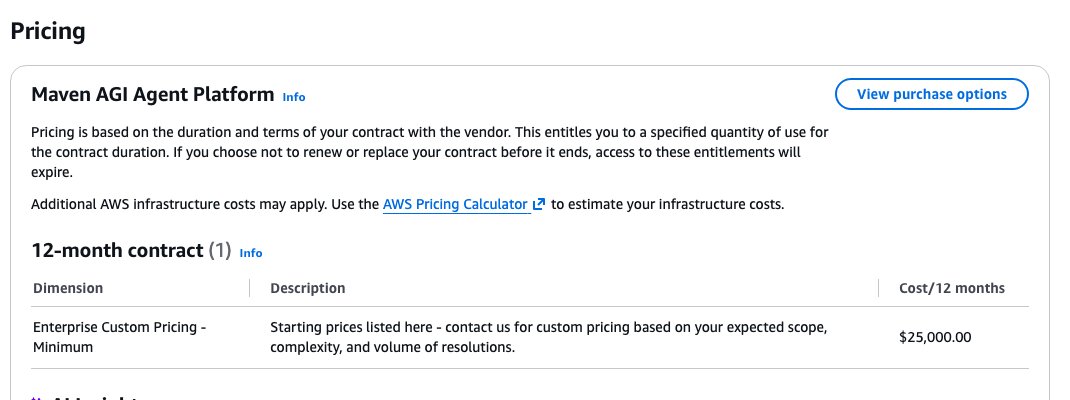
| Published pricing | Free plan, then one monthly amount from $50 to $4,300. | No price list. A $25,000 a year minimum on Maven's AWS listing, priced by resolution volume. |
| Not a fit for | A team whose customers mostly phone or email. | A small team that wants to try an agent before a contract. |
| Biggest limitation | Does not answer phone calls or incoming email. | Website answers come from a crawled copy, and the price starts at a yearly minimum. |
What part of Maven AGI do you need?
TL;DRMaven AGI fits a support organisation that wants one agent across its help desk, phone lines and messaging apps, and Algomo fits a team whose customers ask on the website and who wants answers read from the page itself.
Maven names ClickUp, Tripadvisor, Clio and Rho among its customers, and says it powers more than 90 companies. Before reading on, find the line that sounds like your team:
- Most contacts arrive by phone, email, WhatsApp or inside your help desk: Maven AGI.
- Most questions arrive on your website, about products, prices, orders or bookings: Algomo.
- You want an AI copilot for your own staff inside Zendesk or Salesforce: Maven AGI.
- Your site runs on a system nobody has written an app for: Algomo, which learns it from your pages.
We take the two risks first, then building, sales, actions, channels, testing, security and price.
How much of the integration is left to your team?
TL;DRMaven AGI gives your team more than 100 integrations to install and an action builder for everything else, while Algomo's AI discovers the systems your website already uses and connects to them itself, with a first version the same day.
Your website already knows how to check stock, find an order or search for a slot. The agent needs the same reach before it can resolve anything. What you are really comparing is how much of that reach your engineers have to build.
Maven AGI integrations
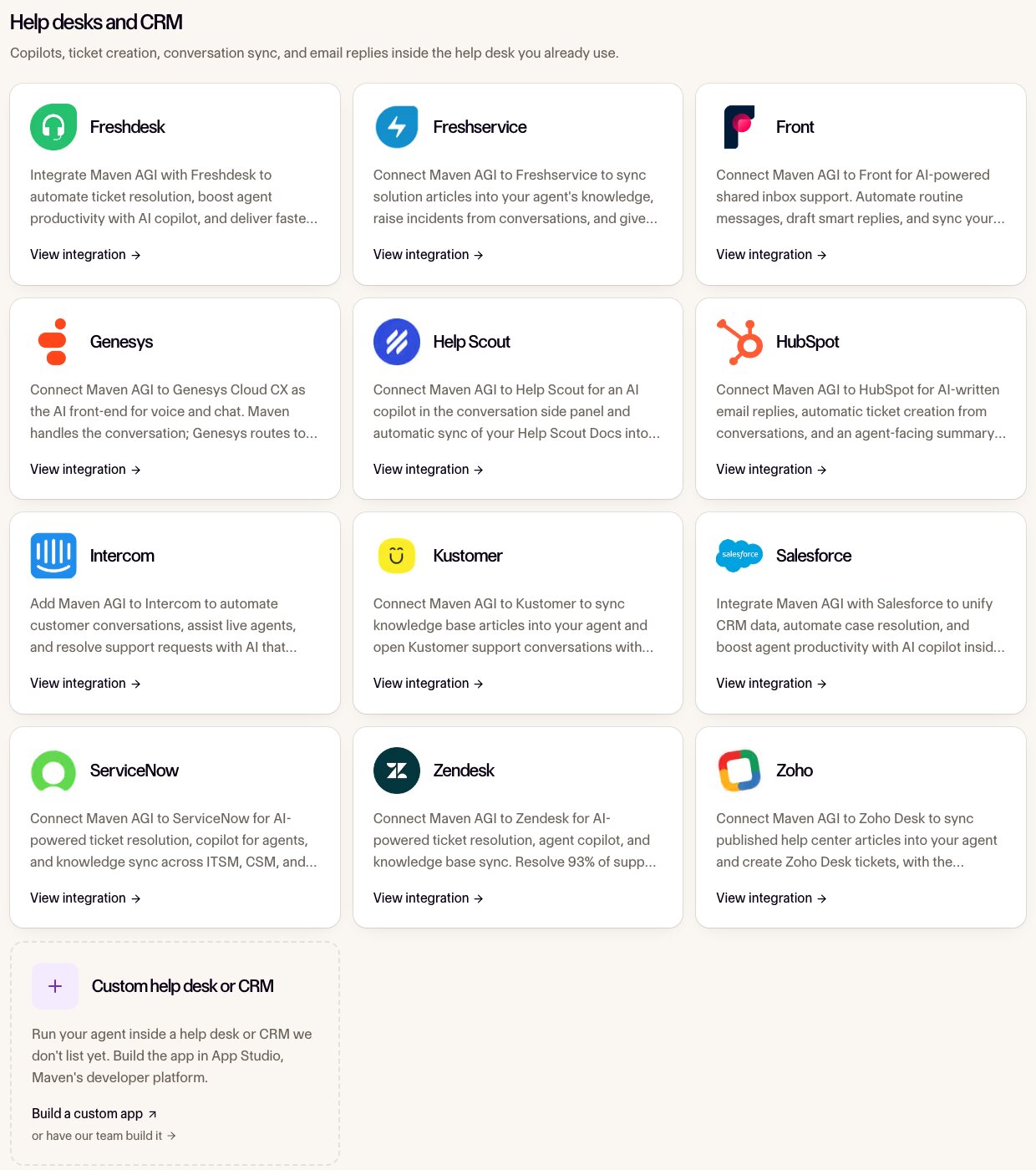
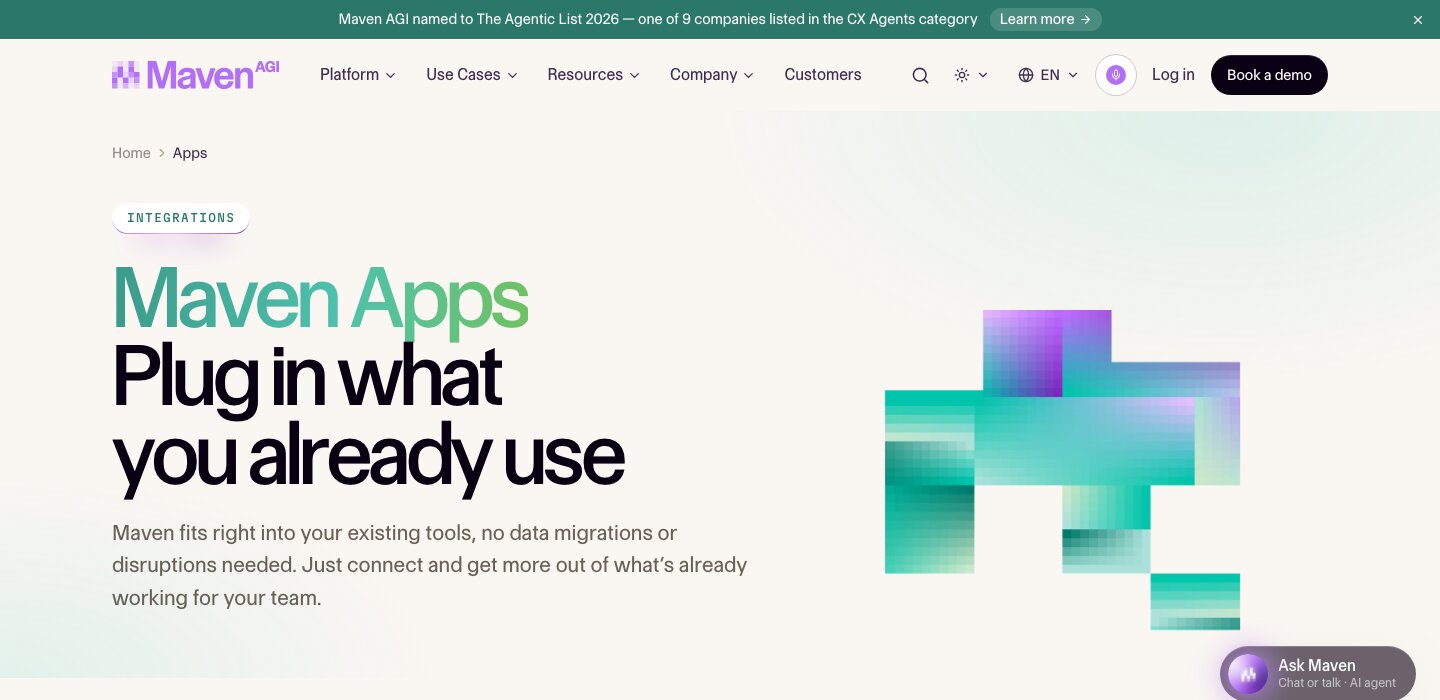
Maven connects through Maven Apps, a directory of help desks, CRMs, knowledge sources and channels. Its Series B post counts more than 100 out-of-the-box integrations. A help desk or CRM that Maven does not list needs a custom app built in App Studio, Maven's developer platform, by your developers or by Maven's team.
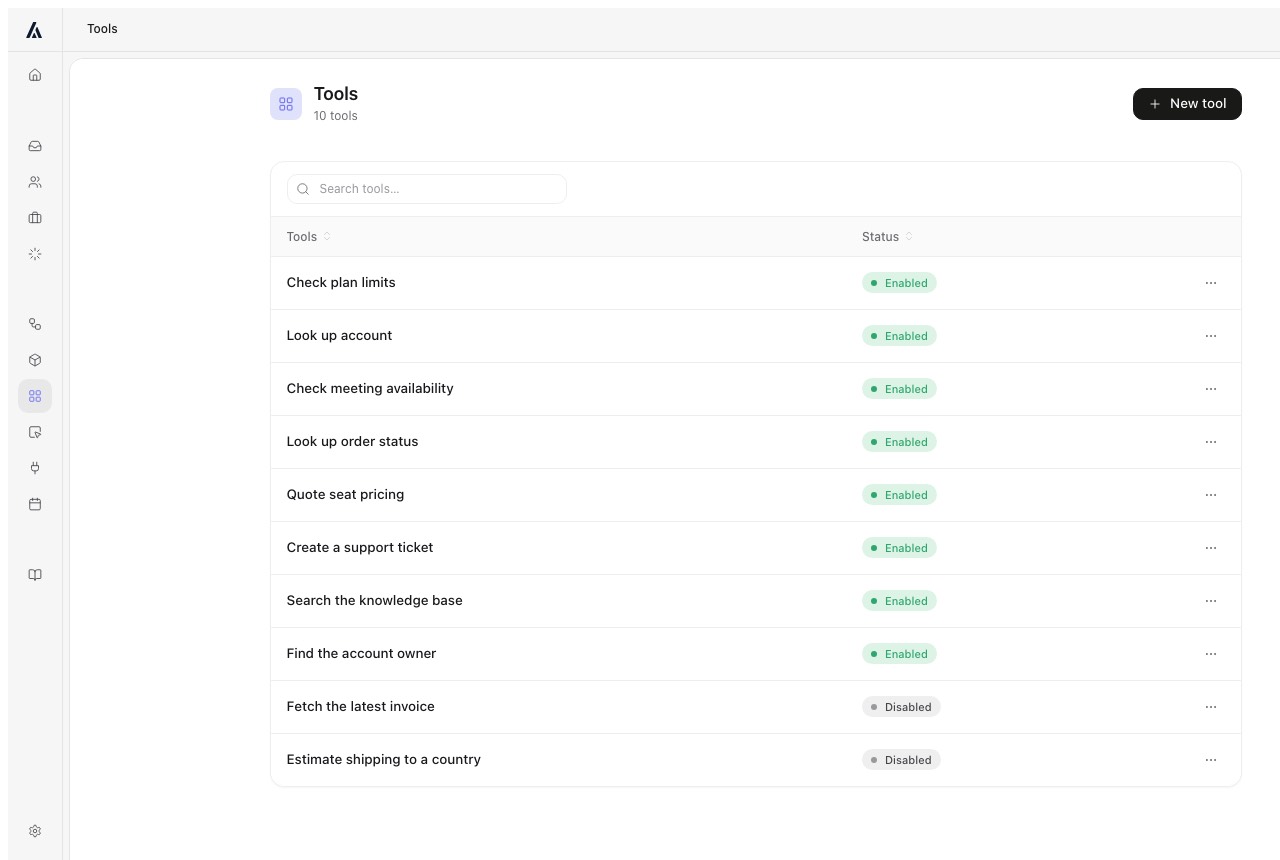
Actions are how the agent reads or changes data in your systems, such as an order lookup or a refund. Your team creates them in the Capabilities area of Agent Designer or installs them with an app. Each action calls an API in your CRM, billing or order system, and can run on behalf of a logged-in user. An MCP app turns the tools on any remote MCP server into actions.
Maven's glossary says customers typically have the knowledge loaded and the agent working within one to two weeks. Deployments with custom integrations typically take four to six weeks. Maven says K1x went live in one week.
Algomo integrations
Algomo does not wait for an API description. Give it your website and it records what your pages call: the stock check, the order lookup, the booking search. Those calls become the agent's tools. Algomo's AI deployment engineer does the discovery, the wiring and the upkeep, and the first version runs the same day.
The gap widens where your stack is unusual, such as an in-house booking engine or an older ERP with no app in anyone's directory. Algomo learns it from what your site already does. A system only your staff can reach uses a connector, from the Business plan. If a redesign breaks a connection, Algomo flags it so the mapping can be rebuilt.
The demo library shows this on brands' own systems with no project on their side. The Blinds 2go demo quotes three made-to-measure blinds in one card using the site's own price engine. The Nike demo reads the live price and UK 9.5 stock. The Qualtrics demo runs next to the chat Qualtrics built on Qualified, where implementation is quoted at 30 to 60 days.
From signature to a working agent
| Algomo | Maven AGI | |
|---|---|---|
| A system with an app in the directory | ✓ Connected by Algomo's AI from your pages | ✓ Installed from Maven Apps |
| A system with no app | ✓ Learned from the calls your pages make | A custom app in App Studio, built by your team or Maven's |
| Who defines each action | ✓ Algomo's AI, from what the page already does | Your team, in Capabilities |
| First version running | ✓ The same day | One to two weeks typically, four to six if complex |
| Systems behind a staff login | A connector, from the Business plan | ✓ Apps and authenticated actions |
Our take: write down the three systems your website depends on, check which have an app in Maven's directory, and run Algomo free on your site to see which it connects to by itself.
Does the agent read your website, or a copy of it?
TL;DRMaven AGI imports your knowledge into its Graph of Record and recrawls websites daily, weekly or monthly, while Algomo opens the live page for each question, and a reviewed agent that contradicts your site makes your next month free.
A price, a cut-off time or a returns rule can change on your site in a minute. Any copy of that page is out of date until it is refreshed. Your team then fields the complaint about an answer your website no longer gives.
Maven AGI knowledge
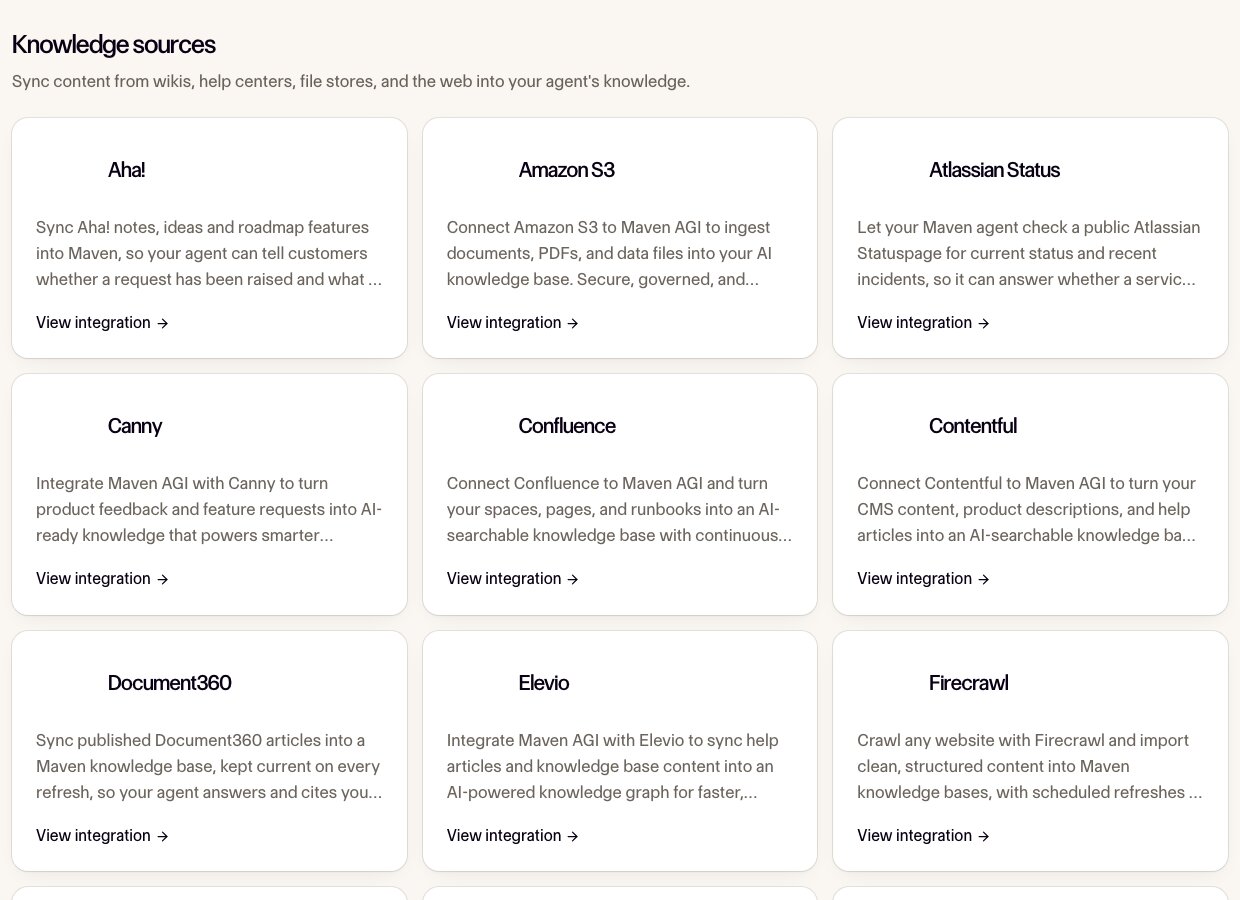
Maven builds a knowledge layer it calls the Graph of Record. It imports content from Salesforce, Zendesk, Freshdesk, documents, spreadsheets and URLs, and normalises it into one structure. Maven's Inbox then flags gaps, conflicts, duplicates and outdated content, and drafts fixes for your team to approve.
Website content arrives through the Firecrawl app. It crawls the pages you choose, turns them into text, and recrawls them daily, weekly or monthly, or when you ask. Each crawl publishes a new version of that knowledge base. Between crawls, the agent answers from the last version.
Live data is a separate path. An action can read an order or a record in your systems while the customer waits, and an Airtable app reads tables live.
Algomo agentic search
Algomo keeps no copy of your site to answer from. It knows where your pages are, opens the one that answers the question as it arrives, and reads what it says at that moment, with the live data behind it. Change your returns window at noon, and the agent quotes the new window at one minute past.
There is no crawl schedule to pick, because nothing is stored to go stale. Algomo reviews an agent before launch, and if a reviewed agent ever contradicts your website, your next month is free. The guarantee page has the terms.
How current each answer is
| Algomo | Maven AGI | |
|---|---|---|
| Your website's pages | ✓ Read live for each question | A crawled copy, refreshed on a schedule |
| Help desk articles and documents | ✓ Read live as pages on your site | ✓ Imported and synced into the Graph of Record |
| Live records such as orders | ✓ The calls your pages already make | ✓ Actions your team defines |
| Spotting outdated content | ✓ Nothing stored to go out of date | ✓ Inbox flags it and drafts a fix |
| A promise tied to your website | ✓ A free month if a reviewed agent contradicts it | Not stated on Maven's public pages |
Our take: change a price on a page Maven has crawled, ask both agents before the next scheduled crawl, and keep the one that quotes the new price.
In November 2026 we tried Maven AGI on 28 sites and found no confirmed wrong answer. Only 3 of them, all help centres, showed its chat to an anonymous visitor, and there it answered 38 of our 40 questions correctly.
Where do you change the agent, and how safely?
TL;DRMaven AGI gives operations teams Agent Designer, where a change is tested against simulated conversations before release, while Algomo is changed from your coding assistant over MCP, with each change staged and previewed on your own site.
An agent gets edited every week once it is live. A new offer, a holiday cut-off, a rule with an exception. You want each edit to be quick for your team and impossible to ship by accident.
Maven AGI Agent Designer
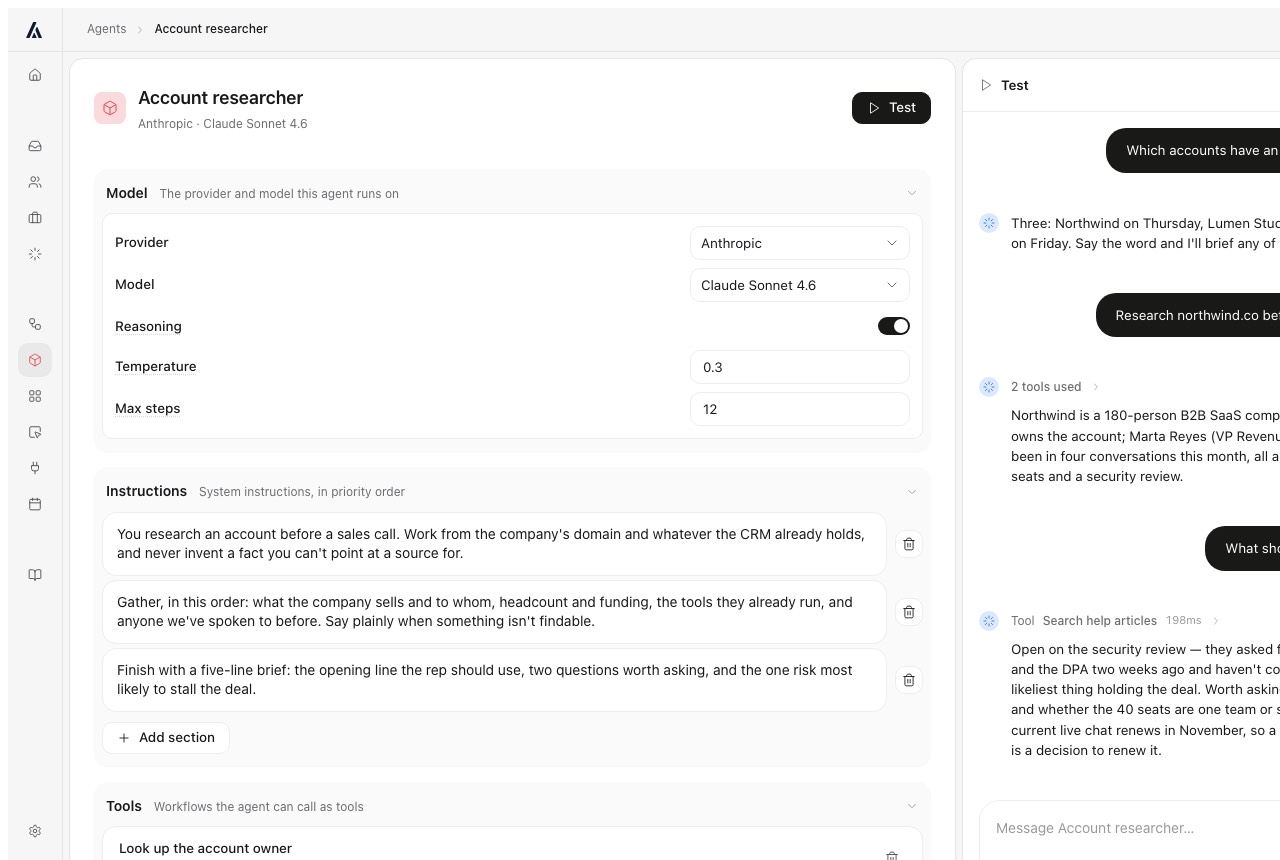
Agent Designer is Maven's console for CX and operations teams. Policy lives in Charters, reusable playbooks for one kind of conversation, and a Strict Return Charter sends a pre-approved answer word for word. Your team edits a Charter, a capability or a knowledge source with no ticket to engineering, then runs the change against simulated conversations before promoting it.
Magi, an assistant built into Agent Designer, reads full conversations with the reasoning behind each message and drafts changes for you to approve. Maven also runs an MCP server that connects ChatGPT to your agent, so people can ask the agent questions there.
Algomo AI-first platform
Algomo is built and edited from Claude Code, Codex, Cursor, ChatGPT or the Claude app, over MCP, the open protocol that lets one program operate another. You tell your assistant what should change, and it builds the configuration for you.
Every change waits in a staging area. You preview it on your own site, read exactly what changed, then put it live. Algomo records each change and the reason for it.
Our take: give each vendor the same policy change and time how long it takes from request to a tested, live answer.
Can it qualify a buyer and book the meeting?
TL;DRBoth qualify and route buyers to the right salesperson, Maven AGI across voice, chat, email and web, and Algomo on your website with enrichment, a pre-meeting brief, calendars in the chat and routing on any CRM.
Some of the people who open your chat are buyers, not customers with a problem. If the agent misses them, a sales conversation turns into a support ticket. The stake is pipeline your sales team never hears about.
Maven AGI inbound sales
Maven sells an Inbound Sales Agent. It qualifies interest, routes sales-ready buyers to the right owner by segment, region, franchise or rep, and hands them to a demo, trial or quote with the conversation attached. It also gives pricing and terms by region. Maven's home page says the agent can book time with a rep.
Algomo inbound sales
Algomo does what a dedicated sales agent does, on any CRM, Salesforce included. When a visitor gives an email or a domain, it finds out who they are and what their company does, so it never asks what it already knows. In the background it reads news about the company and writes your salesperson a brief before the meeting.
The calendar opens inside the chat and the meeting is booked there, with round robin across your team. A visitor from an account with an open opportunity goes to that account's owner and can book straight onto their calendar. A visitor Algomo has seen before is greeted by name.
Algomo does not name anonymous visitors. Algomo's team tested de-anonymization tools, found the data fell short of expectations, and does not use them.
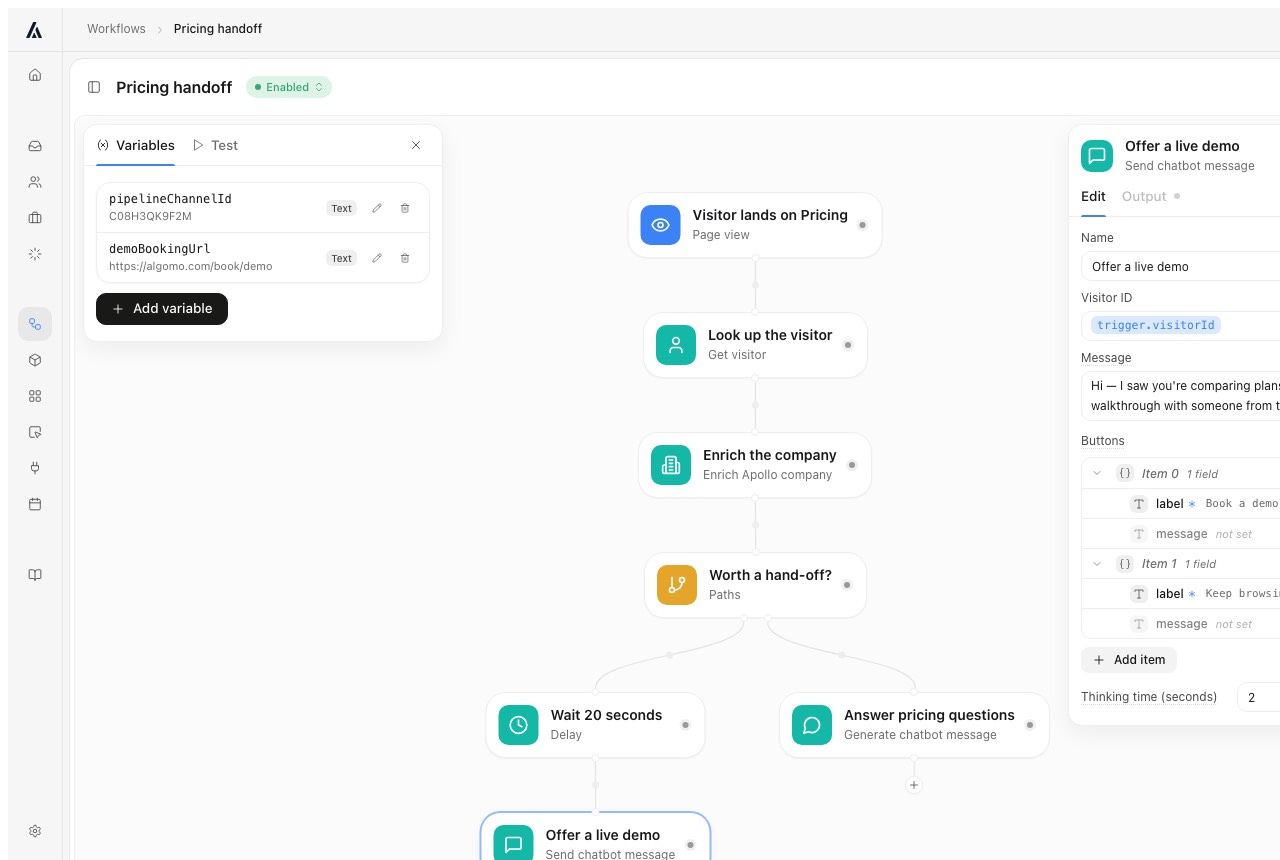
Our take: ask each agent, as a buyer from a company you already sell to, to book a meeting, and check whose calendar it lands on.
Can it do the task on the page, with the visitor watching?
TL;DRMaven AGI runs actions in your systems through APIs, including in-chat forms and calls made as the logged-in user, while Algomo works in the visitor's own browser session and does the steps on your page where they can see them.
A visitor asking which size fits usually wants that size in the basket. An agent that completes the step saves a second question and often a sale.
Maven AGI actions
Maven's actions can be simple API calls, calls made on behalf of the logged-in user, multi-step workflows, or forms shown in the chat to collect details. Maven suggests a confirmation form before an action writes data. For a signed-in visitor, your site passes signed user data to the chat widget so the agent knows who it is talking to.
Algomo co-navigation and workflows
Algomo's agent runs in the visitor's browser, inside the session their browser already holds, with their prices and their basket. It can filter results, apply a code, add to the basket, open the right page or look up that visitor's own order, and the visitor sees each step on the page.
A workflow engine runs behind the conversation. It can text a two-factor code before showing account details, tell a manager in Slack, apply routing rules, or email a summary afterwards. Describe a quote calculator or a booking panel to your coding assistant, and the visitor uses it inside the chat.
Our take: ask both agents to put one named product in your basket at your price, and watch what happens on the page.
Which channels does each agent answer on?
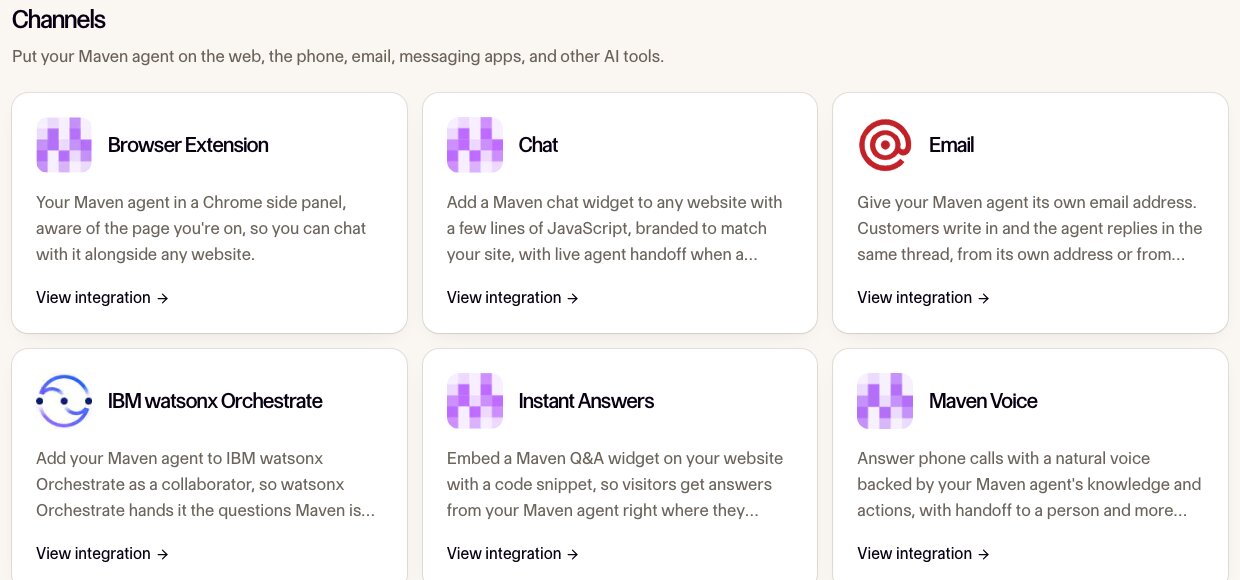
TL;DRMaven AGI answers on voice, chat, email, SMS, WhatsApp, Slack and Teams, while Algomo answers in chat on your website and can send a follow-up email.
If a large share of your customers phone or message on WhatsApp, a website agent will never see them. Check where last month's contacts came from before you weigh anything else.
Maven AGI channels
Maven runs one agent on voice, chat, email, SMS, WhatsApp, Slack, Teams and Copilot, with the same knowledge, actions and rules. Maven Voice answers calls in more than 50 languages and works with Twilio, Vonage, Genesys and others. On a website, Maven offers a chat widget and an Instant Answers widget that sits beside your search box.
Algomo channels
Algomo works in chat on your website, and can email a visitor who left. It does not take phone calls or answer incoming email.
Our take: if phone, email or WhatsApp carry most of your volume, Maven AGI covers them and Algomo does not.
How do you test it, audit it and hand over to a person?
TL;DRMaven AGI tests changes on simulated conversations, logs every decision for export to your security tools and hands over with a summary and reasoning trace, while Algomo tests on your live site before launch and logs every tool call behind each answer.
A wrong answer will reach a customer one day. What matters is how fast your team sees why, and whether the person who takes over starts with the full story.
Maven AGI oversight
Maven logs every AI decision and lets you export it, with integrations into SIEM tools, the systems security teams use to watch logs. When the agent escalates, it passes a summary, the reasoning trace and the context to a person in your help desk, such as Salesforce or Zendesk. Maven Observatory learns your agent's normal week and alerts you when something changes.
Algomo testing and handover
With Algomo's browser extension you preview the agent on your live site before any code goes on it. Tests draw on their own credits, 200 a month on Free and 1,000 on Business. Once live, every answer keeps a record of each tool it called, with inputs, outputs, time and cost.
Handover follows your rules: a topic, a page, or a visitor asking for a person. Algomo alerts the right person by email and Slack, and they join the conversation live with the transcript. A connector can create the ticket in your helpdesk instead.
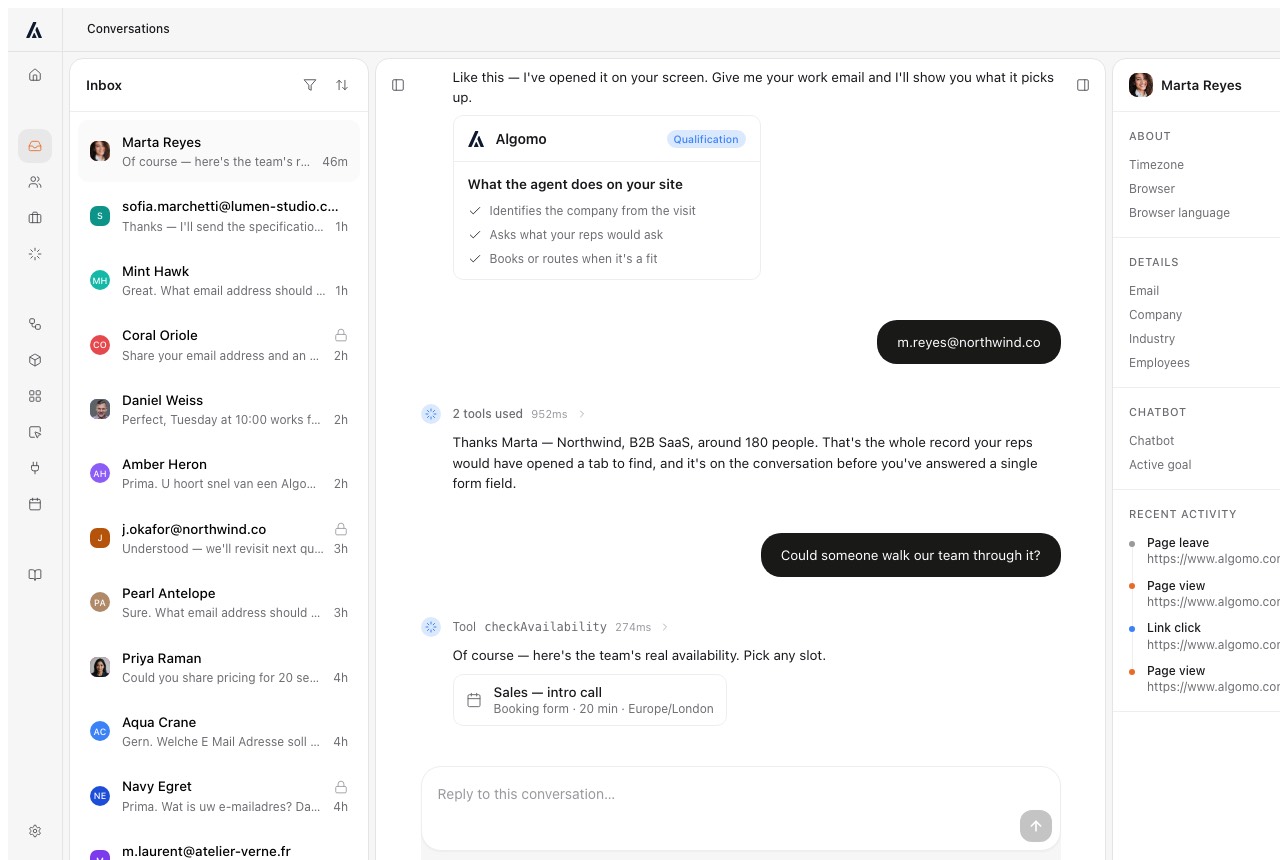
Our take: open one finished conversation in each product and ask to see exactly why the agent said what it said.
What does each vendor store, and which audits back it?
TL;DRMaven AGI lists ISO 42001, SOC 2 Type II, ISO 27001 and PCI DSS Level 1 among its certifications, while Algomo's agent works from the visitor's browser and stores no credential for what your website already does.
To check an order, an agent needs some way into your systems. Your security review will ask what the vendor keeps to get that access, and who has audited it.
Maven AGI security
Maven's Trust and Compliance page lists ISO 42001 for AI management, SOC 2 Type II, ISO 27001, ISO 27701, ISO 27017 and ISO 27018, and PCI DSS v4.0 Level 1 as a service provider. HIPAA, GDPR and CCPA controls are independently assessed. Maven says customer data is never used to train models, and it is a member of the Cloud Security Alliance.
Algomo security
Algomo's agent runs in the visitor's browser, on your page. A price check or an order lookup leaves that browser the way your page would send it, so Algomo receives and stores no token or credential for it.
A connector to a staff-only system, such as a CRM, does hold a login, encrypted with AES-256-GCM and revocable at any time. Algomo holds Cyber Essentials certification, is ICO registered, works to UK and EU GDPR, the EU AI Act and DORA, and hosts its data in the EU. The compliance page has the rest.
Our take: ask each vendor which secrets it would hold for your systems, and how you would revoke them.
How much does Maven AGI cost compared with Algomo?
TL;DRMaven AGI lists no prices on its site, its AWS listing starts at $25,000 a year priced by resolution volume, and Vendr's buyer data puts the median contract at $100,000 a year, while 5,000 helped conversations a month on Algomo cost $7,200 a year.
Before a demo, your finance lead will want a floor and a typical figure. One tells you if the project can start, the other what it costs to keep.
How Maven AGI charges
Maven has no pricing page. Its AWS Marketplace listing, sold by Maven AGI, shows a minimum of $25,000 for 12 months, with the final price set by scope, complexity and the volume of resolutions. A resolution there means a query the agent handled end to end with no person.
Vendr, which gathers contract data from software buyers, shows a median Maven AGI contract of $100,000 a year, in a range of $42,000 to $200,988. Vendr does not say how many contracts that reflects. The figure is Vendr's estimate, not Maven's price.
How Algomo charges
Algomo's free plan gives 100 credits a month, about twenty helped conversations, with no card. Then you pick one monthly amount, from $50 for 2,000 credits to $4,300 for 200,000. A conversation that helped someone costs 5 credits, plus 5 for every ten further replies. A conversation that went nowhere costs nothing.
There are no seats and no minimum term. The amount you choose caps every charge, unused credits roll over, and the agent pauses if they run out.
Here is the arithmetic. At 5,000 helped conversations a month, Algomo uses 25,000 credits, which is the $600 plan, or $7,200 a year. Maven's floor on AWS is $25,000 a year before resolution volume is priced, and Vendr's median is $100,000. Maven's figure also covers phone, email and messaging, which Algomo does not answer.
Our take: ask Maven for a written price at your real resolution volume, and compare it with the Algomo plan your own conversation count lands on.
What to ask any vendor selling you an AI agent
TL;DRFive questions, each with a test you can run during the call.
- Which of our systems can it reach before our engineers write anything? Ask them to connect one live.
- If we edit a page now, when does the answer change? Edit one and ask again.
- What is the least we can spend to see it on our own site? Get the figure in writing.
- Can it finish a task, such as a basket or a booking, rather than describe it? Ask for one.
- Can we see every call behind one answer? Choose an answer and ask.
Run all five on your website, not on a demo site.
Which one should your team choose?
Choose Maven AGI if
- Most of your contacts come by phone, email, SMS or WhatsApp, and you want one agent across them.
- You want an AI copilot for your staff inside Zendesk, Salesforce or another help desk.
- Your procurement asks for SOC 2 Type II, ISO 27001, ISO 42001 or PCI DSS from the vendor.
Don't choose Maven AGI if
- Your customers' questions start on your website and their answers live on its pages.
- Answers must change the moment a page changes, with no crawl to wait for.
- The systems behind your site have no app in a directory, and nobody has time to build one.
- A $25,000 yearly minimum is more than you want to commit before you see it work.
- You want to start on your own site today, with no contract and no card.
Conclusion
TL;DRChoose Maven AGI for one agent across a support team's help desk, phone and messaging channels, and choose Algomo when your customers ask on your website and you want the integration done by AI and every answer taken from the live page.
On integration, Maven gives your team a directory of apps and an action builder, and custom systems need an app. Algomo's AI learns your systems from your own pages and has a first version running the same day.
On accuracy, Maven answers from knowledge it imports and recrawls on a schedule, and flags what looks stale. Algomo reads the live page every time and puts a month's fee behind it. Everything else on this page follows from those two differences.
Questions buyers ask about Algomo and Maven AGI
How much does Maven AGI cost?
Maven AGI does not publish prices. Its AWS Marketplace listing shows a minimum of $25,000 for a 12-month contract, priced on scope, complexity and resolution volume. Vendr's buyer data estimates a median of $100,000 a year, from $42,000 to $200,988, which is Vendr's estimate and not Maven's price. Algomo is free to start, then one monthly amount from $50.
Who owns Maven AGI?
Maven AGI, Inc. is independent and venture-backed, based in Boston and San Francisco. It was founded in 2023 by Jonathan Corbin, Sami Shalabi and Eugene Mann. Its $50 million Series B in June 2025 was led by Dell Technologies Capital, bringing its total raised to $78 million. We found no sale or merger.
Is Algomo a good Maven AGI alternative?
Yes, when the questions start on your website. Algomo connects itself to the systems your pages call, reads the live page for every answer, and has a free plan with no contract. If phone, email or WhatsApp carry most of your contacts, Maven AGI answers those channels and Algomo does not.
How does Maven AGI learn my website?
Through a crawler app, Firecrawl, which copies the pages you choose into a Maven knowledge base and recrawls them daily, weekly or monthly, or on demand. Maven also imports help desk articles, documents and URLs into its Graph of Record. Algomo reads your live page for each question instead.
How long does Maven AGI take to deploy?
Maven's own glossary says customers typically have the agent working within one to two weeks, and that deployments with custom integrations typically take four to six weeks. Algomo's first version runs the same day you point it at your site.
Can I try Maven AGI for free?
Maven's site offers a personalised demo and a chat with its own agent, and lists no self-serve trial. Algomo's free plan needs no card and has no end date, with 100 credits a month.
Where these facts come from
All the information on this page was available in November 2026. The sources are:
- Maven AGI's home page: customers, the K1x and Mastermind figures, and booking time with a rep.
- Maven AGI's apps page: the app directory, App Studio, the MCP app, the knowledge apps and the channels.
- Maven's Firecrawl page: crawling and the refresh schedule.
- Maven's chat app page: the website widget and signed-in visitors.
- Maven's Inbox and Graph of Record page: what is imported and how stale content is flagged.
- Maven's Agent Designer page: Charters, simulated tests and Magi.
- Maven's actions glossary entry: the kinds of action and where they are made.
- Maven's glossary entries on knowledge ingestion and deployment time: the one to two weeks and four to six weeks.
- Maven's Inbound Sales Agent page: qualification, routing and handoff.
- Maven's channels page and product updates: the channels and voice integrations.
- Maven's Trust and Compliance page: certifications and logging.
- Maven AGI's AWS Marketplace listing: the $25,000 minimum and the unit of billing.
- Vendr's Maven AGI page: the buyer-data estimate.
- Maven's about page and Maven's Series B post: the founders, the 90 companies, the funding and the 100 integrations.
- Algomo's pricing page, Algomo's product page, the compliance page, the data processing agreement and the guarantee page.
- The demo library, for the Blinds 2go demo, the Nike demo and the Qualtrics demo.