
Summarize withChatGPTPerplexityClaudeGrokAlgomo vs Landbot
TL;DRTeams hold back on AI agents for two reasons: the work of connecting the agent to real systems, and the chance it says something your site does not. Landbot leaves the connections to your team and answers from pages it scraped on a schedule. Algomo wires itself to the requests your pages already make, and reads the live page for each answer, with a free month if a reviewed agent contradicts your site.
Algomo vs Landbot at a glance
| Algomo | Landbot | |
|---|---|---|
| What it is | An AI agent on your website for support and inbound sales, with an inbox your team takes over from. | A no-code builder for chat flows on the web, WhatsApp and Messenger, with an AI Agent block and a shared inbox. |
| Owner | Algomo | Hello Umi, S.L., Barcelona, independent |
| Who wires it to your systems | Algomo's AI, from the requests your pages already send. | Your team adds REST API actions, webhooks or integrations, or pays Landbot's team to build the agent. |
| Where answers come from | The page as it reads now, and the data behind it. | A knowledge base of text, files and scraped pages, refreshed daily, weekly, every two weeks or monthly. |
| Published pricing | Free, then one monthly amount from $50 to $4,300, in US dollars. | Free, then €40 or €100 a month, or €32 and €80 billed yearly, plus €0.10 per AI chat past the allowance. |
| Channels | Chat on your website, plus a follow-up email. | Web chat, WhatsApp, Facebook Messenger and API. |
| Biggest limitation | Website chat only, with no phone and no incoming email. | Answers come from a stored copy, and every live lookup is a REST action your team sets up. |
What part of Landbot do you need?
TL;DRLandbot suits a marketing team that wants scripted lead flows on its site and WhatsApp, and Algomo suits a team whose visitors ask questions that need live data from the site.
The right tool depends on the conversation you expect. Some chats are a short form with buttons. Others are open questions about price, stock or an order. Find your case below:
- You want a lead form that asks one question at a time and books a call: Landbot.
- Your customers message you on WhatsApp: Landbot.
- Visitors ask about live prices, stock, bookings or their own order: Algomo.
- Nobody on your team can write API calls for the agent: Algomo, which builds its tools from your site.
The two risks come first. The builder, lead capture, the page, channels, testing, handoff, security and price follow.
Who connects the agent to the systems behind your site?
TL;DRIn Landbot your team adds a REST API action for each lookup and describes when the agent should call it, while Algomo records the requests your pages already send and turns them into tools itself, with a first version the same day.
Answers that matter often need your data. Is the sofa in stock, where is my parcel, is there a slot on Friday. If the agent cannot reach those systems, it can only ask for an email and pass the question on.
Landbot REST API actions
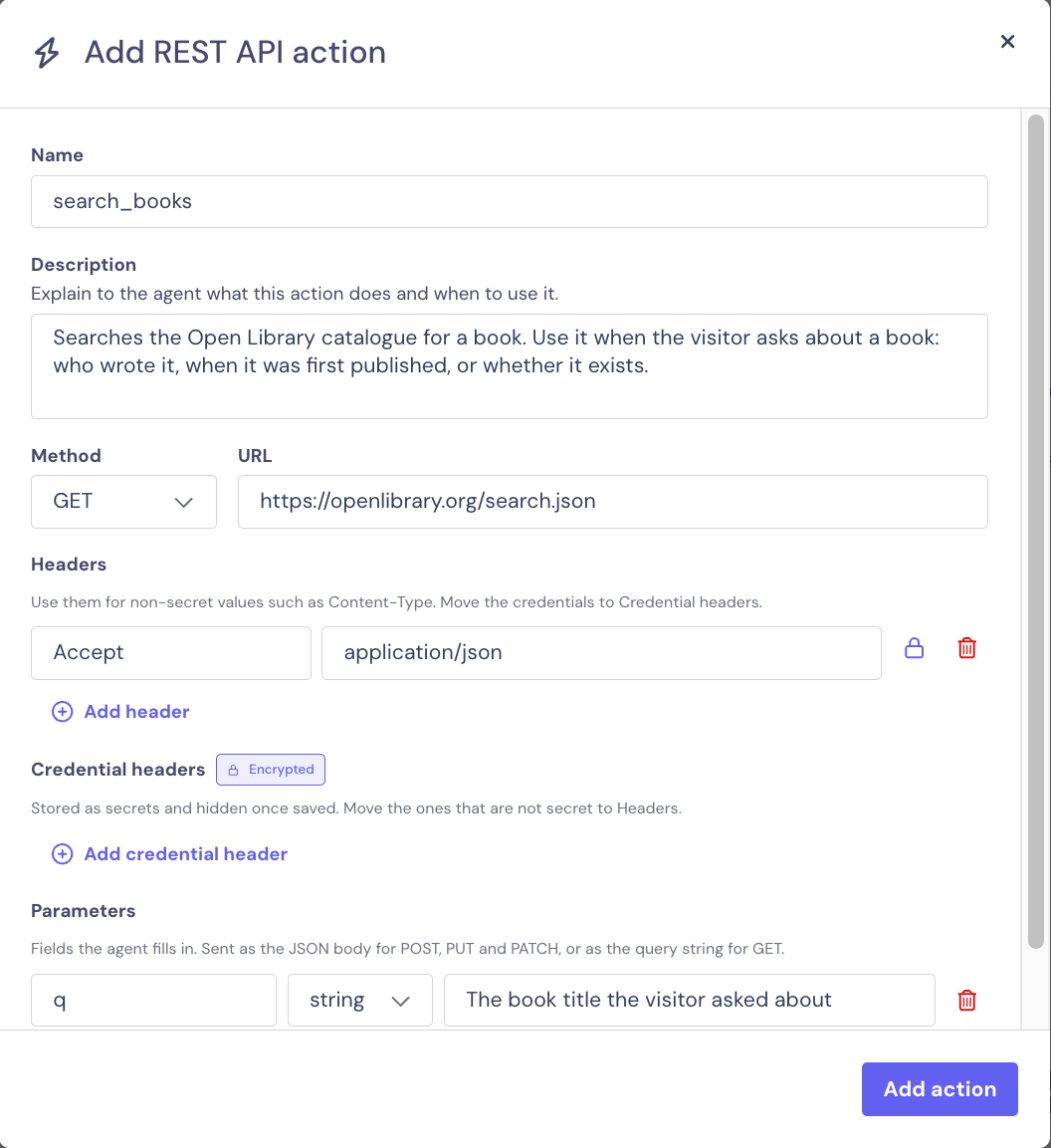
Landbot's AI Agent block reaches your systems through REST API actions. For each one, your team enters a name, a description the agent reads to decide when to call it, the method, the URL, headers and parameters. API keys go in credential headers, which are encrypted and hidden once saved. Every call then shows in a log with what was sent and what came back.
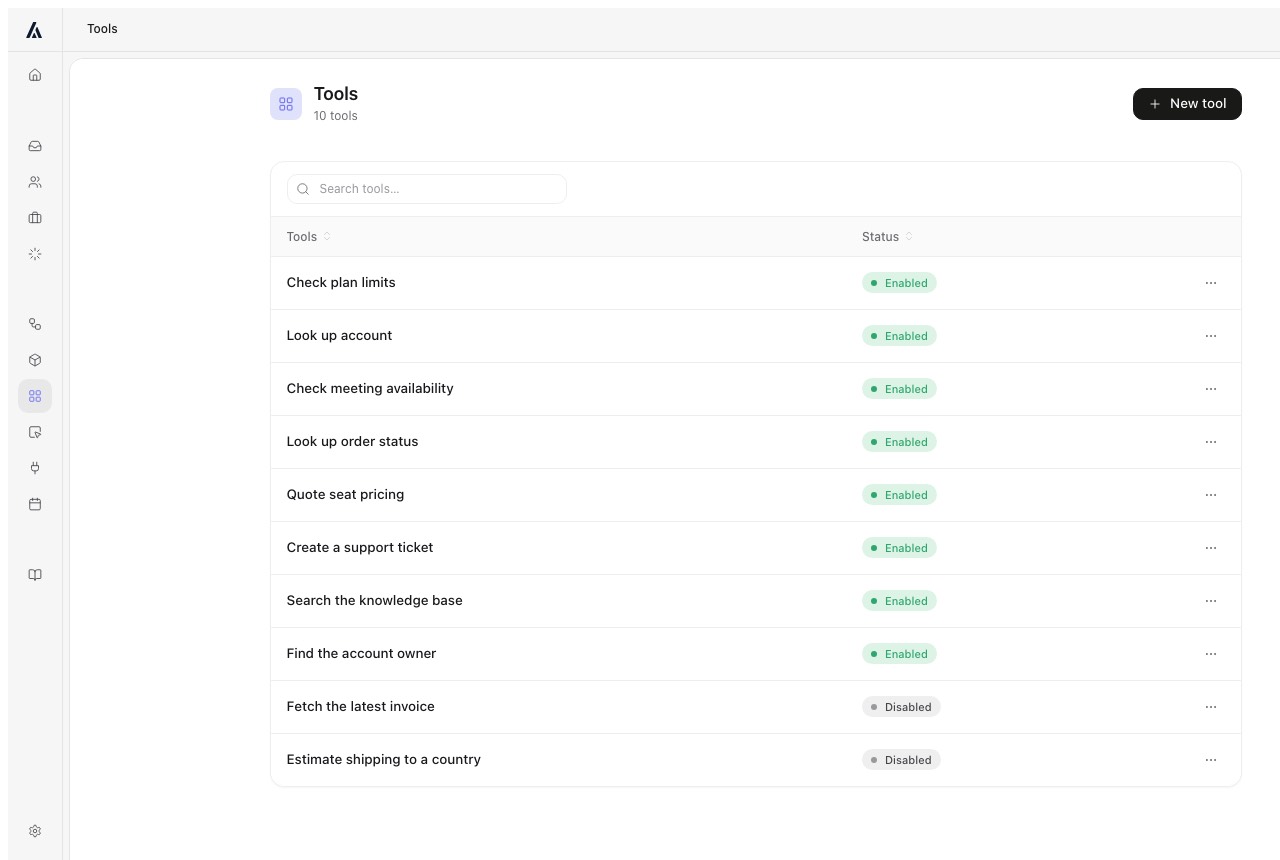
Outside the AI block, flows can call webhooks, run code, and use integrations such as HubSpot, Salesforce, Pipedrive, Zoho and Google Sheets from the Professional plan. If you would rather not build it, Agent Studio is Landbot's service where its team designs, builds and runs the agent for you.

Algomo self-integration
Algomo starts from the website itself. It records the requests your pages send, such as the stock check, the order lookup and the booking search, and each becomes a tool the agent can call. Algomo's AI deployment engineer does that discovery, the wiring and the upkeep, and the first version runs the day you start.
It helps most where the stack is unusual, such as an in-house booking engine or an older ERP that no marketplace covers. If a redesign breaks a connection, Algomo flags it so the mapping can be rebuilt. Systems only your staff can open, like a CRM, use a connector from the Business plan.
The demo library shows this on big brands' own systems, with no project on their side. The Blinds 2go demo prices three made-to-measure windows in one card through the site's own price engine. The Nike demo reads live price and UK 9.5 stock. The Qualtrics demo runs beside the chat Qualtrics built on Qualified, whose site quotes 30 to 60 days to implement.
Connecting the agent
| Algomo | Landbot | |
|---|---|---|
| Finds the systems behind your site | ✓ From the requests your pages send | ✗ Your team picks them |
| Builds each lookup | ✓ Algomo's AI | ✗ Your team, as a REST API action |
| CRM and sheet integrations | ✓ Connectors, from Business | ✓ HubSpot, Salesforce, Pipedrive, Zoho, Sheets, from Professional |
| Built for you | ✓ Same day, by the AI | Agent Studio, a managed service |
Our take: pick the lookup your visitors ask for most, and time how long each product takes to answer it on your site with real data.
Will the agent repeat a price you changed last week?
TL;DRLandbot's AI Agent answers from a knowledge base whose scraped pages refresh daily, weekly, every two weeks or monthly, while Algomo opens the live page for each question and backs a reviewed agent with a free month if it contradicts your site.
Sites change faster than anyone writes it down. A promotion ends, a shipping rule moves, a product is discontinued. An agent working from a saved copy goes on saying the old thing until the copy is replaced.
Landbot knowledge base
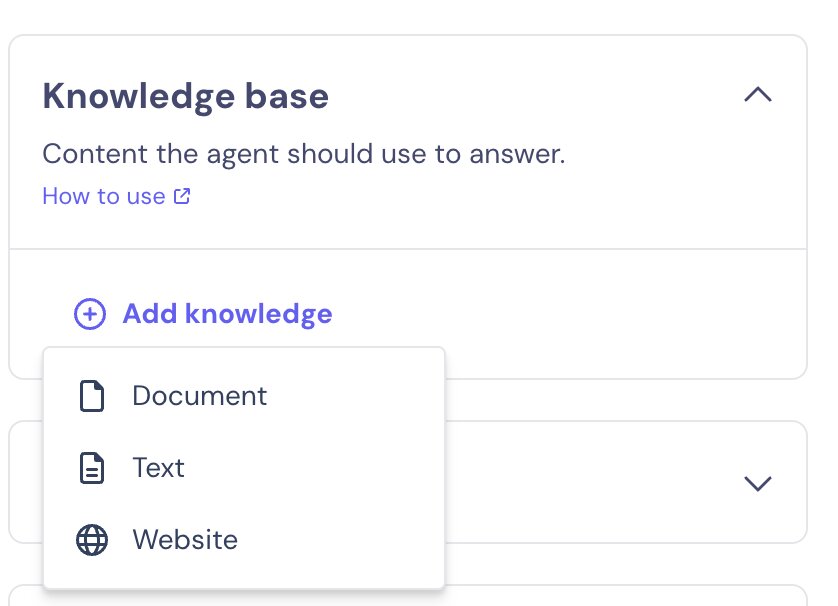
Landbot's knowledge base takes text, documents and websites. A website source scrapes up to 200,000 characters of a page's HTML, and you can switch on Refresh automatically, then choose daily, weekly, every two weeks or monthly. The agent reads text only, so anything shown in an image is invisible to it.
Landbot calls its approach controlled AI. You keep the critical paths in button flows and let the AI answer only where it helps, from your own knowledge base. That keeps the agent on script, and it still answers from the last copy it took.
Algomo agentic search
Algomo keeps no copy of your site to answer from. It holds a map of where your pages are, opens the right one while the visitor waits, and answers from what it says now. Change a price at nine, and the answer is right at nine oh one, with no refresh to schedule.
Stock, orders and rates come through the tools above, read at the moment of the question. Algomo reviews each agent before launch. If a reviewed agent ever contradicts your website, the next month is free, on the terms in the guarantee page.
Where answers come from
| Algomo | Landbot | |
|---|---|---|
| Your web pages | ✓ The live page, each question | ✓ A scraped copy, refreshed daily to monthly |
| Prices and stock | ✓ The requests your pages send | ✓ A REST API action your team adds |
| A promise on accuracy | ✓ Next month free if a reviewed agent contradicts your site | Not listed on its pricing page |
Our take: change one shipping charge on your site, ask both agents about it ten minutes later, and see which one has the new figure.
In November 2026 we tried Landbot on 25 sites and found no confirmed wrong answer. Every live Landbot widget we reached was a button menu, a form or a hand-off to a person, and the one AI bot we found never replied, so there was almost no AI answer to check.
Do you want to script the conversation, or describe the outcome?
TL;DRLandbot builds conversations as flows of blocks, with an AI Agent block where you want open answers, and both Landbot and Algomo can be built from Claude, ChatGPT, Codex or Cursor over MCP.
A scripted flow is predictable and easy to review. An agent that picks its own next step handles questions nobody scripted. Your choice decides how much of the conversation your team has to draw in advance.
Landbot builder and MCP
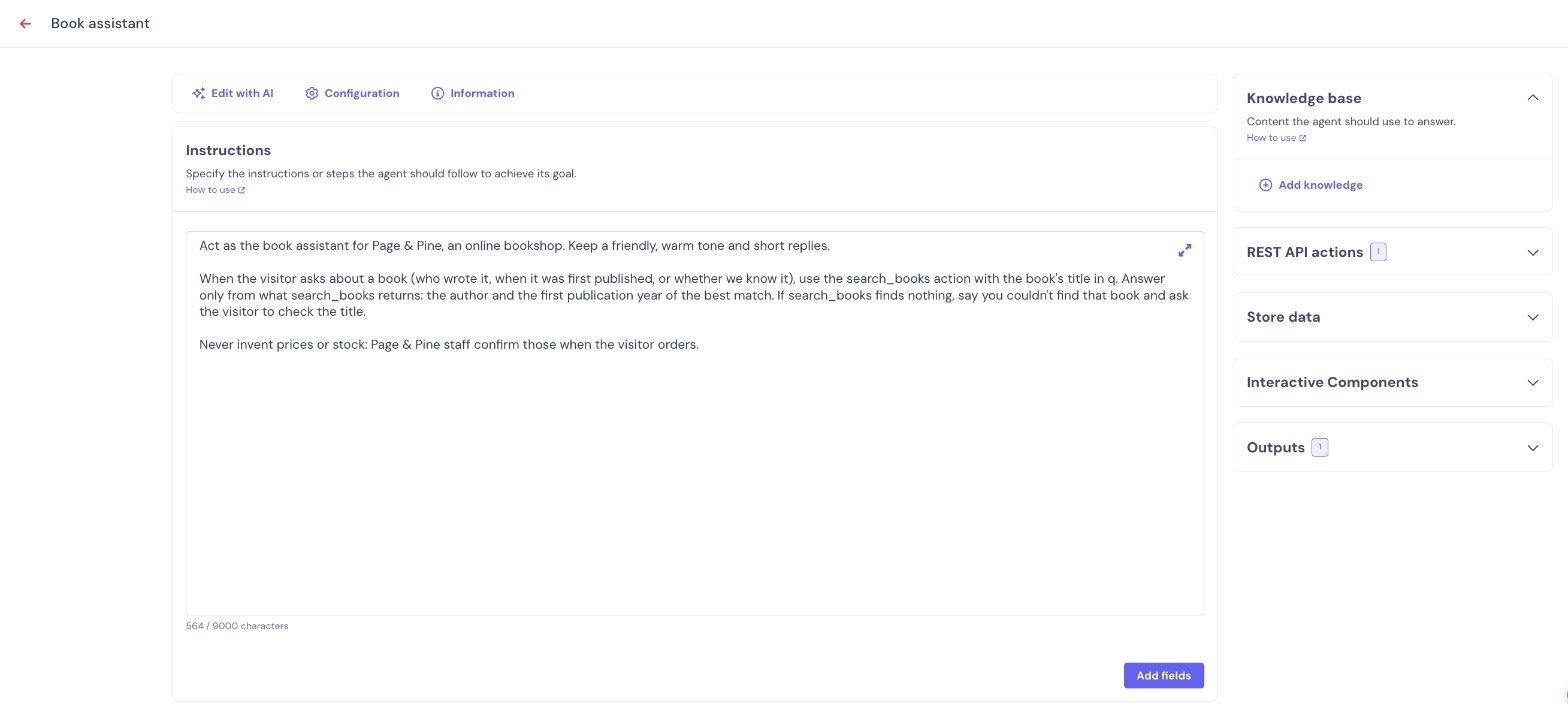
Landbot's builder lays a conversation out as blocks: questions, buttons, conditions, integrations and an AI Agent block. Inside that block you write instructions, add knowledge, REST actions and up to 20 fields to collect, and set outputs that hand the visitor back to the flow. Every AI Agent runs on one model, GPT-6.1 Terra, with no model to choose.
Landbot also has an MCP server for Claude, ChatGPT, Codex and Cursor. MCP is the open protocol that lets an AI tool use another app. You describe the agent in plain words, the assistant builds it, gives you a summary and publishes only after you approve.
Algomo from your coding assistant
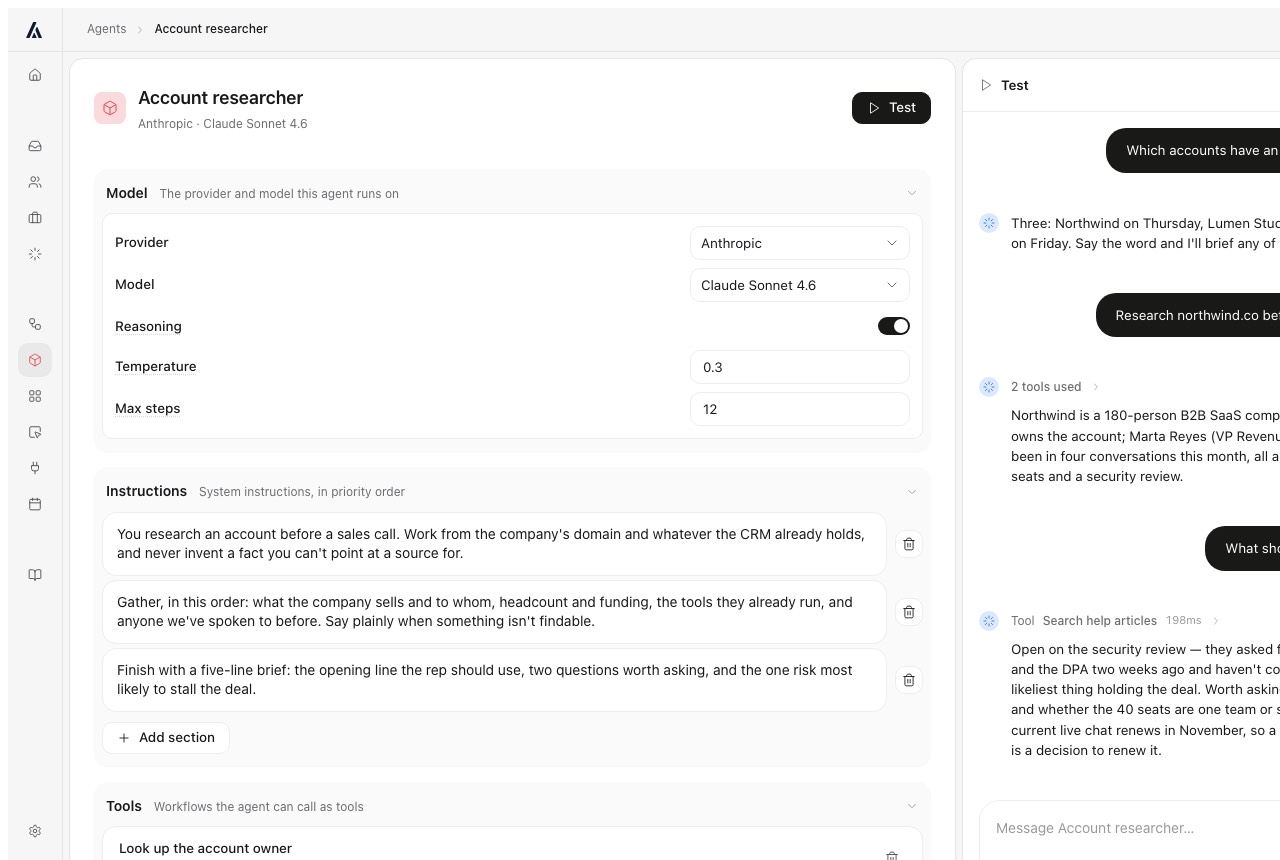
Algomo is run from ChatGPT, Claude Code, Cursor, Codex or the Claude app over MCP. You tell the assistant what the agent should answer and hand over, and it writes the configuration. There is no flow to draw, because the agent chooses which tool or page answers the question.
Each change is staged. You try it on your own site, read what changed, then put it live, and Algomo keeps a history of every change and its reason.
Building and changing the agent
| Algomo | Landbot | |
|---|---|---|
| Works from Claude, ChatGPT, Codex, Cursor | ✓ Over MCP | ✓ Over MCP |
| Visual flow builder | ✗ Not needed | ✓ Blocks and conditions |
| Choice of AI model | ✓ OpenAI by default, your pick on Enterprise | One model, GPT-6.1 Terra |
| Changes reviewed before going live | ✓ Staged, with a history | ✓ Publish after approval |
Our take: ask each assistant to add one new question type to the agent, and count how many steps of the conversation it had to edit.
Which one qualifies leads and books meetings better?
TL;DRLandbot qualifies leads with scripted questions, scoring and Calendly booking synced to your CRM, while Algomo looks the visitor up first, asks only what enrichment cannot answer, and books on the right owner's calendar inside the chat.
A form that asks ten questions loses people at question three. Your sales team wants the meeting booked and the context ready, with the fewest questions in between.
Landbot lead flows
Lead generation is Landbot's main use. A flow asks one question at a time, scores the answers, routes the lead and offers a Calendly slot, then saves the lead to HubSpot, Salesforce or a sheet. The AI Agent block can collect fields from free text, and the Interactive components section adds buttons and cards in the conversation.
Algomo inbound sales
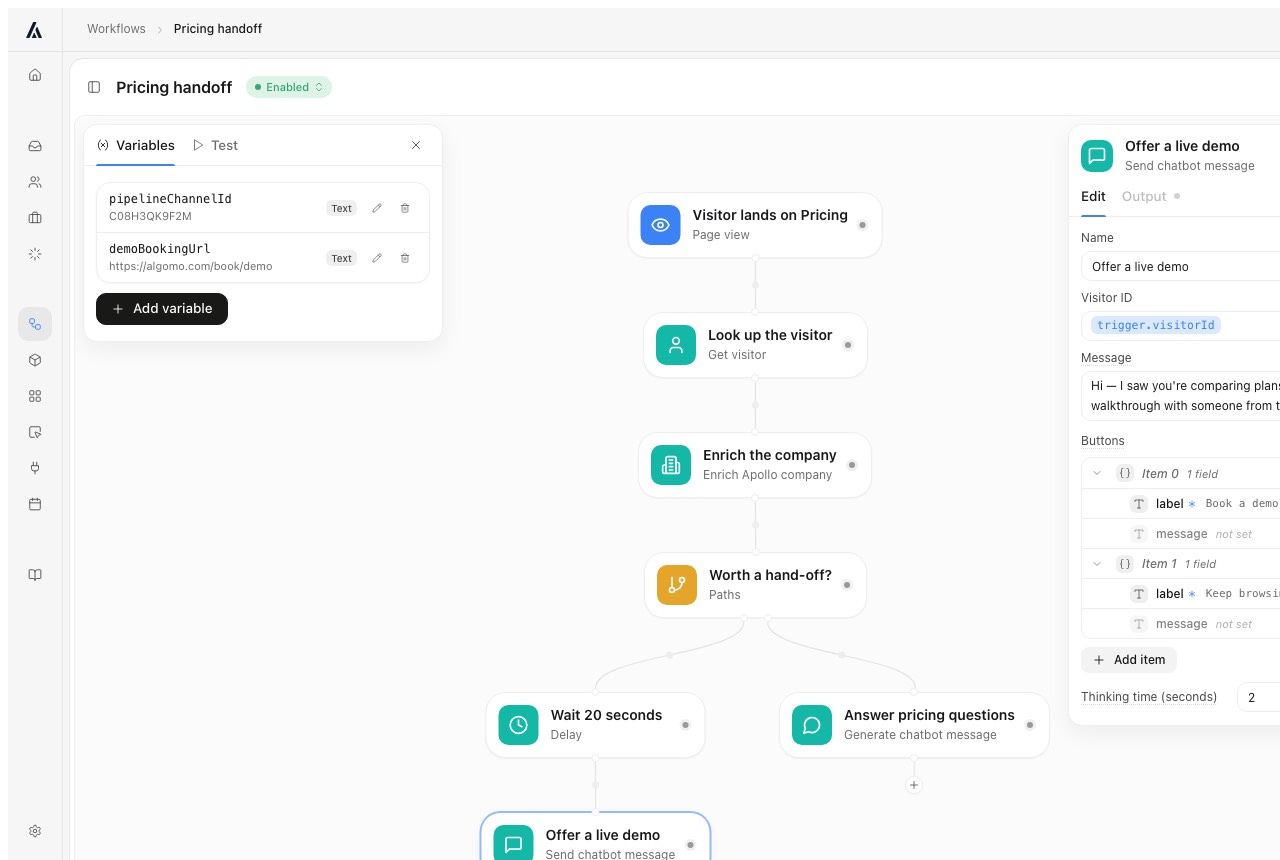
When a visitor gives an email or a company name, Algomo's agents find out who they are and skip the questions enrichment already answers, such as the company and what it does. A visitor Algomo has seen before is greeted by name. Agents also research the company and write a brief for the salesperson before the meeting.
The calendar opens in the chat, and the meeting is booked there, with round robin across your team. A visitor from an account with an open opportunity goes to that account's owner. Algomo works with Salesforce and with any other CRM.
Our take: give both your own email on your pricing page, and count the questions each asks before it offers a meeting.
Can the agent act on the page for the visitor?
TL;DRLandbot shows buttons, cards and forms in its chat and can pass data to the page it is embedded in, while Algomo works in the visitor's own browser session, applying a code or adding to the basket, with each step in view.
Some questions end in an action. Add this to my basket, apply my code, show me my order. An agent that can do it on the page saves the visitor the clicks.
Landbot on your page
Landbot embeds as a chat bubble, a full page or an inline frame. The inline frame can exchange information with the page around it through a custom data object, set up by your developers. Inside the chat, the agent shows buttons, cards and forms you define.
Algomo co-navigation and workflows
Algomo's agent runs in the visitor's browser, on your page, in the session that browser already has. It sees their prices, region and basket, and can filter a list, apply a code, add an item or check that visitor's own order while they watch.
Workflows run during and after the chat, such as sending a two-factor code before showing account details. Describe a quote calculator to your coding assistant, and visitors use it as a widget inside the chat.
Our take: ask each agent to put one named product in your basket, and see whether it does it or explains how.
Which channels does each one cover?
TL;DRLandbot covers web chat, WhatsApp, Facebook Messenger and API, and Algomo covers chat on your website with a follow-up email.
Count where your conversations start. If many customers message you on WhatsApp, a website-only agent leaves them out.
Landbot channels
Landbot is a Meta Business Partner on the official WhatsApp Business API. A WhatsApp number costs €100 a month on Professional and comes with Business, and Meta's own message fees apply. The same builder makes web, Messenger and API chat agents.
Algomo channels
Algomo answers in a chat on your website, and can send a follow-up email after the visitor leaves. It does not answer calls or reply to incoming email.
Our take: if WhatsApp carries a large share of your questions, Landbot covers it, and Algomo stays on your website.
How do you test it before visitors see it?
TL;DRLandbot tests a published agent through a share link and logs its API calls, while Algomo previews the agent on your live site before any code goes in and logs every tool call behind each answer.
You want to see wrong answers before your customers do. The faster you can see why an answer went wrong, the fewer customers hear it.
Landbot testing
Landbot's help centre says to publish the agent and open it with Share with a Link, or a WhatsApp test number. You check that it collects the fields, follows the knowledge base and leaves at the right output. Transcripts and API logs sit in the Analyze section.
Algomo testing
Algomo's browser extension shows the agent on your live site before you add any code. Testing has its own allowance, 200 credits a month on Free and 1,000 on Business, kept apart from the live budget.
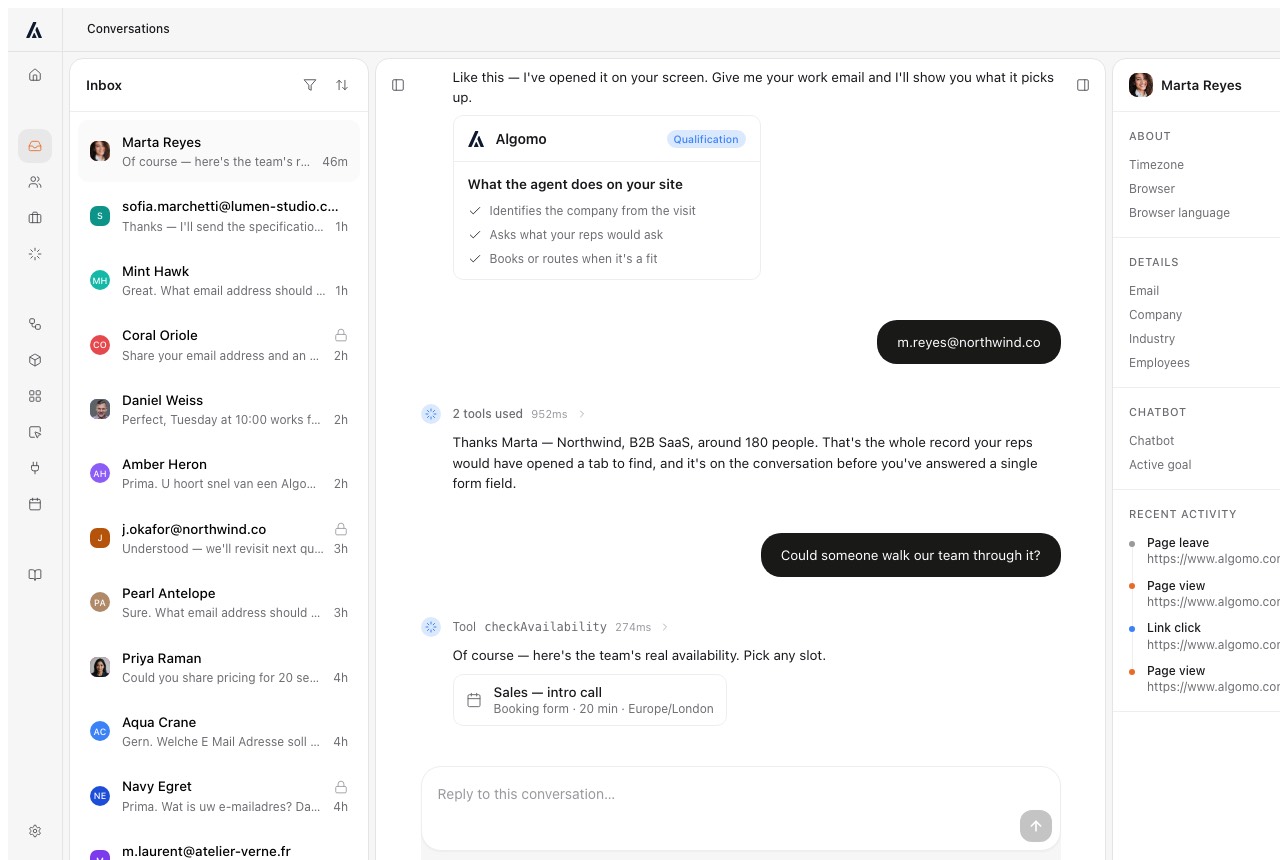
In production, every answer records the tools it called, their inputs and outputs, the time and the cost. Every workflow run keeps a trace of each step.
Our take: put your ten hardest questions to both on your real pages, and open the record behind any answer you doubt.
How does a person take over?
TL;DRLandbot's Human takeover block assigns the chat to an online teammate in its shared inbox, while Algomo alerts the right person by email and Slack so they join the live chat with the transcript.
Some visitors need a person. What counts is whether that person sees the conversation so far and can reply at once.
Landbot human takeover
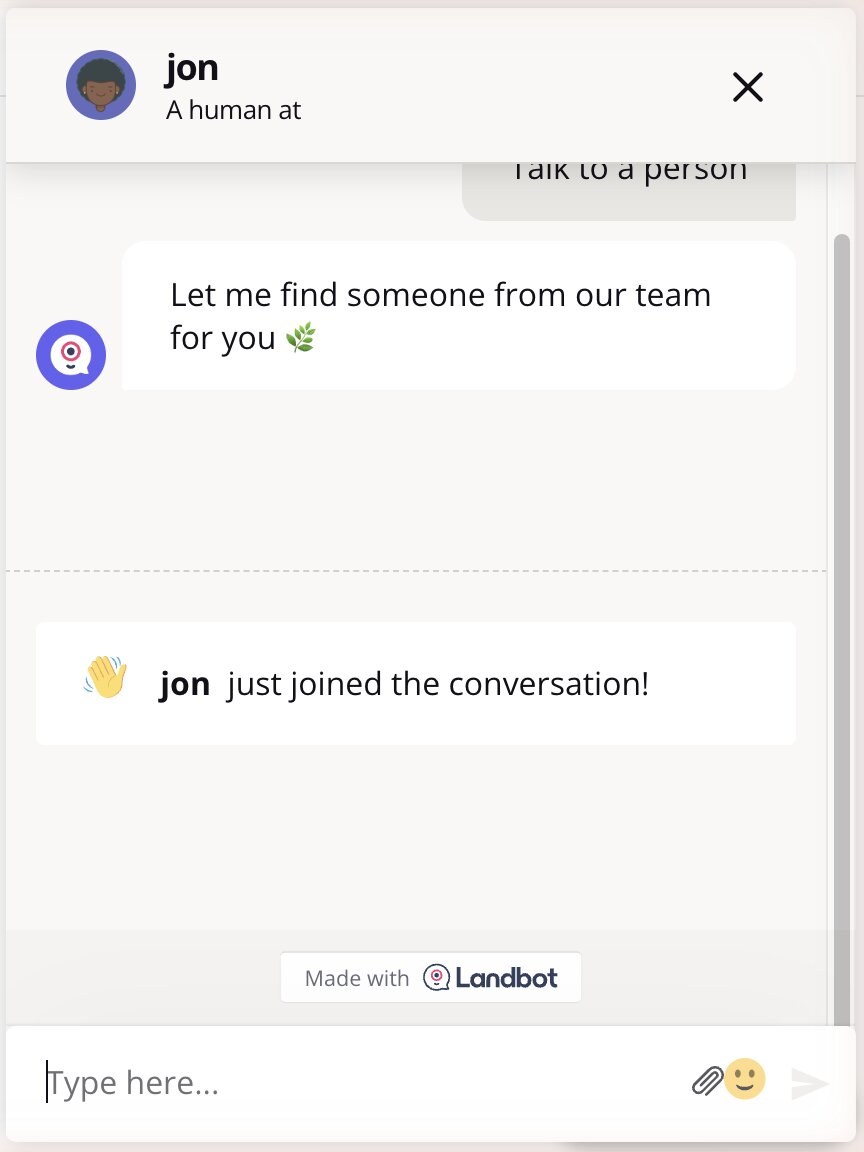
A Human takeover block in the flow assigns the chat to a teammate who is online, and the bot stops. The visitor sees who joined, and the teammate replies from Landbot's shared inbox, which comes with every plan from Starter, one seat per person. If nobody is online, the flow carries on so the visitor still gets an answer.
Algomo handoff
Algomo hands over on rules you set: a topic, a page or a request for a person. The right teammate hears by email and Slack and joins the live chat from Algomo's inbox, with the transcript. A connector can also open a ticket in a helpdesk such as Zendesk.
Our take: ask each agent for a person, and see what that person knows before they reply.
What does each one keep to reach your data?
TL;DRLandbot stores the API keys your team adds as encrypted credential headers and lists SOC 2 and GDPR, while Algomo's agent sends requests from the visitor's browser and keeps no token for anything your website already does.
An agent that looks up orders needs access to your systems. Your security team will ask what the vendor holds and where.
Landbot security
Landbot is an EU platform under GDPR and lists SOC 2, with the report shared under an NDA through its trust centre. Chats are not used to train models. Keys for REST API actions are encrypted and hidden once saved.
Algomo security
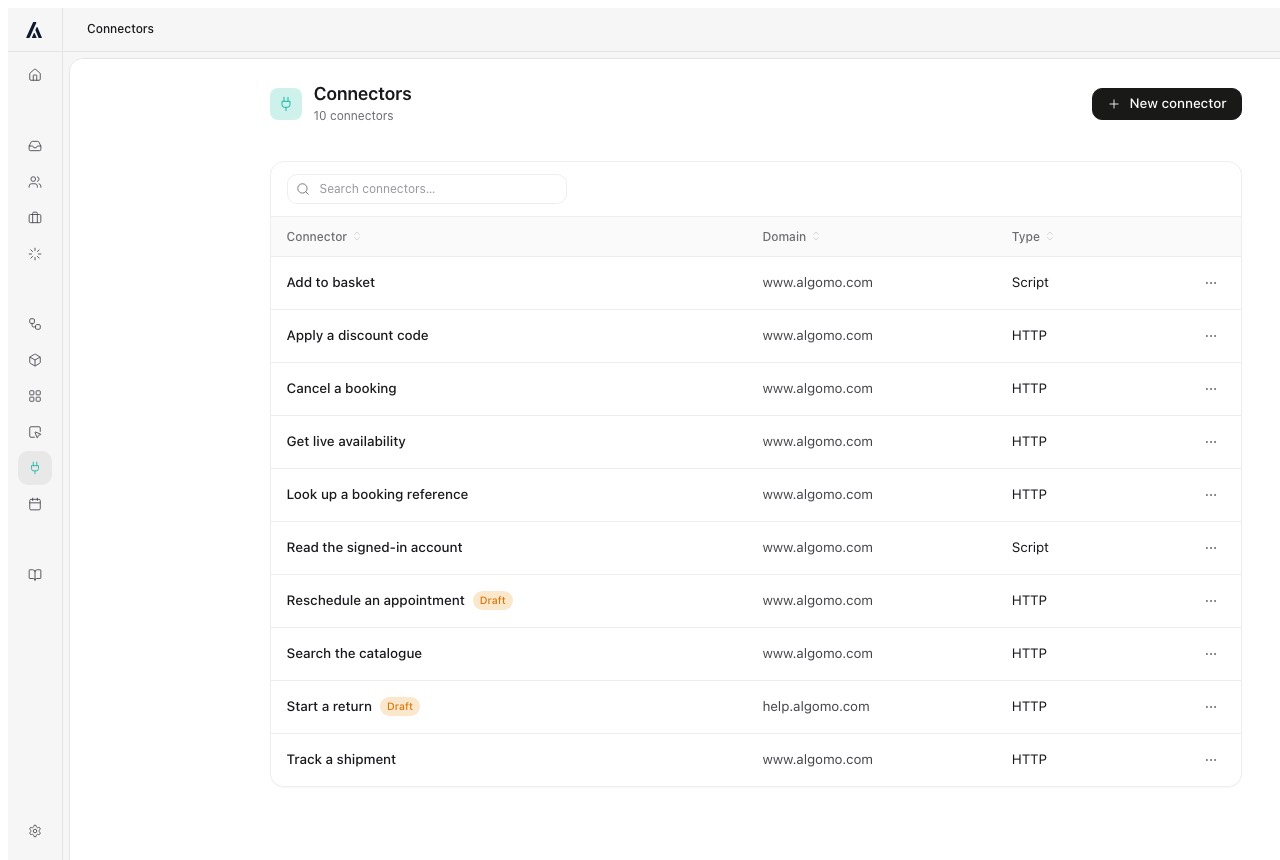
Algomo is secure by design. The agent runs in the visitor's browser, so a stock check or an order lookup is sent by that browser, as your own page sends it. Algomo receives and stores no token or credential for those requests.
A staff-only system, like billing, uses a connector, and Algomo keeps that login encrypted with AES-256-GCM and revocable at any time. Algomo holds Cyber Essentials and works to UK and EU GDPR, the EU AI Act and DORA, with its application, database and files in the EU. Algomo's trust and compliance page and the data processing agreement give the detail.
Our take: ask each vendor to list every key it would store for your systems after launch.
Which costs more, Algomo or Landbot?
TL;DRAt 1,000 AI conversations a month, Landbot Professional comes to €170 billed monthly, €100 plus 700 extra AI chats at €0.10, and Algomo's plan for the same volume is $200.
Both publish their prices, so the question is how each bill grows. Your finance team will want to know what a busy month costs and who decides.
How Landbot bills
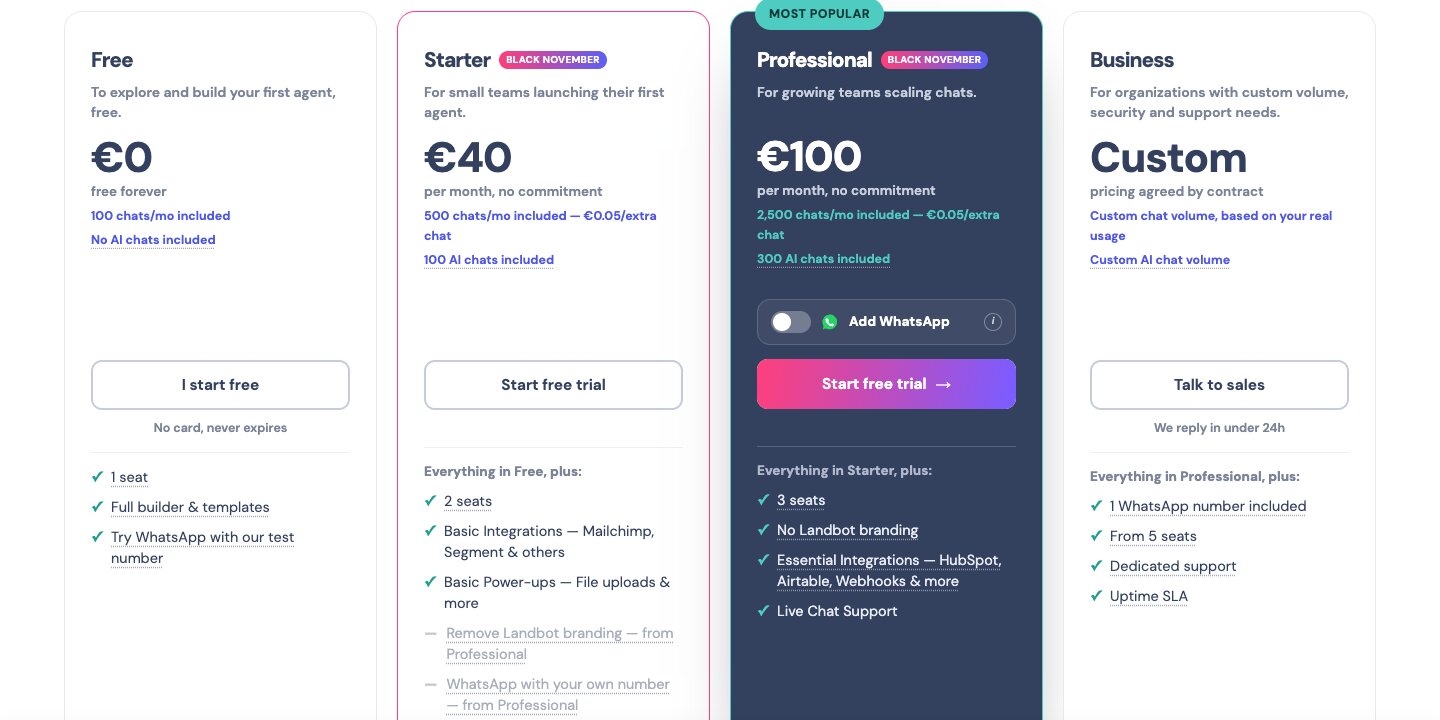
Landbot prices in euros in the EU and in dollars elsewhere. Free is €0 for 100 chats and no AI chats. Starter is €40 a month for 500 chats and 100 AI chats, and Professional is €100 for 2,500 chats and 300 AI chats. Billed yearly they are €32 and €80 a month, and in the US $36 and $88.
Two allowances run side by side. A chat handled fully or partly by AI counts as an AI chat, at €0.10 each past the allowance. Other chats past the allowance cost €0.05 each, billed in packs of 500 for €25. Landbot alerts you at 80% and 90%, and extra seats are €25 a month.
How Algomo bills
Algomo's free plan needs no card and includes 100 credits a month, about twenty helped conversations. Then you pick one monthly amount, from $50 for 2,000 credits up to $4,300 for 200,000. A helped conversation uses 5 credits, plus 5 for every further ten replies. Spam and gibberish cost nothing, and there are no seats.
No charge can go past the amount you chose. Unused credits roll over, and if they run out, the agent pauses until you renew. The full ladder is on Algomo's pricing page.
How the two bills behave
| Algomo | Landbot | |
|---|---|---|
| Unit you pay for | Credits per helped conversation | Chats and AI chats, counted apart |
| Seats | ✓ None | 2 on Starter, 3 on Professional, €25 each after |
| Past the allowance | ✓ The agent pauses at your amount | €0.10 per AI chat, €0.05 per chat |
| Unused allowance | ✓ Rolls over | Not listed on its pricing page |
| A free way to start | ✓ Free plan, no card | ✓ Free plan, no AI chats |
Here is the sum for 1,000 AI conversations a month. Landbot Professional at €100 includes 300 AI chats. The other 700 at €0.10 add €70, so the month comes to €170, or €150 on yearly billing. A WhatsApp number would add €100.
On Algomo, 1,000 helped conversations of up to ten replies each use 5,000 credits. The $200 plan holds 8,000, and that is the whole bill.
Our take: take last month's busiest week, multiply it by four, and work out each bill and its ceiling.
What to ask any vendor selling you an AI agent
TL;DRFive questions, and the test that settles each one in a demo.
- Who connects the agent to our stock or order system? Ask them to do it on the call.
- Does it answer from our live site or a saved copy? Ask when the copy was taken.
- What will it say five minutes after we change a price? Change one and ask.
- Can it act on the page, like adding to the basket? Ask it to.
- What is the most a busy month can cost? Ask for the figure in writing.
Run every test on your own website, never on a demo site the vendor built.
Which one fits your team?
Choose Landbot if
- Many of your customers write to you on WhatsApp or Messenger.
- You want every step of the conversation drawn as a button flow.
- Your chat is mainly a short form that should feel like a conversation.
Don't choose Landbot if
- Your visitors ask questions whose answers depend on live prices, stock or orders.
- Nobody on your team has time to write and maintain REST API actions.
- An answer from a copy scraped last week is a risk you will not take.
- You want the agent to act on the page with the visitor, in their session.
- You want one bill with a ceiling and no separate AI meter.
Conclusion
TL;DRChoose Landbot for scripted lead flows on your site and WhatsApp, and choose Algomo when your visitors ask open questions that need live data and you want the AI to connect itself.
On the first risk, Landbot gives your team REST actions to build each connection, or its own team for a fee. Algomo makes the connections itself from what your pages already call, and runs the same day.
On the second risk, Landbot answers from pages it scraped on the schedule you set. Algomo reads the live page and puts a month's fee behind it.
Questions buyers ask about Algomo and Landbot
Is Algomo a good Landbot alternative?
Yes, when your visitors ask questions on your website that need live data. Algomo builds its own tools from your site, reads the live page for each answer and bills one amount you pick. If you need WhatsApp or want scripted button flows, Landbot fits better.
How much does Landbot cost?
Free costs nothing for 100 chats with no AI. Starter is €40 a month and Professional €100, or €32 and €80 a month billed yearly, and $36 and $88 in the US. AI chats past the allowance cost €0.10 each, and WhatsApp adds €100 a month on Professional.
Who owns Landbot?
Hello Umi, S.L., the company behind Landbot, founded in 2015 and based in Barcelona. We found no acquisition or merger.
Does Landbot work with Claude or ChatGPT?
Yes. The Landbot MCP lets Claude, ChatGPT, Codex and Cursor build, test and publish Landbot agents from a plain description. Algomo also runs from those assistants over MCP, and builds its tools from your site, so there is no flow to draw.
What AI model does Landbot use?
Landbot's help centre says every AI Agent uses GPT-6.1 Terra, with no model to choose. Algomo uses an OpenAI model by default, and on Enterprise you choose the provider.
Can I move from Landbot to Algomo?
Yes. Point Algomo at your site, and it maps the systems behind your pages and has a first version answering the same day. Your public pages are read live, so there is no knowledge base to rebuild.
Where these facts come from
The sources are:
- Landbot's pricing page: plans, chats, AI chats, seats, WhatsApp and the pricing FAQ.
- Landbot's company summary: the owner, positioning, channels and compliance.
- The AI Agent guide: knowledge sources, refresh schedules, REST API actions, logs, the model and testing.
- The MCP guide: building from Claude, ChatGPT, Codex and Cursor.
- The human takeover guide: handoff and the inbox.
- The embedding guide: chat bubble, full page and inline frame.
- The trust centre article: SOC 2 and GDPR.
- Landbot help centre articles, each named under the screen it belongs to.
- Algomo's pricing page, the guarantee page, the data processing agreement and Algomo's trust and compliance page.
- Algomo's demos: the Blinds 2go demo, the Nike demo and the Qualtrics demo.
All the information on this page was available in November 2026.