Summarize withChatGPTPerplexityClaudeGrokAlgomo vs Gladly
TL;DRGladly wires your systems in a setup with its own team and answers from an index of your site, while Algomo connects itself and reads the live page every time.
One word first. Gladly calls the people on your team Agents, and its AI setup a Gladly Agent. On this page, the agent means the AI.
Algomo vs Gladly at a glance
| Algomo | Gladly | |
|---|---|---|
| Main job | An AI agent for your website that answers, sells and acts in the shopper's session, with an inbox your team takes over from. | A customer service platform built around one lifelong conversation per customer, with a shopping and support AI on every channel. |
| Who owns it | Algomo, independent. | Gladly Software, Inc., independent and privately held. It bought the AI start-up Thankful in 2023. |
| Who does the integration | Algomo's AI. It records what your pages call and turns those calls into tools. | Your team builds actions and custom actions, and for Agentic Commerce Gladly's team connects your catalogue and order system with you. |
| Where the answers come from | The live page and the live data behind it, opened when the question is asked. | Public Answers, uploaded documents, your product catalogue, and websites Gladly has indexed, with results reused for up to 24 hours. |
| Channels | Chat on your website, plus a follow-up email. | Chat, email, Facebook, Instagram, SMS and an AI voice agent on the phone. |
| Published pricing | Free plan, then one monthly amount from $50 to $4,300. | None. Vendr reports a median of $24,150 a year paid by its buyers. |
| Not a fit for | A brand whose customers mostly phone, email or message on social apps. | A store that wants to start without a sales process, or whose stack has no ready connection. |
| Biggest limitation | Does not answer phone calls or incoming email. | A change on your website can take up to 24 hours to reach the AI. |
Which part of Gladly do you actually need?
TL;DRGladly suits a retail service team that wants every channel, voice included, in one customer timeline with AI on top, and Algomo suits a brand whose shoppers ask on the website and need the answer acted on there.
Most retail teams are not swapping their whole service stack at once. They want one kind of conversation handled better. Match yours:
- Phone calls, email, SMS and social messages in one timeline per customer: Gladly.
- Shoppers on your site asking about sizes, stock, prices or their order: Algomo.
- A store on Shopify or BigCommerce with the standard order actions: either, and the sections below decide it.
- A custom price engine, an in-house booking system or an older ERP behind the site: Algomo, which learns it from your own pages.
The two risks come first below, then building, selling, channels, testing, handover, security and the bill.
Who connects the AI to your catalogue and order system?
TL;DROn Gladly your team builds actions and custom actions, and Gladly's own staff connect your catalogue and order system during an Agentic Commerce setup, while Algomo finds the calls your pages already make and connects to them itself the same day.
Your store already asks a catalogue, a stock service and an order system for answers. An AI that cannot reach them can only describe them. The real question for your team is whose time goes into that wiring.
Gladly integrations
Gladly reaches outside systems through actions, which run through its App Platform and sit inside a Guide, Gladly's word for the instructions for one type of conversation. An action runs first in its section, before any guidance or rule. Shopify and BigCommerce have ready actions to refund, discount or cancel an order, and Shopify templates for order tracking and cancellation.
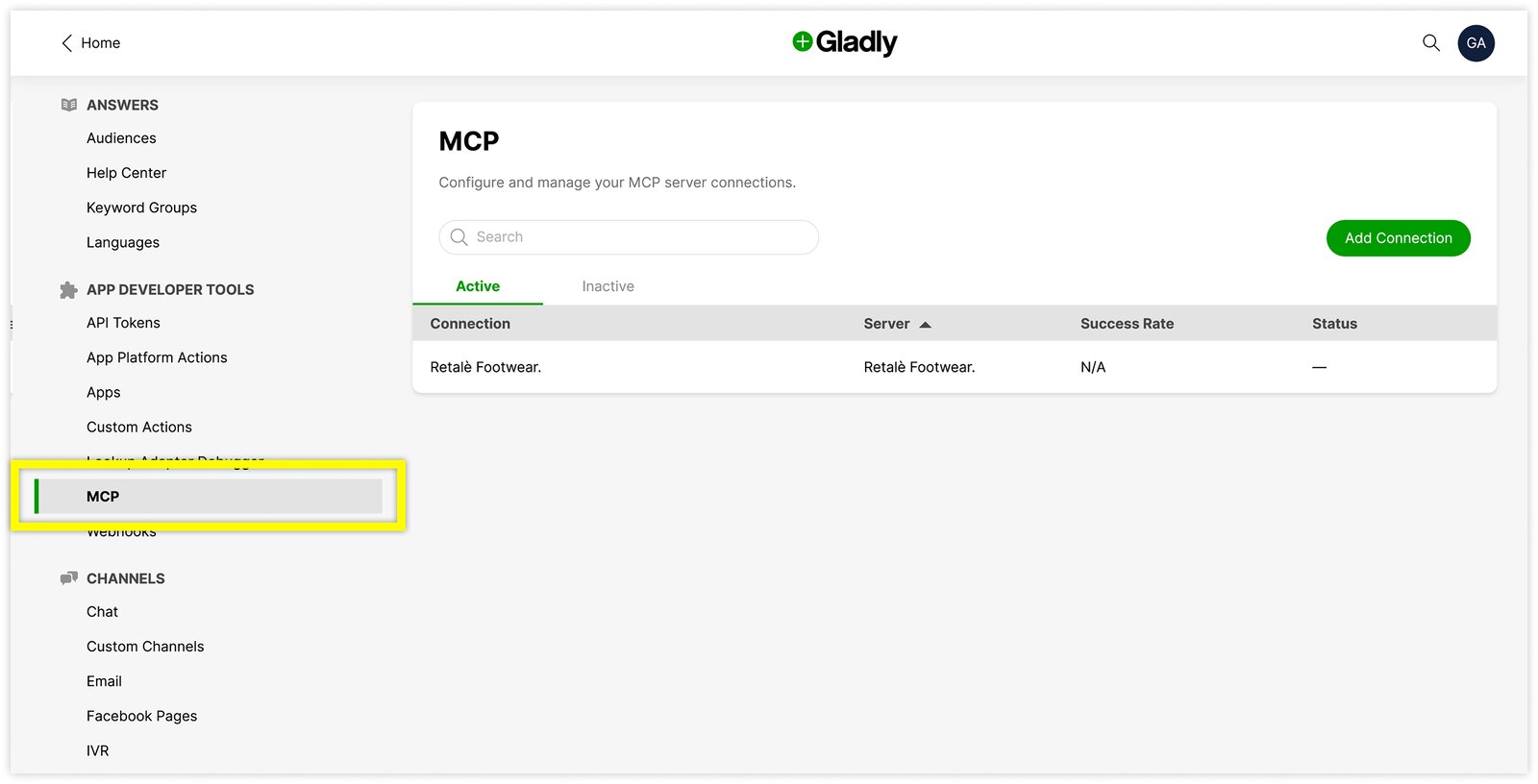
For anything else, your team builds a Custom Action. You name its inputs, pick a tool, and can add a transformation step written in JavaScript. That tool can sit on an MCP server, the open protocol that lets an AI call another system's functions. Your team registers the server, and Gladly lists the tools it offers.
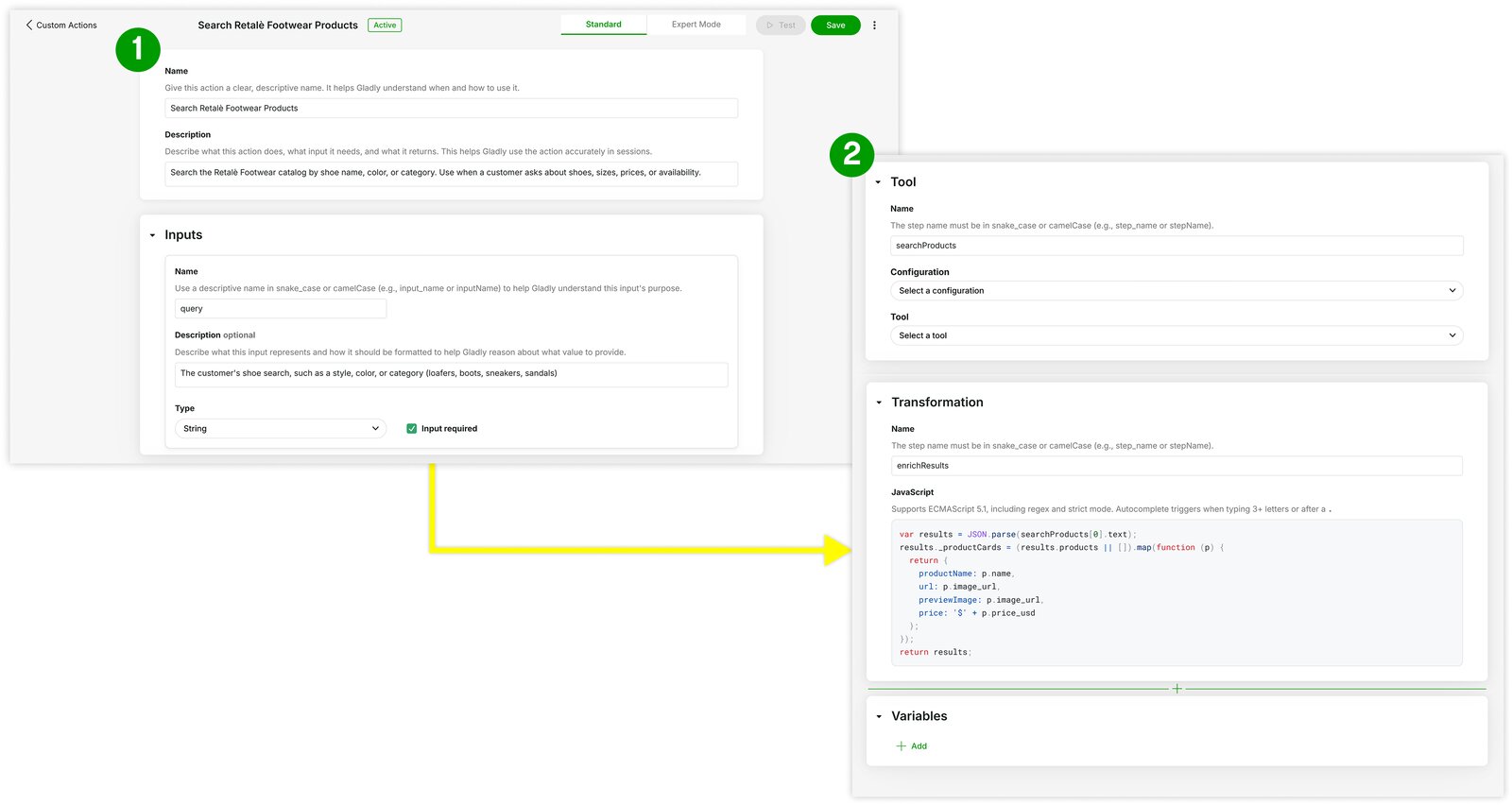
Gladly's own article warns that it does not screen what the tool returns, so your server must only send what a customer may see. For Agentic Commerce, the help centre says Gladly's team reviews your site, identifies the catalogue and order system, and connects them with you.
Algomo integrations
Algomo starts from your website. It records what your pages call, such as the stock check, the order lookup and the booking search, and turns those calls into the agent's tools. Algomo's AI deployment engineer does the discovery, the integration and the upkeep. Your first version runs the same day.
That matters most where no ready connection exists. A made-to-measure price engine or an in-house booking system has no marketplace app, yet your site already talks to it. Algomo learns it from that traffic. Systems only staff can reach use a connector, from the Business plan, and a redesign that breaks a connection is flagged so it can be rebuilt.
The demo library shows it on big brands' own systems with no project on their side. In the Blinds 2go demo, Algomo prices three made-to-measure windows in one card through the site's own price engine. In the Nike demo it reads today's price and UK 9.5 stock. In the Qualtrics demo it runs beside a chat Qualtrics built on Qualified.
Getting the AI connected
| Algomo | Gladly | |
|---|---|---|
| Finds the systems behind your site | ✓ Algomo's AI, from what your pages call | Gladly's team, with you, during an Agentic Commerce setup |
| Builds the connection | ✓ Algomo builds the tools itself | Your team, as actions and Custom Actions |
| Ready connections | ✓ Any system your site already calls | ✓ Shopify and BigCommerce actions, Shopify templates |
| A system with no ready connection | ✓ Learnt from your own pages | An MCP server or App Platform integration your team provides |
| Systems behind a staff login | A connector, from the Business plan | Connected by your team |
Our take: write down the one system behind your store with no Shopify app, then ask each vendor who wires it, and how many of your engineering days that takes.
How fast does a change on your site reach the AI?
TL;DRGladly reuses website results for up to 24 hours and advises putting promotions in a Guide instead, while Algomo opens the live page on every question, and a reviewed agent that contradicts your website makes your next month free.
Retail pages change all the time. A sale starts, a size sells out, a returns window stretches for the holidays. An agent that answers from yesterday's version quotes the old price to a shopper with full confidence.
Gladly knowledge
Gladly answers from Public Answers, documents you upload, your product catalogue and websites. Gladly Support adds a website on request, and the AI can answer from it once the site is indexed. You can then include or exclude paths.
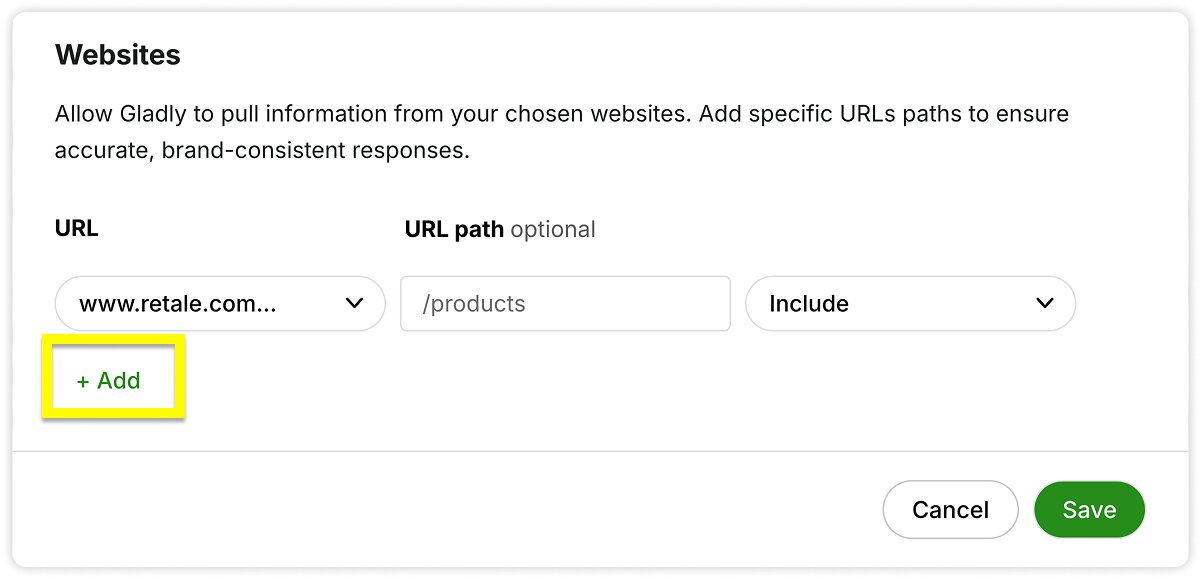
Gladly's help centre explains its caching. If a similar question was asked in the last 24 hours, the AI reuses the earlier results without searching the site again. It says a change to your website may take up to 24 hours to reach the AI, and suggests a dedicated Guide for promotions and other time-sensitive content.
An uploaded document cannot be replaced in place. Your team deletes it, uploads the new version, and selects it again in every Guide section that used it. With Agentic Commerce, product answers come from your catalogue rather than your website.
Algomo agentic search
Algomo keeps no copy of your website to go stale. It knows where your pages are, opens the right one while the shopper waits, and answers from what that page says now and the live data behind it. Edit a price after lunch, and the next shopper who asks hears the new one.
So a promotion needs no separate setup. When it is on the page, the agent quotes it, and when you take it down, the agent stops. Stock and order status are read through the same calls your page makes.
Algomo reviews each agent before it goes live. If a reviewed agent ever contradicts your website, your next month is free, on the terms of the guarantee page.
Where the answers come from
| Algomo | Gladly | |
|---|---|---|
| Your website | ✓ The live page, on every question | ✓ An index, results reused up to 24 hours |
| A sale or promotion | ✓ Read from the page while it is live | A dedicated Guide, as Gladly advises |
| Documents and FAQs | ✓ Knowledge base, plus saved past tickets | ✓ Public Answers and uploaded documents |
| Product data | ✓ The calls your product pages make | ✓ Your product catalogue |
| A guarantee on accuracy | ✓ Next month free if a reviewed agent contradicts your site | None listed |
Our take: change a sale price on one product page, ask both agents about it ten minutes later, and keep the one that gives the new number.
In November 2026 we tried Gladly's AI on 18 retail sites that load it and found no confirmed wrong answer. Only 3 of those sites had an AI that answered a visitor, and each chat asks for an email before it starts, so few answers could be put to a second, fresh visitor.
Can you build and change it from Claude or another assistant?
TL;DRGladly's MCP for Claude is in a closed beta that edits Guides as the signed-in user, while Algomo is built and changed over MCP today from Claude Code, Codex, Cursor, ChatGPT or the Claude app, with every change staged first.
Retail policies move every season. The person who updates the agent, and how safely, decides how much of your week that takes.
Gladly Guides and the MCP for Claude
Gladly's AI is configured as Guides, each with sections of guidance, rules, actions, knowledge sources and handoffs. A changelog records every configuration change, and the Versions page restores an earlier one.
The Gladly MCP for Claude connects Claude to your Gladly organisation. Claude can investigate sessions, draft a Guide from a policy document and test it in a draft. It is a closed beta for organisations Gladly enables, from Claude Desktop or claude.ai on a paid plan. Gladly's own advice is to work on drafts, because saving an active Guide changes what customers see right away.
Algomo AI-first platform
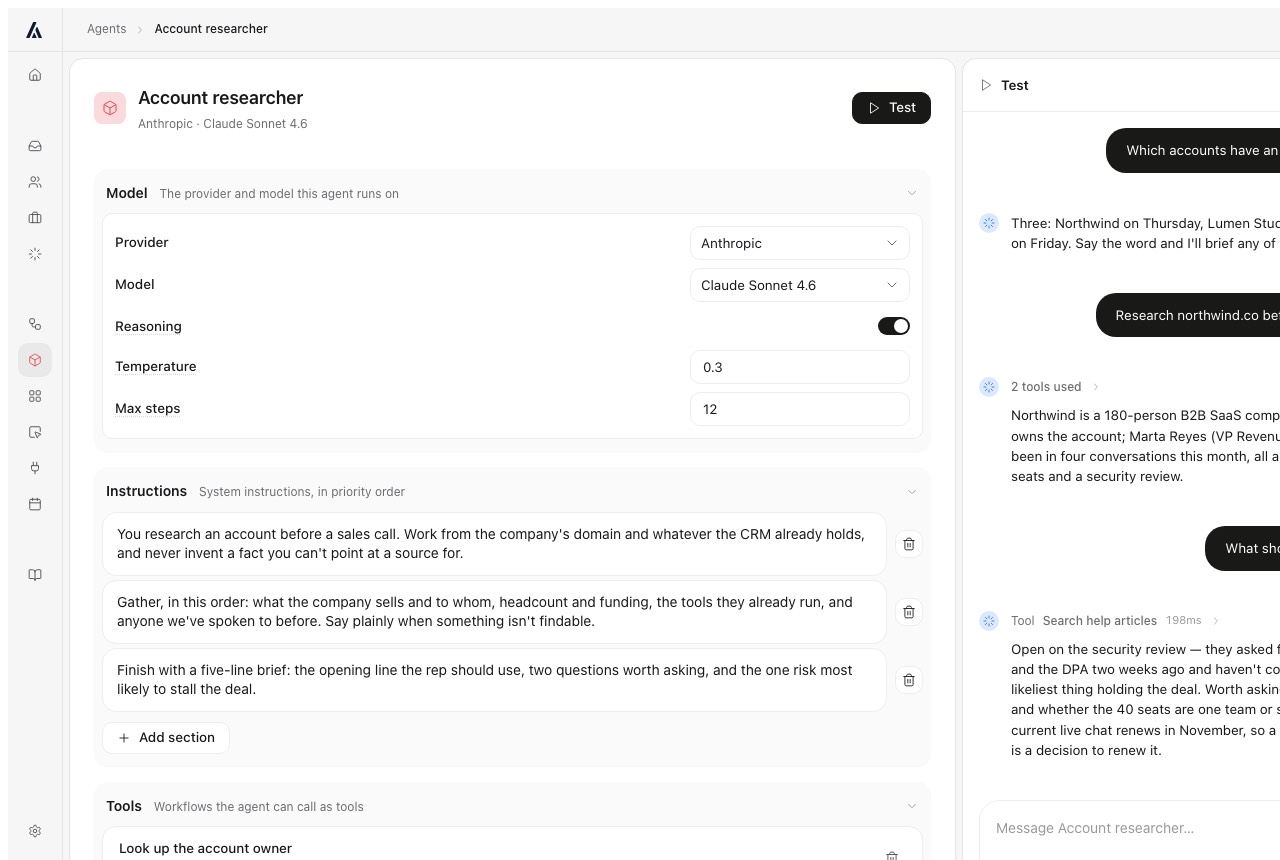
Algomo is built and changed over MCP from Claude Code, Codex, Cursor, ChatGPT or the Claude app, for every customer. You say what the agent should do, and the assistant writes the configuration.
Every change is staged. You preview it on your own site, read what changed, then put it live, and the history keeps why each change was made. Moving a holiday returns window is one sentence, one review and one approval.
Building and changing the agent
| Algomo | Gladly | |
|---|---|---|
| Built from your coding assistant | ✓ Claude Code, Codex, Cursor, ChatGPT, the Claude app | Claude only, in a closed beta |
| Changes staged before customers see them | ✓ Preview, read the diff, then ship | ✓ Drafts, if you choose to work on one |
| History and restore | ✓ What changed and why | ✓ Changelog and Versions |
Our take: take last month's policy change and time how long each product needs to make it, from the request to a tested change on the live site.
Can the AI sell on the page, not just answer?
TL;DRGladly's Agentic Commerce recommends, compares and adds to the cart inside the chat, while Algomo works in the shopper's own browser session and does the steps on the page itself, in plain sight.
A shopper who asks which size to buy usually wants the right size in the basket. Every extra step between the answer and the checkout costs you orders.
Gladly Agentic Commerce
Gladly's Agentic Commerce recommends products from your catalogue, compares options and lets the shopper add an item to the cart without leaving the chat. Enhanced Chat, a chat bar across the site, can offer help based on what the shopper is doing. After the sale, the same AI handles order status, returns and exchanges.
Two details matter when you plan it. Gladly sets up the commerce side with you, and upgrading an existing chat to the new experience is permanent for that chat.
Algomo co-navigation
Algomo runs in the shopper's own browser, on your page, in the session it already has. It sees their prices, their region and their basket. It can filter a collection, apply a code, add to the basket, open the right page beside the chat or check their own order, and the shopper watches each step.
It knows which page the shopper is on and what they viewed this visit, so nobody has to describe the product. It acts only through the tools you gave it, and it works on any website, with no platform app.
Selling on the page
| Algomo | Gladly | |
|---|---|---|
| Recommends and compares products | ✓ From your live product pages | ✓ From your catalogue |
| Adds to the basket | ✓ In the shopper's own session, on the page | ✓ Inside the chat |
| Works the page with the shopper | ✓ Filters, applies a code, opens a page | Chat bar across the site |
Our take: ask each agent to find a product in your size and colour and put it in the basket at your sale price, and watch which one finishes the job.
What can run before and after the conversation?
TL;DRGladly runs Workflows and Rules inside its own platform, while Algomo can run any function you describe, during and after the chat, from a two-factor code to a research memo.
Some jobs fall outside what your website does. Check who a shopper is before showing an order, alert the right person, follow up tomorrow.
Gladly Workflows and Rules
Gladly's Workflows run a fixed sequence of steps the same way every time, such as a required disclosure or a message before a handoff. Rules trigger an action when a conversation meets set conditions, such as routing or closing it.
Algomo workflows and widgets
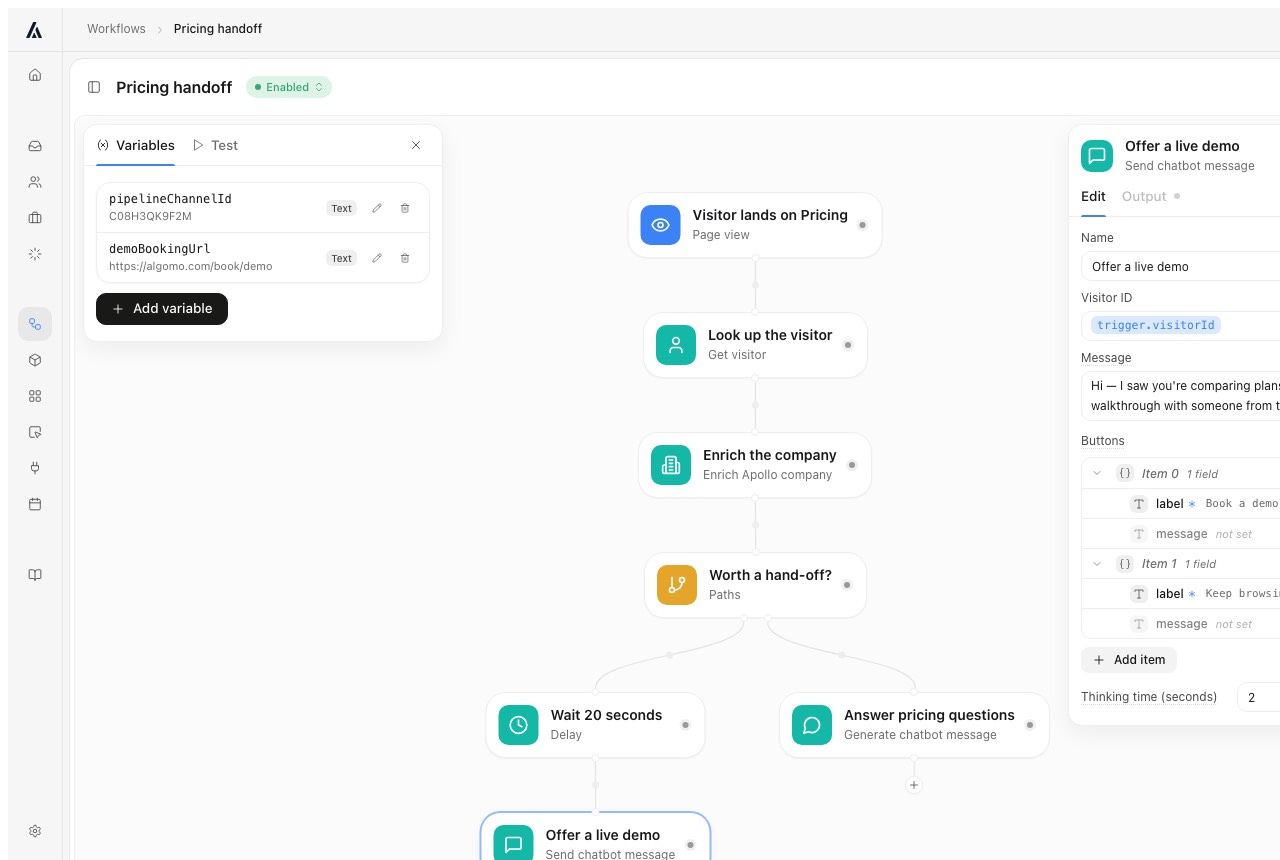
Algomo puts a workflow engine behind every agent. During the chat it can send a two-factor code before it shows an order, apply your routing rules, or alert a manager in Slack. After the chat it can email a summary, or research a business buyer and send your team a memo.
Inside the chat, describe a mini-app such as a product comparison or a quote calculator to your coding assistant, and Algomo builds it as a widget the shopper uses in the conversation.
Our take: pick one task your team does by hand after a chat ends, and ask each vendor to show it running with nobody touching it.
Which channels does each AI answer on?
TL;DRGladly's AI answers chat, email, Facebook, Instagram and SMS and has a voice agent for the phone, while Algomo answers where shoppers browse, in chat on your website, with a follow-up email when they leave.
Shoppers reach you where they already are. If half your volume arrives by phone, a website agent leaves that half to your team. Count where last month's contacts came from before you choose.
Gladly channels
Gladly's AI supports chat, email, Facebook, Instagram and SMS. Voice AI answers the phone from your IVR, the recorded menu a caller presses through, and passes calls to people. Your team works voice, email, chat, SMS, Messenger, Instagram and WhatsApp in one timeline per customer. Chat can also take a card payment, with card numbers redacted.
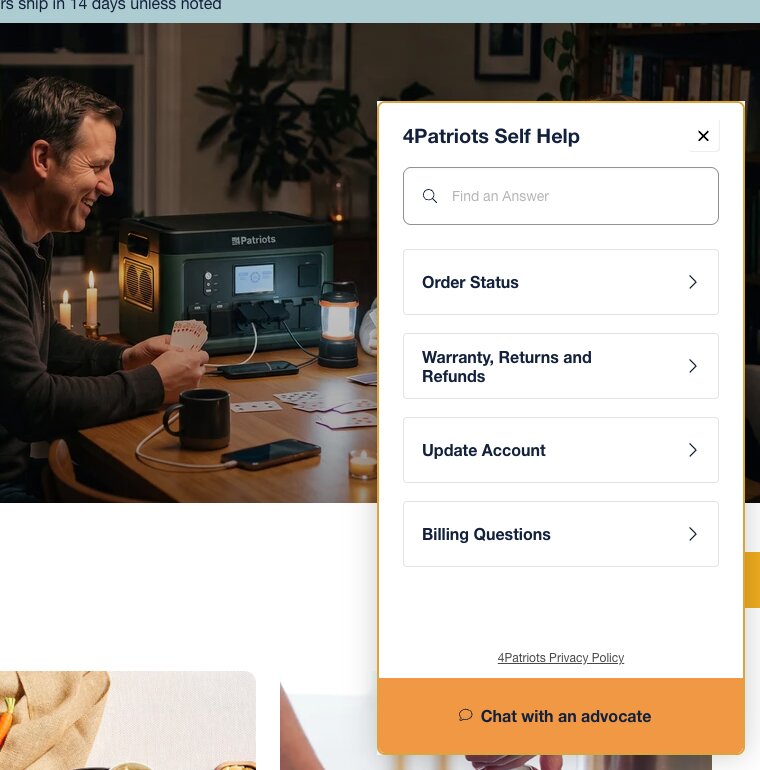
On 4Patriots, which Gladly names as a customer, the chat opens on a self-help panel with a search box and a button to reach a person.
Algomo channels
Algomo is chat on your website, plus a follow-up email to a shopper who left. It does not answer phone calls or incoming email.
Our take: if most of your contacts arrive by phone or in an email queue, choose Gladly, and if they start on a product page, test Algomo there first.
How do you test it, and see why it answered?
TL;DRGladly tests with a simulator, an A/B split by entry point and a step-by-step Inspect view, while Algomo previews on your live site before any code is added and logs every tool call behind every answer.
You want to find a bad answer before a shopper does. When one slips through, your team needs to see why in minutes, not after a support ticket to the vendor.
Gladly testing and review
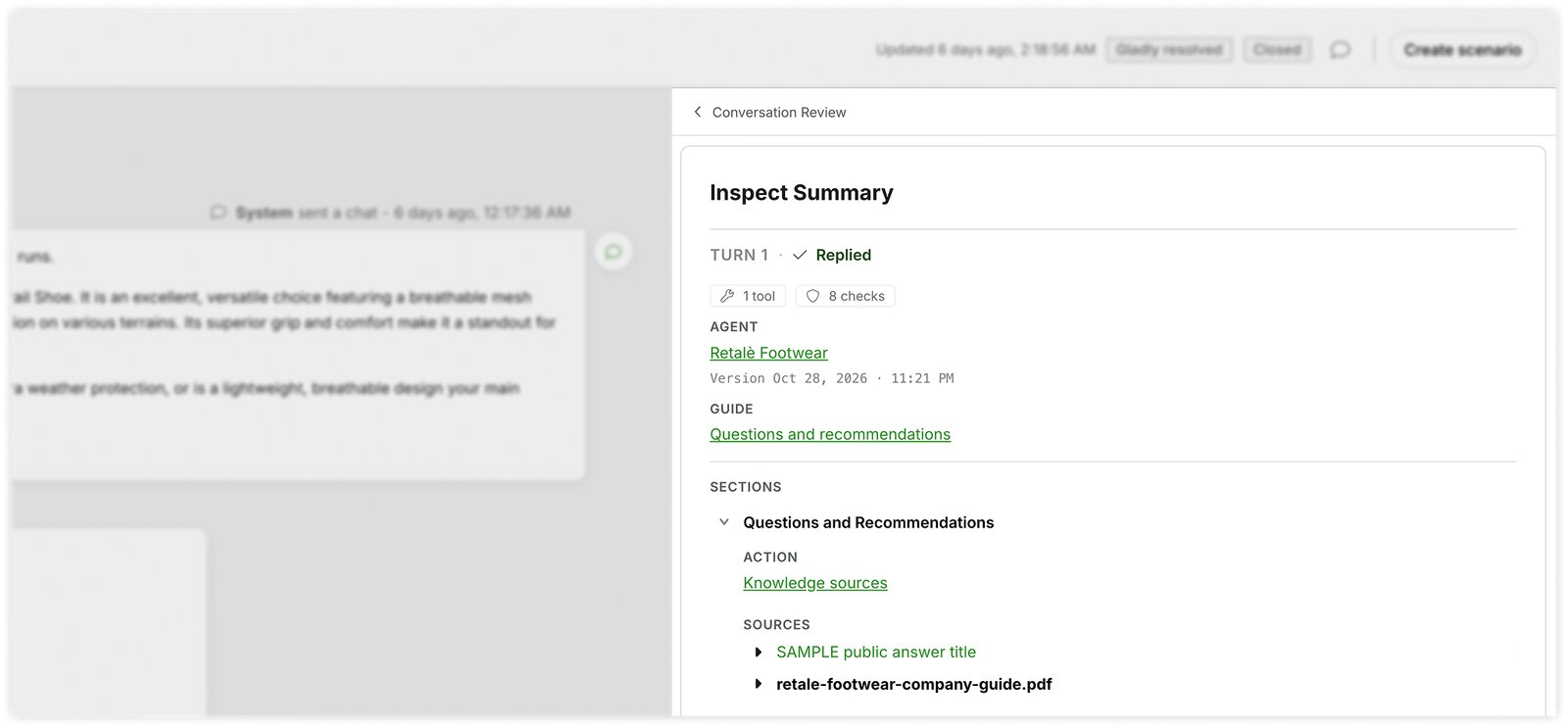
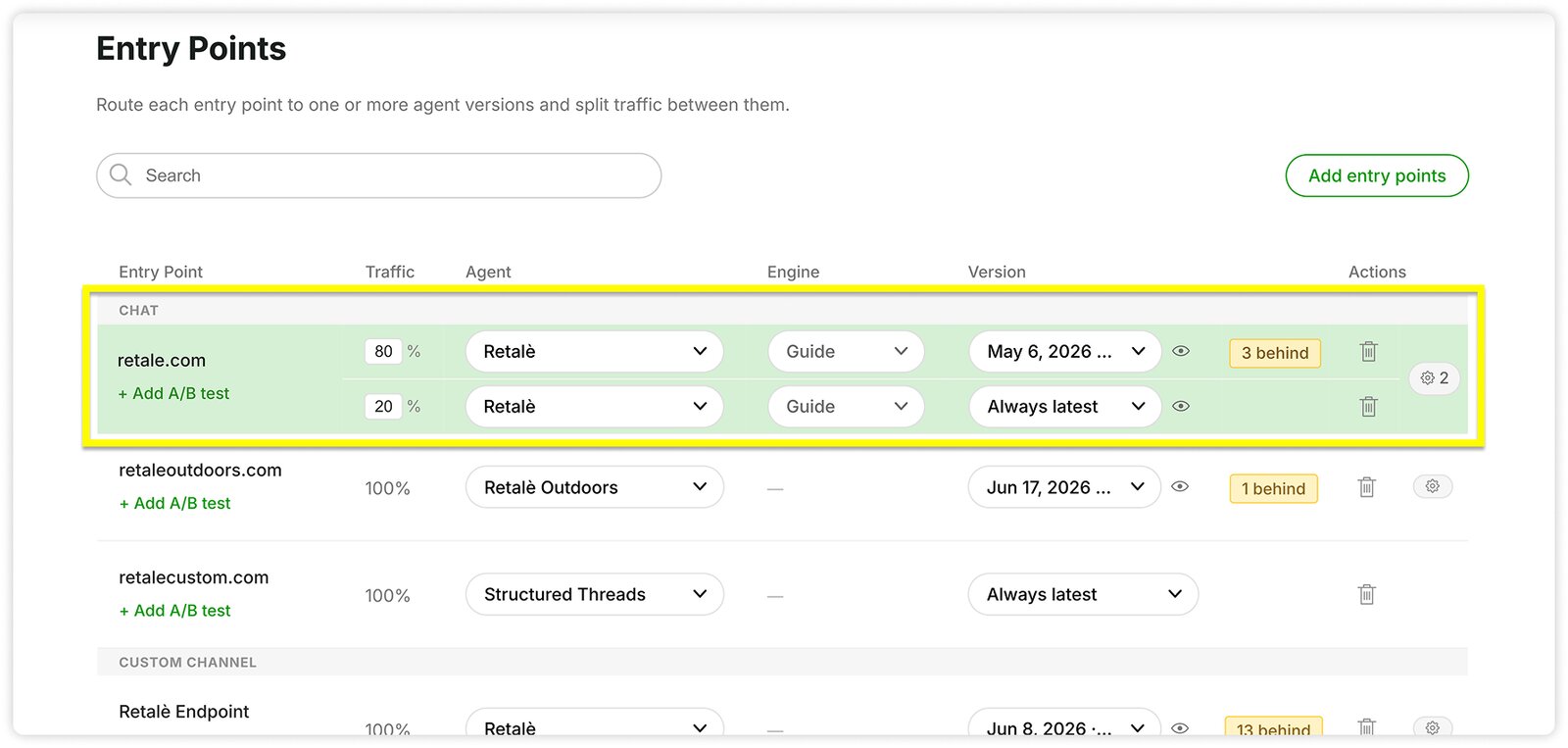
Gladly's Simulator runs written test scenarios. An A/B test splits traffic on an entry point, such as your website chat, between two agent versions. Review and Inspect show a manager how the AI reached a reply: the Guide it followed, the actions it ran and the knowledge sources it retrieved.
Algomo testing and audit
Algomo lets you preview the agent on your live site from its browser extension before any code is added. Testing spends its own credit allowance, 200 a month on Free and 1,000 on Business, never the live budget.
After launch, every answer logs the tools it called, with inputs, outputs, time and cost, and every workflow run keeps a step-by-step trace.
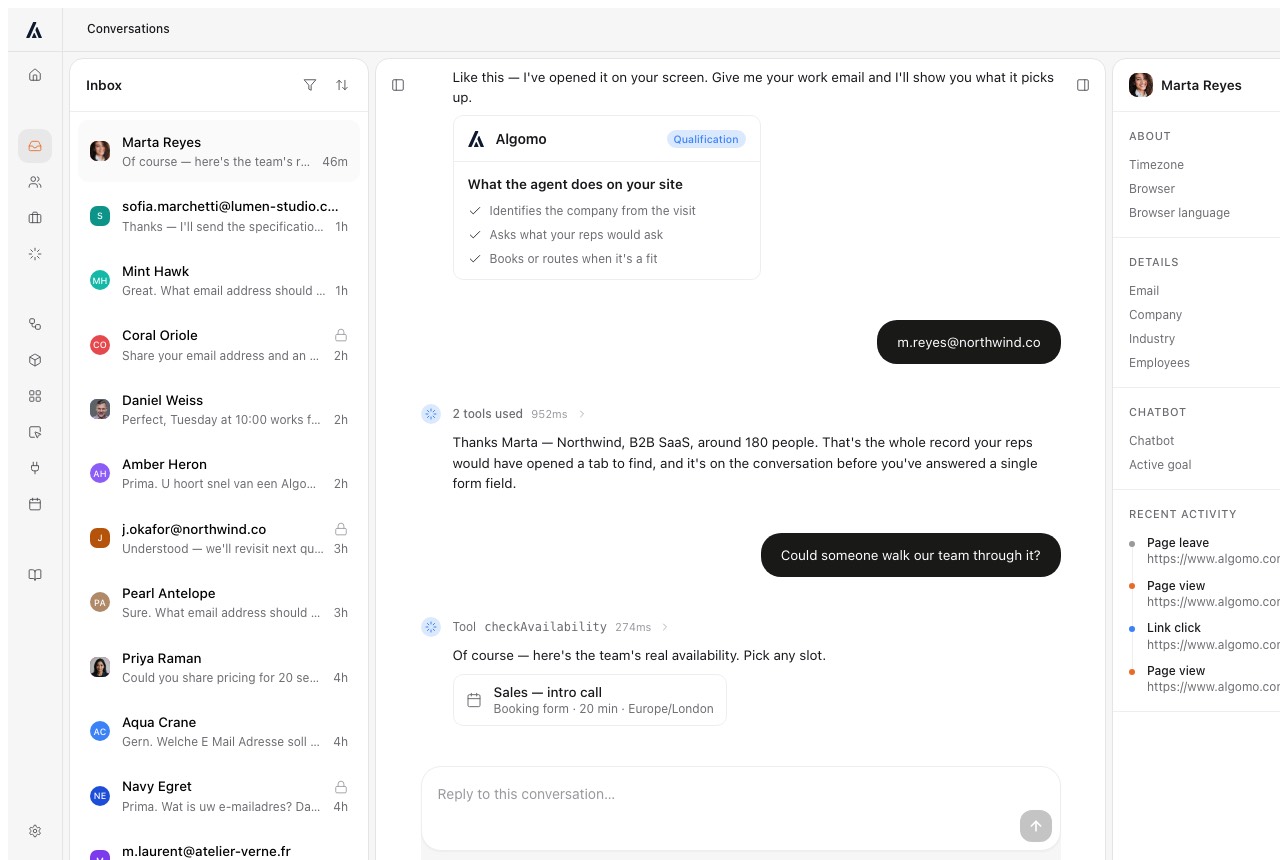
Our take: open one wrong answer in each product and check whether you can see the exact data it read, or only which instructions it followed.
What happens when a person needs to step in?
TL;DRGladly hands the conversation to a person inside the customer's timeline with a handoff reason you wrote, while Algomo alerts the right person by email and Slack and they join the live chat on your site with the transcript.
Damaged parcels, refunds and angry customers need a person. What that person sees when they pick it up decides whether the shopper repeats the whole story.
Gladly handoff
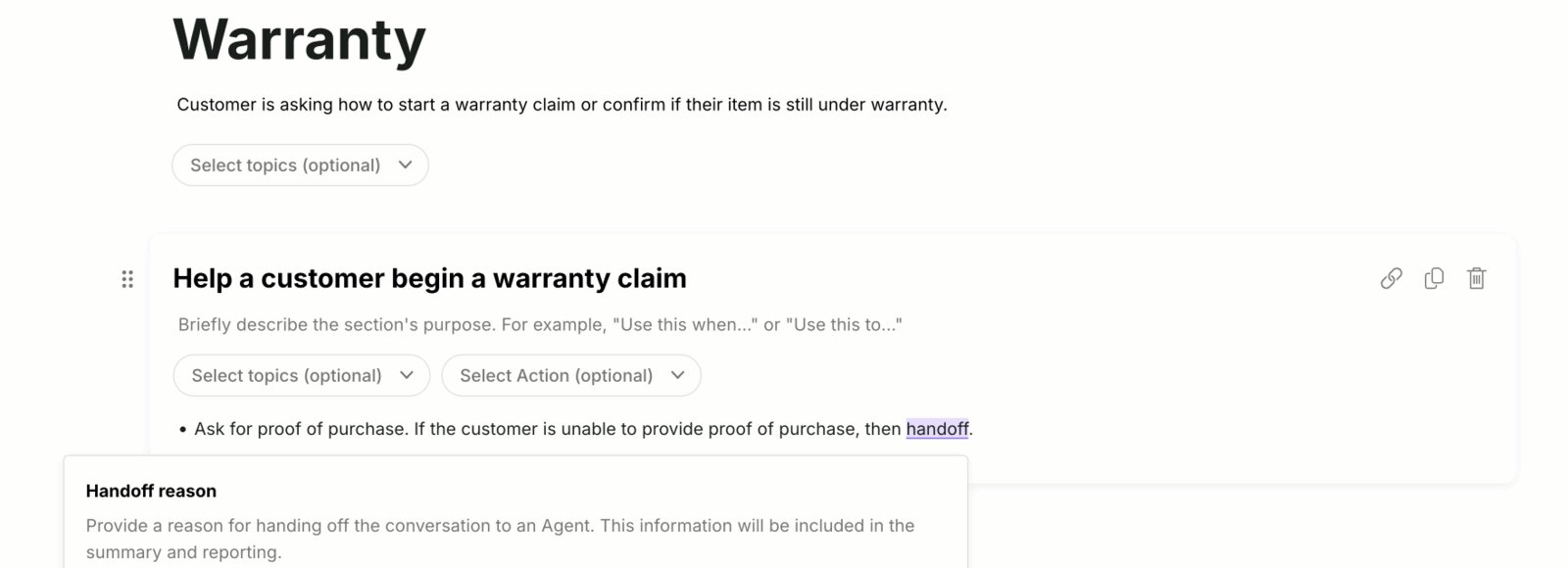
In Gladly, your team writes handoffs inside a Guide, such as handing off when an order arrived damaged. Each one carries a reason, which appears in the handoff summary on the customer's timeline. After hours, an unresolved chat becomes a follow-up email for your team.
Algomo handoff
Algomo hands over on rules you set, by topic, by page, or when the shopper asks. The right person is told by email and Slack and joins the conversation live on your site, with the full transcript and the tools the agent called. If your team works tickets in a helpdesk, a connector can open the ticket there.
Our take: trigger a handoff on each, and read what the person sees before they type their first word.
What does the first week look like?
TL;DRGladly starts with a demo and a sales conversation, and parts of the setup go through Gladly Support, while Algomo's free plan puts an agent on your own site the same day with no card.
Before anyone signs, your team wants to see the AI answer about your own products. How soon that happens decides how fast you can judge it.
Setting up Gladly
Gladly's site offers a demo, an interactive tour and a contact form, and lists no self-serve plan. Its guided setup, which asks for your website and Shopify store, is not yet in every Gladly instance. Websites as knowledge, some channel entry points and the commerce setup go through Gladly Support or your account manager.
Setting up Algomo
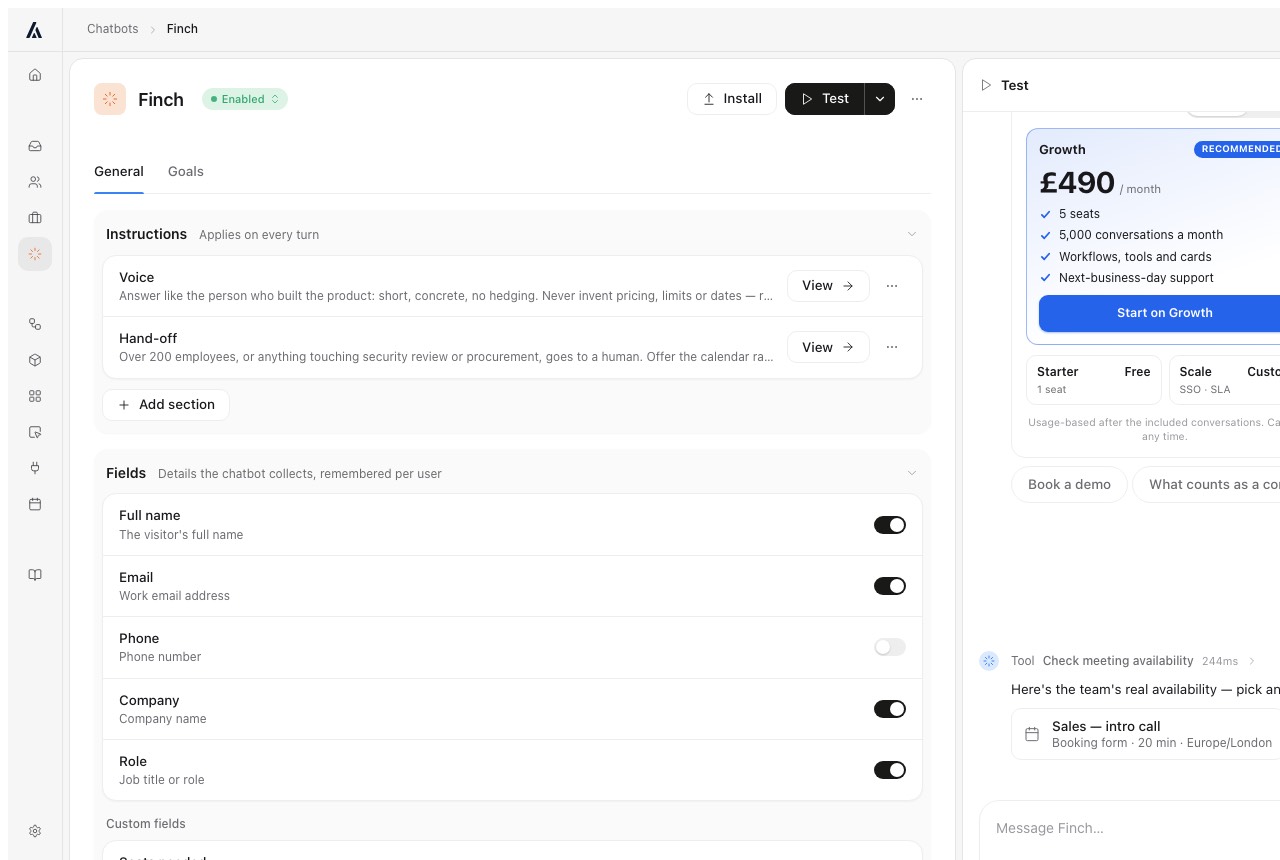
Algomo's free plan is self-serve with no card. You give it your URL, it finds the systems your pages call, and the first version runs the same day. You shape what it says in plain language and test it beside the configuration.
Connectors for systems behind a staff login come with the Business plan. You set them up from your coding assistant, or in a session with Algomo's team, which usually takes a day or two.
Our take: ask Gladly for a date when its AI will answer on your own site, and compare it with an afternoon on Algomo's free plan.
What does each one hold that could open a customer's account?
TL;DRGladly backs its platform with SOC 2 Type II, PCI DSS and a HIPAA agreement, while Algomo's agent works from the shopper's browser and stores no token for anything your website already does.
An AI that looks up orders needs access to order data. Your security team will ask what the vendor keeps in order to get it.
Gladly security
Gladly's security page lists SOC 2 Type II, PCI DSS, HIPAA with a signed BAA, GDPR and CCPA, with AES-256 encryption and annual penetration tests. Its AI partners are named as Azure, OpenAI, Anthropic and Deepgram, which keep messages up to 30 days for abuse monitoring. The AI reaches your systems through the actions and MCP connections your team sets up.
Algomo security
Algomo is secure by design. When it checks stock, a price or the shopper's own order, the request goes from that shopper's browser, the same way your page sends it. For all of that, Algomo stores no token or credential.
A staff-only system such as a CRM or billing needs a connector, and Algomo does store that login, encrypted with AES-256-GCM and revocable at any time. Algomo holds Cyber Essentials, is registered with the ICO under ZA821756, works to UK and EU GDPR, and hosts its application, database and files in the EU.
Our take: ask each vendor to list every credential it would store to answer "where is my order".
How much does Gladly cost compared with Algomo?
TL;DRGladly publishes no price and Vendr reports its buyers' median at $24,150 a year, while 1,000 helped conversations a month on Algomo sit on the $200 plan, $2,400 a year.
A quote you cannot check is hard to budget. Your finance team wants a number before the first call, and a bill that holds still when a good month brings more shoppers.
How Gladly bills
Gladly lists no price on its site, and its pricing address goes to the home page. The nearest public figure is from Vendr, a software buying service, which reports what its own buyers paid. That is an estimate, not Gladly's price.
On Vendr's Gladly page, the median buyer pays $24,150 a year, in a range from $14,323 to $78,521. Vendr describes Gladly Hero, the workspace for your team, as per-seat licensing with a 10-seat minimum. One Vendr buyer noted Hero AI Support seats offered at $155 a person a month against a usual $180.
On that buyer's number, ten seats come to $1,550 a month, or $18,600 a year. The note covers seats only.
How Algomo bills
Algomo's free plan is self-serve, with 100 credits a month, about twenty helped conversations, and no card. Then you pick one monthly amount. The ladder runs $50 for 2,000 credits, $100 for 4,000, $200 for 8,000 and $400 for 16,000, up to $4,300 for 200,000, with Enterprise above.
A conversation that helped someone costs 5 credits, plus 5 for every further ten replies. One that went nowhere costs nothing. There are no seats. The amount you picked is the most any charge can be, unused credits roll over, and when they run out the agent pauses until you renew.
How the two bills behave
| Algomo | Gladly | |
|---|---|---|
| Published price | ✓ On the pricing page | None, through sales |
| A charge per person on your team | ✓ None | Per seat, 10-seat minimum, per Vendr |
| A free way to start | ✓ Free plan, no card, no end date | A demo and an interactive tour |
| A busier month than planned | ✓ Capped at the amount you set | Depends on your contract |
Here is the worked sum for Algomo. 1,000 helped conversations a month are 5,000 credits. No plan holds exactly 5,000, so you would buy the $200 plan with 8,000, which is $2,400 a year.
The two figures cover different work. Gladly's includes a full service platform for your team across every channel. Algomo's is the agent on your website, with its inbox.
Our take: ask Gladly for a written quote with seats, AI usage and any services itemised, and set it beside the Algomo plan that fits last month's chats.
What to ask any vendor selling you an AI agent
TL;DRFive questions, each with something to try in the demo.
- Who connects our order system, and when? Ask for it to be done live on the call.
- If we change a price now, when does the AI quote it? Change one and ask again.
- Where did that answer come from? Ask them to open the record behind it.
- Can it put a product in my basket at my price? Ask it to.
- What does it store to look up my customer's order? Ask for the list in writing.
Run every test on your own store, not on the vendor's demo site.
Which one fits your brand?
Choose Gladly if
- A large share of your customers phone, and you want an AI voice agent on that line.
- Your team works email, SMS, Instagram and WhatsApp alongside chat, and wants one timeline per customer.
- Your procurement asks for SOC 2 Type II, PCI DSS or a HIPAA agreement on the vendor's side.
Don't choose Gladly if
- Your shoppers ask on your website, and the answers live on its pages and the systems behind them.
- A system behind your store has no ready connection, and nobody has time to build one.
- A shopper told yesterday's price is a risk you will not take.
- You want to start today on a published price, without a sales cycle.
- You want the agent to act on the page with the shopper: their basket, their price, their own order.
Conclusion
TL;DRChoose Gladly when you want one service platform for every channel with AI and voice inside it, and choose Algomo when your shoppers are on your website and you want the wiring done for you and every answer read from the live page.
On implementation, Gladly gives your team actions, custom actions and MCP connections, and runs the commerce setup with you. Algomo finds the systems behind your site and connects to them itself, with a first version the same day.
On accuracy, Gladly answers your website from an index it may reuse for 24 hours. Algomo reads the live page every time and puts a month's fee behind it. Building, selling, channels and the bill follow from those two.
Questions buyers ask about Algomo and Gladly
Is Algomo a good Gladly alternative?
Yes, when your customers' questions start on your website. Algomo connects itself to the systems behind your pages, answers from the live page, and costs one published monthly amount. If you need phone, email and social messages in one service platform, Gladly is built for that.
How much does Gladly cost?
Gladly does not publish prices. Vendr, which tracks what its buyers pay, reports a median of $24,150 a year, ranging from $14,323 to $78,521, and per-seat licensing with a 10-seat minimum for Gladly Hero. Those are Vendr's figures, so ask Gladly for a written quote.
Who owns Gladly?
Gladly Software, Inc. is independent and privately held. Its last reported round was $40 million in September 2024, led by AXA Venture Partners, and in 2023 it bought Thankful, whose AI became Gladly Sidekick.
What is Gladly Sidekick?
Sidekick was the name of Gladly's AI for customers, built on the technology Gladly bought with Thankful. The site now calls it Gladly AI, with the Commerce Agent and Shopping Assistant for selling, and the help centre still uses Sidekick in places.
Does Gladly have an AI voice agent?
Yes. Gladly's Voice AI answers calls from your phone menu and passes them to a person when needed. Algomo has no voice channel and answers chat on your website.
Does Gladly work with Claude?
Gladly has an MCP for Claude in closed beta, which lets an admin investigate sessions and edit Guides from Claude Desktop or claude.ai. Algomo is built and changed over MCP for every customer, from Claude Code, Codex, Cursor, ChatGPT or the Claude app.
Can I run Algomo while my team stays on Gladly?
Yes. Algomo answers on your website, and when a person is needed it alerts your team by email and Slack so they join the chat live. Past tickets can be saved into Algomo's knowledge base.
Which AI model does Algomo use?
The default model is from OpenAI. On Enterprise you choose the provider, and the application, database and files stay hosted in the EU.
Where these facts come from
All the information on this page was available in November 2026. The sources are:
- Gladly's home page: the product, channels and the company name in its footer.
- Gladly's security page: certifications and encryption.
- Gladly's customers page: 4Patriots as a named customer.
- The knowledge sources article: website indexing, caching up to 24 hours and advice on promotions.
- The Agentic Commerce article: add to cart in chat, Enhanced Chat and what Gladly sets up with you.
- The MCP for Claude article: the closed beta and how changes are saved.
- The AI security article: AI partners and data retention.
- The channels article: which channels Gladly's AI supports.
- Gladly help centre articles, each named under its screen.
- Vendr's Gladly page: the median, range, seat minimum and a buyer's seat price.
- Gladly's funding release from September 2024, and CX Today on the Thankful purchase.
- Algomo's pricing page, Algomo's compliance page and the guarantee page.
- The demo library, for the Blinds 2go demo, the Nike demo and the Qualtrics demo.