
Summarize withChatGPTPerplexityClaudeGrokAlgomo vs Agentforce
TL;DRAgentforce leaves the integration to your Salesforce admins and answers your website from a daily copy, while Algomo connects itself to your systems and reads the live page, with a free month if a reviewed agent contradicts your site.
Two things stall an AI agent project. One is the months spent wiring it to your systems. The other is an answer taken from a page that has since changed. The rest of this page follows those two risks.
Agentforce now sits beside other Salesforce purchases. Salesforce completed its acquisition of Informatica in November 2025, Qualified in April 2026 and Fin, formerly Intercom, in September 2026.
Algomo vs Agentforce at a glance
| Algomo | Agentforce | |
|---|---|---|
| What it is | An AI agent for your website, with an inbox your team takes over from. It handles support and inbound sales. | A platform for building AI agents for service, sales and internal work, running on the Salesforce CRM and Data 360. |
| Who owns it | Algomo | Salesforce, which also owns Informatica, Qualified and Fin, formerly Intercom |
| Who does the integration | Algomo's AI. It records what your pages call and turns those calls into tools. | Your Salesforce admins and developers, who turn Flows, Apex, APIs and MuleSoft connectors into agent actions. |
| Where website answers come from | The live page and the live data behind it, read when the question is asked. | Pages a Data 360 connector ingests from your public site, every 24 hours, into a search index. |
| Published pricing | Free plan, then one monthly amount from $50 to $4,300, at 40 credits per dollar or more. | Flex Credits at $500 per 100,000 with 20 credits an action, or $125 a user a month for an add-on. Per-conversation pricing is for existing customers, through sales. |
| How you buy it | Self-serve, with no card for the free plan and no seats. | Free to start with Salesforce Foundations, then through a Salesforce Account Executive for the buying models. |
| Biggest limitation | Does not answer phone calls or incoming email. | Website pages rendered by JavaScript are not ingested, and the website copy refreshes every 24 hours. |
What part of Agentforce do you need?
TL;DRAgentforce suits a company that runs on Salesforce and wants agents on every channel and inside the CRM, and Algomo suits the questions your visitors ask on your website, answered from the page and the systems behind it.
Agentforce covers a lot of ground: service agents, sales agents, voice, employee agents and Slack. You probably need one slice of it. Match your slice to a product:
- Agents that work inside Salesforce records for your own staff: Agentforce.
- Phone calls answered by an AI voice: Agentforce.
- Visitors on your website who want an answer, a price or an order checked there and then: Algomo.
- A site that runs on an in-house booking engine or an older platform no connector covers: Algomo, which learns it from your own pages.
The sections below start with the two risks, integration and answer quality. The builder, the channels, the handoff, security and the bill come after.
Who connects Agentforce to your systems, and how long does it take?
TL;DROn Agentforce your Salesforce admins and developers turn Flows, Apex and APIs into agent actions, while Algomo records what your website already calls and connects to those systems itself, with a first version the same day.
A useful agent has to reach the systems behind your site: stock, orders, bookings, quotes. Somebody has to connect it to each one. For your team, the question is whose time that takes and how many weeks pass before a customer sees the result.
Agentforce integrations
Agentforce agents act through actions. Salesforce's how-it-works page says you can turn your existing workflows, prompt templates, Apex and APIs into actions, and reuse Flows. MuleSoft connectors reach systems outside Salesforce. The page says Agent Builder is for Salesforce admins and developers.
So the starting point matters. If your orders and customers already live in Salesforce, much of the data is in reach. If your stock or booking system lives elsewhere, someone builds the Flow, the Apex class or the MuleSoft connection first. Salesforce's Agentforce page links to a directory of consulting partners for that work.
Algomo integrations
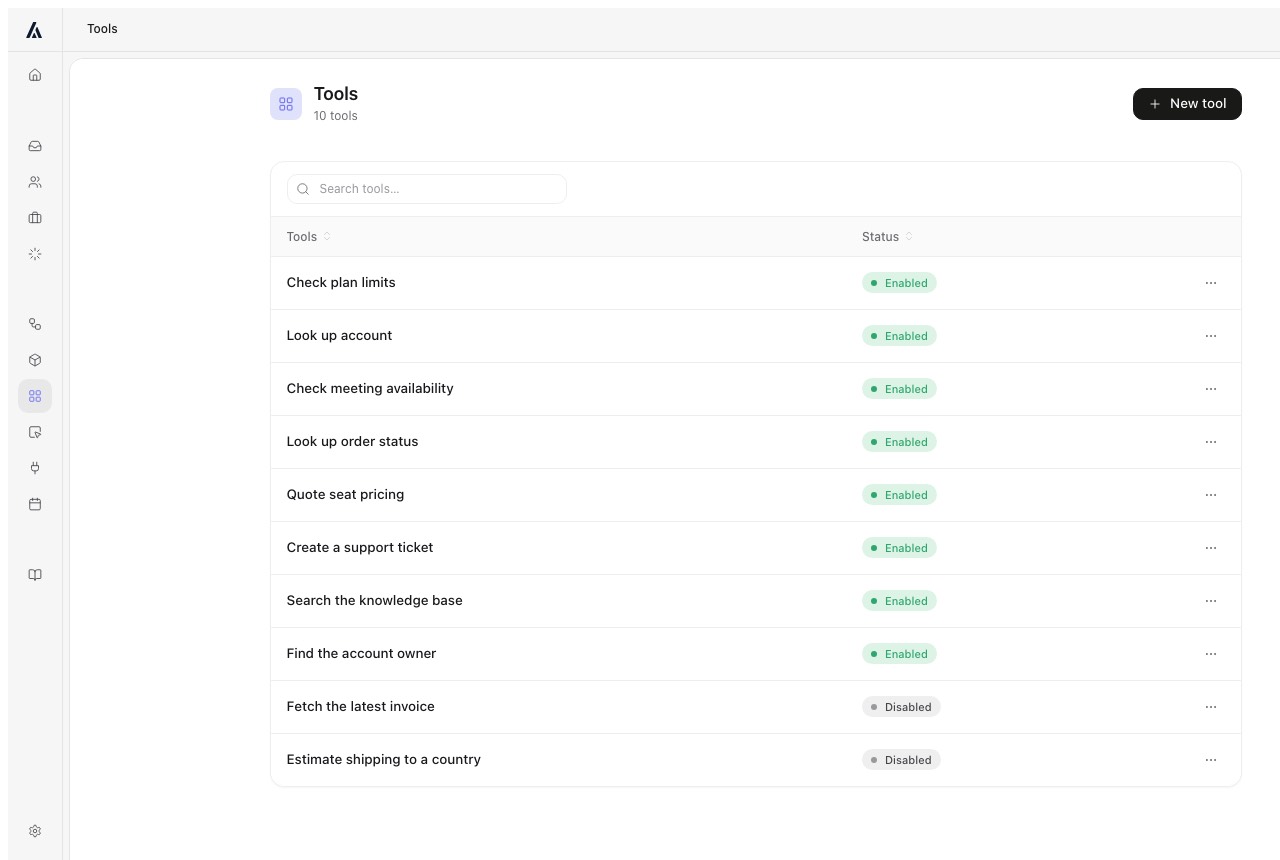
Algomo starts from your website. It records what your pages call, such as the stock check, the order lookup and the booking search, and turns each call into a tool for the agent. Algomo's AI deployment engineer does the discovery, the integration and the upkeep. Your first version runs the same day.
This gap is widest where your stack is unusual. Algomo learns an in-house booking engine or an older ERP from what your site already does with it. Systems that only your staff can reach use a connector, from the Business plan. If a redesign breaks a connection, Algomo flags it so the mapping can be rebuilt.
The demo library shows it on brands' own systems with no project on their side. In the Qualtrics demo, Algomo runs beside the chat Qualtrics built on Qualified, now a Salesforce company, whose own site quotes 30 to 60 days to implement. In the Blinds 2go demo it prices three made-to-measure windows in one card with the site's price engine. In the Nike demo it reads the live price and UK 9.5 stock.
Getting the agent connected
| Algomo | Agentforce | |
|---|---|---|
| Finds the systems behind your site | ✓ Algomo's AI, from what your pages call | ✗ Your team chooses and builds each action |
| Builds the actions | ✓ Algomo builds the tools itself | ✗ Admins and developers, in Flows, Apex or MuleSoft |
| Data already in Salesforce | Through a connector, from the Business plan | ✓ Native to the platform |
| First version answering | ✓ The same day | After the actions are built |
| When the website changes | ✓ A broken connection is flagged for rebuilding | Your team updates the affected actions |
Our take: if the system behind your site is not Salesforce, try Algomo's free plan on your site and list what it connects to before you scope a partner project.
Does Agentforce answer from your live website?
TL;DRAgentforce grounds website answers in a Data 360 copy that its crawler refreshes every 24 hours and that skips content rendered by JavaScript, while Algomo opens the live page for each question and backs that with a free month if a reviewed agent contradicts your site.
Your website is where prices, stock and policies change first. An agent that answers from a copy repeats yesterday's version until the next refresh. What is at stake for you is a customer quoted a number you stopped charging this morning.
Agentforce knowledge
Salesforce's guide to grounding Agentforce on your website has you ingest the site into Data 360 with a sitemap or crawler connector. Your team then builds a search index and a retriever, and the agent answers from that index. Setting up the crawler needs the Data Cloud Architect permission.
The crawler connector ingests the data every 24 hours. The guide says Data 360 ingests only public content, and nothing generated by JavaScript. The connector's limits page adds that it marks all ingested content as English.
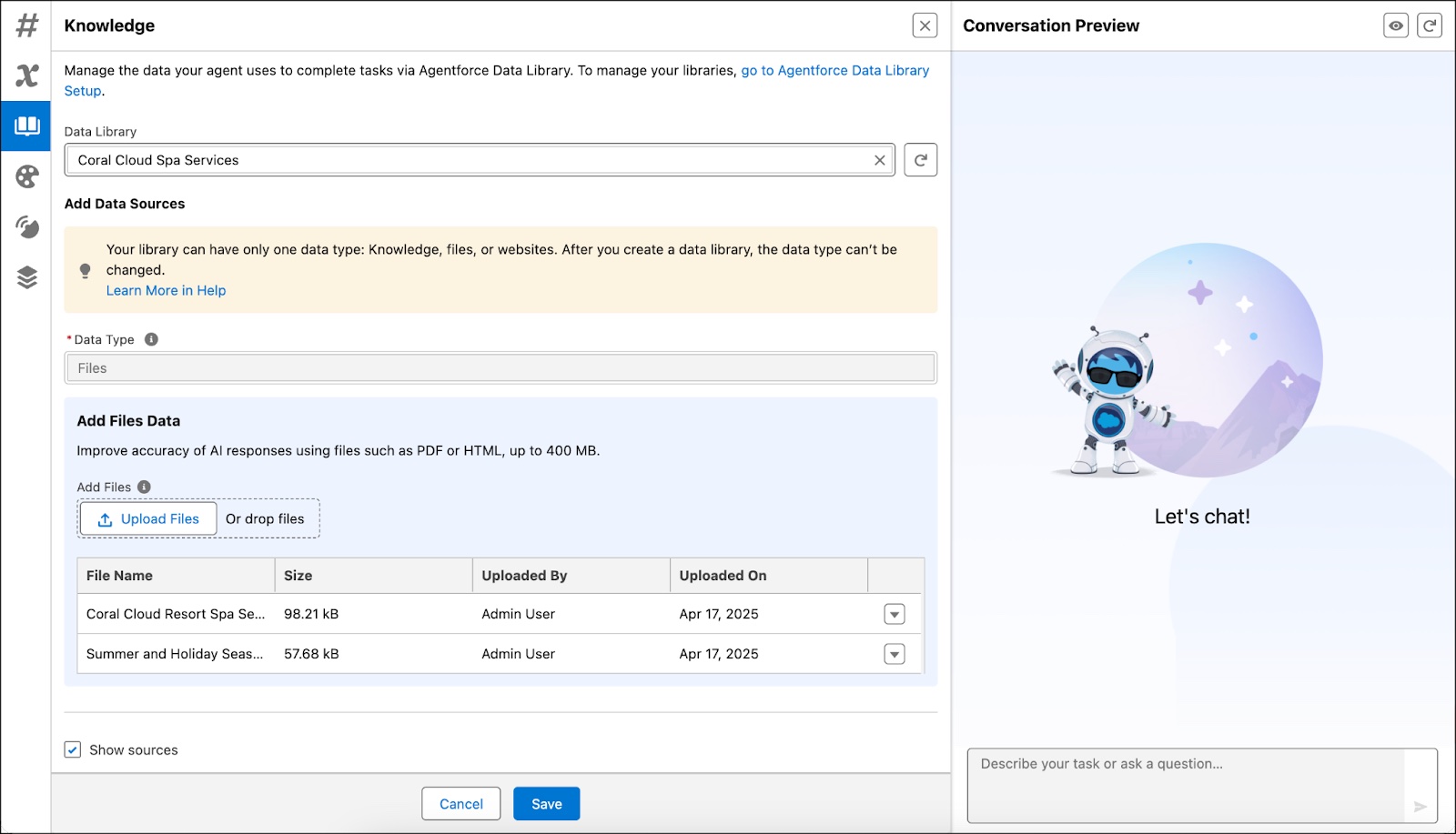
Inside Agentforce Builder, a data library holds one type of source: knowledge articles, files or websites. You cannot change the type once the library exists.
Algomo agentic search
Algomo keeps no copy of your website. It knows where your pages are, opens the right one while the visitor waits, and answers from what that page says now. Live data comes through the same calls your page makes. If you change a price at nine, the answer is right at nine oh one, with no crawl to wait for.
Algomo reviews each agent before it goes live. If a reviewed agent ever contradicts your website, your next month is free, on the terms set out on the guarantee page.
Where website answers come from
| Algomo | Agentforce | |
|---|---|---|
| Your website | ✓ The live page, on every question | ✓ A copy in Data 360 |
| How fresh the website copy is | ✓ No copy, read live | Re-ingested every 24 hours |
| Pages built by JavaScript | ✓ Read through the calls the page makes | ✗ Not ingested |
| Knowledge articles and files | ✓ In the knowledge base | ✓ In a data library |
| Data in your CRM | Through a connector, from the Business plan | ✓ Salesforce records, natively |
Our take: open one important page with JavaScript switched off in your browser, which is Salesforce's own check, and if it goes blank, ask how Agentforce would ever read it.
Who builds the agent, and who changes it later?
TL;DRAgentforce gives your admins Agentforce Builder, a low-code workspace with its own Agent Script language, while Algomo is built and changed from the coding assistant you already use, with each change staged and shown first.
An agent needs changing every week: a new product, a new return rule, an exception for one country. Whoever makes that change, and how they check it, decides the cost of keeping the agent right.
Agentforce Builder
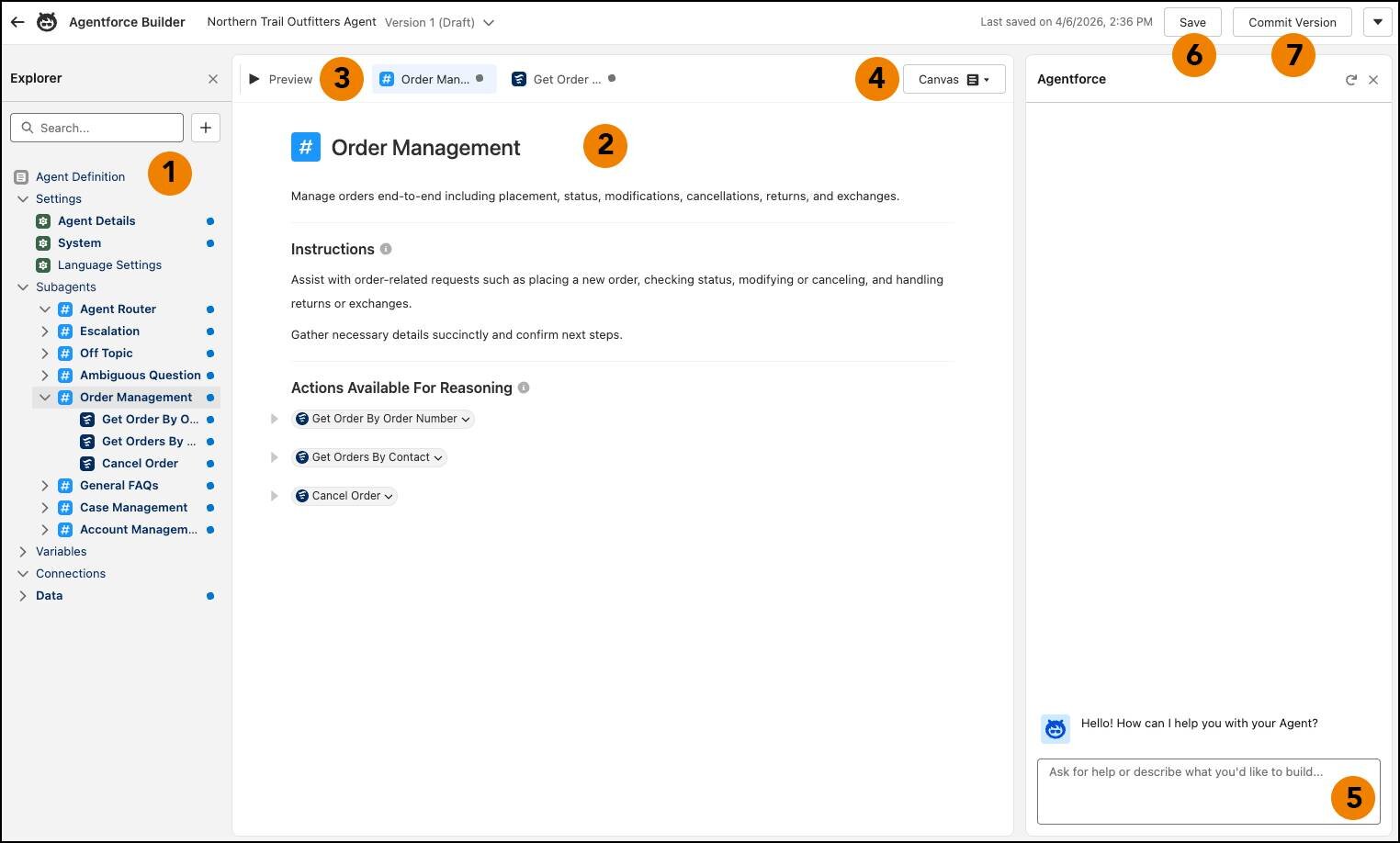
Agentforce Builder lives in Agentforce Studio. Your team writes the agent in plain language on Canvas, a document-style workspace, and adds conditions and variables in Agent Script, Salesforce's language for agents. Agent Optimizer, an assistant inside the builder, drafts changes and explains behaviour. The builder comes with Agentforce at no extra cost.
Salesforce's MCP page says Agentforce will use MCP, the open protocol that lets software call tools in other software, through a native MCP client. The page is written in the future tense and gives no date.
Algomo AI-first platform
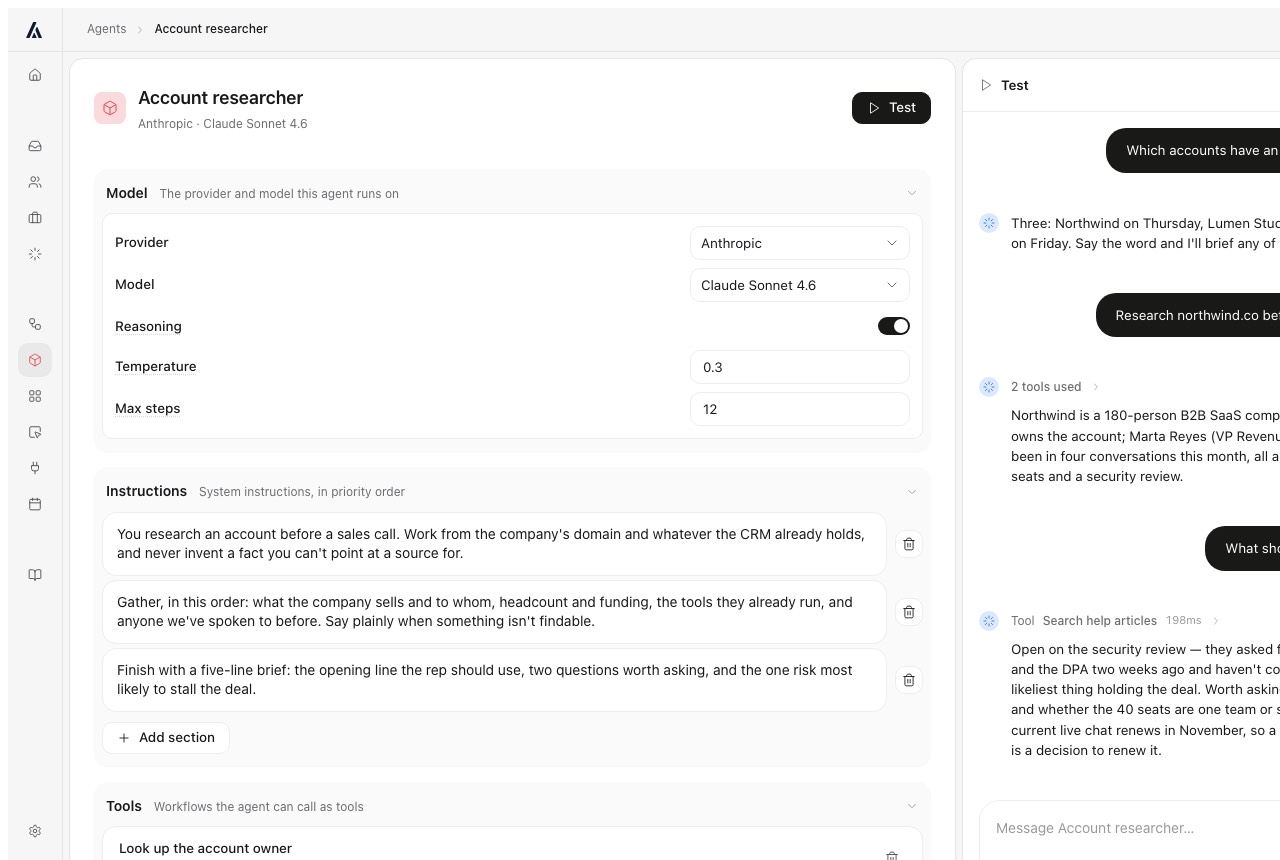
You build and change Algomo from Claude Code, Codex, Cursor, ChatGPT or the Claude app, over MCP. You say what the agent should answer and your assistant writes the configuration.
Each change is staged. You preview it on your own site, read what changed, then put it live, and Algomo keeps the history of what changed and why.
Our take: ask each vendor to change one rule your team changed last month, in front of you, and note what you saw before it went live.
What can each agent do for a visitor beyond answering?
TL;DRAgentforce runs actions on the server through Flows, Apex and APIs, while Algomo also works inside the visitor's own browser session, with their basket and their prices, and does each step on the page where they can see it.
A visitor who asks whether a sofa comes in green would rather see it in the basket. Telling them the steps is slower than doing them. The difference shows up in your conversion rate.
Agentforce actions
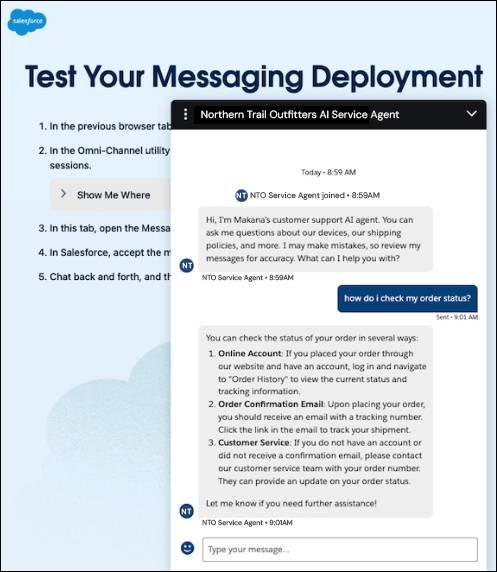
Agentforce agents act through the Flows, Apex and API actions your team built. They can look up a record, update it, create a case or run a workflow, and reply in the chat window. Salesforce's own Trailhead test of a service agent shows it answering an order-status question by listing the steps the customer can take.
Algomo co-navigation and workflows
Algomo's agent runs in the visitor's browser, on your page, inside the session that browser already has. It can filter a list, apply a code, add to the basket, open the right page beside the chat, check the visitor's own order or book a slot. The visitor sees each step. It can only do what you gave it a tool for.
Behind the chat, workflows run during and after the conversation. They can send a two-factor code before showing account details, alert the right person, or research a company and send your salesperson a memo. Describe a quote calculator to your coding assistant, and the visitor uses it inside the chat as a widget.
Acting for the visitor
| Algomo | Agentforce | |
|---|---|---|
| Acts in the visitor's own browser session | ✓ Their basket, prices and account | Server-side actions |
| Works the page with the visitor | ✓ Filters, applies codes, adds to the basket | Replies in the chat window |
| Runs your own automations | ✓ Workflows during and after the chat | ✓ Flows and Apex |
| Shows more than text | ✓ Cards, tables, reply buttons and widgets | Formatted replies in the chat |
Our take: ask each agent to put one named product in your basket at your own price, and see whether it does it or tells you how.
Which channels does each one cover?
TL;DRAgentforce covers phone calls, web chat, messaging apps and Slack, with Agentforce Voice generally available, while Algomo covers chat on your website plus a follow-up email.
Your customers choose the channel. If half of them phone, a website agent answers half. Count where last month's questions came in before you compare anything else.
Agentforce channels
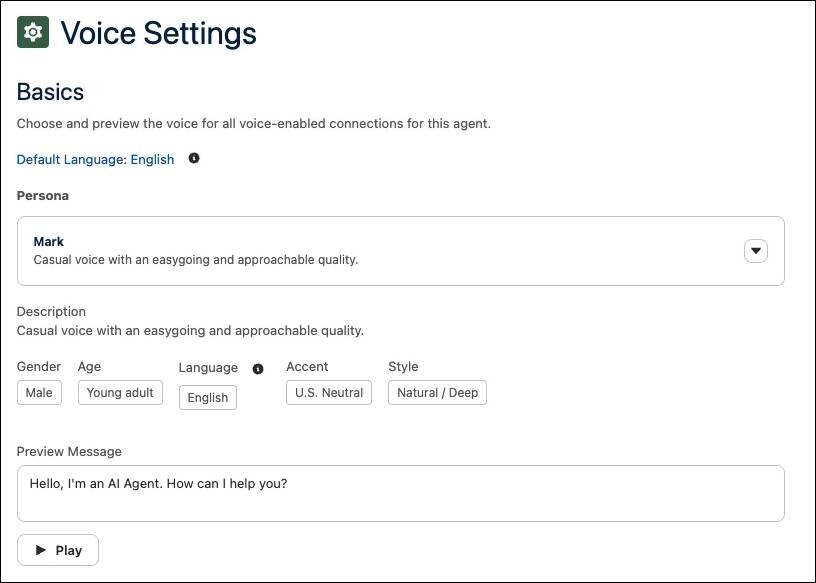
Agentforce works on web chat, messaging apps such as WhatsApp, self-service portals and Slack. Agentforce Voice answers phone calls and offers click-to-talk on a website. Salesforce says it is generally available in all regions, in English, French, Spanish, Italian, German, Portuguese, Japanese and other languages. A voice action costs 30 Flex Credits.
Algomo channels
Algomo is chat on your website, with a follow-up email to a visitor who left. It does not answer phone calls or incoming email.
Our take: if a large share of your questions arrives by phone, choose Agentforce for that share, and put the website questions to whichever agent answers them better.
How do you test it before launch, and check it after?
TL;DRAgentforce tests in a builder preview with a trace of each action and in batch tests, while Algomo tests on your live website through its browser extension and logs every tool call behind every answer.
You want to find a wrong answer before a customer does. When one slips through, you want to see why within minutes. That speed decides how much you can trust the agent with.
Agentforce testing
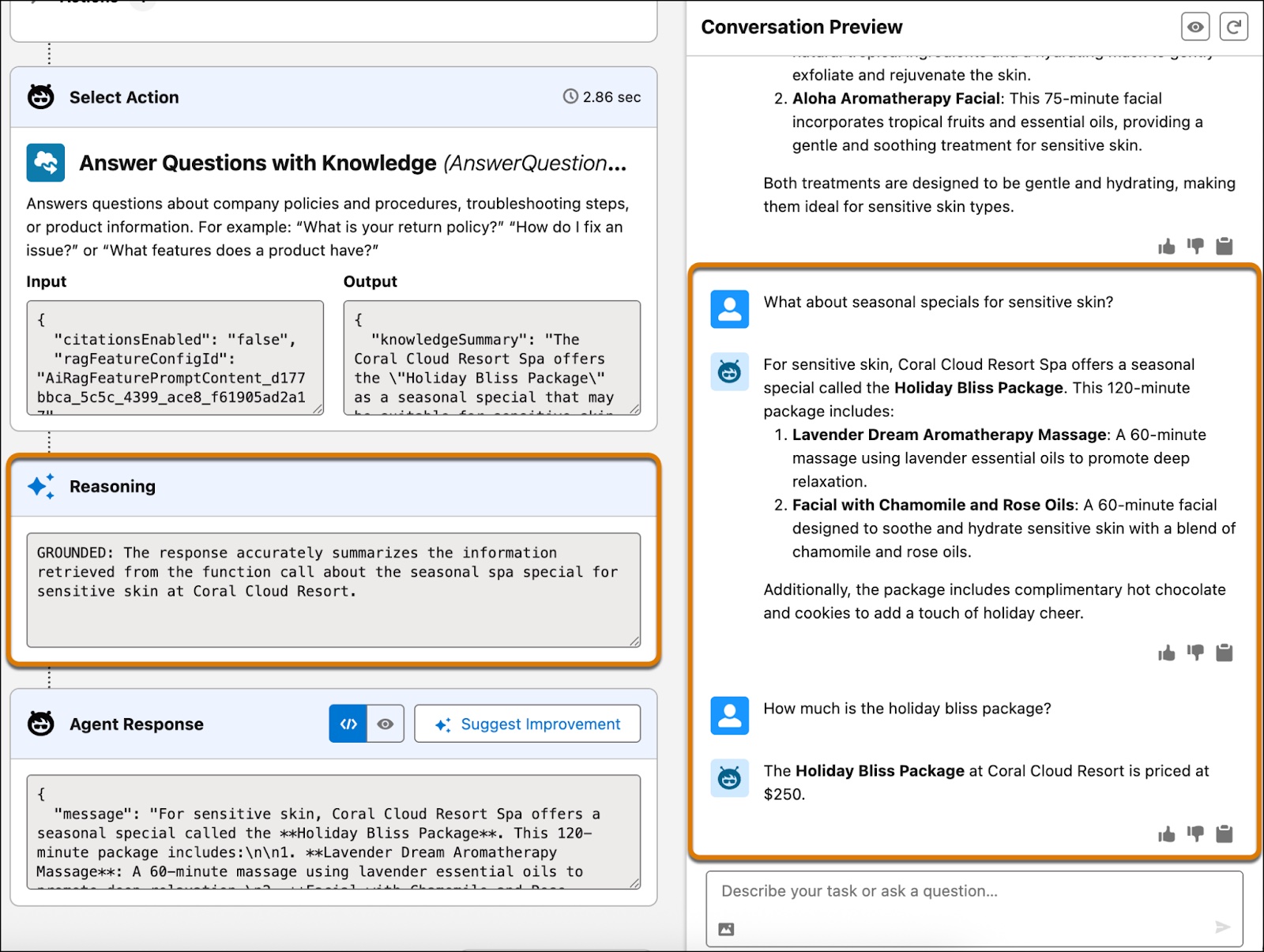
Agentforce Builder has a simulator that previews the agent and traces the subagents it chose, the actions it ran and the variables that changed. Batch testing turns real conversations into reusable test cases. Salesforce's Testing Center generates test cases, and an audit trail records agent actions and outputs.
Algomo testing and audit
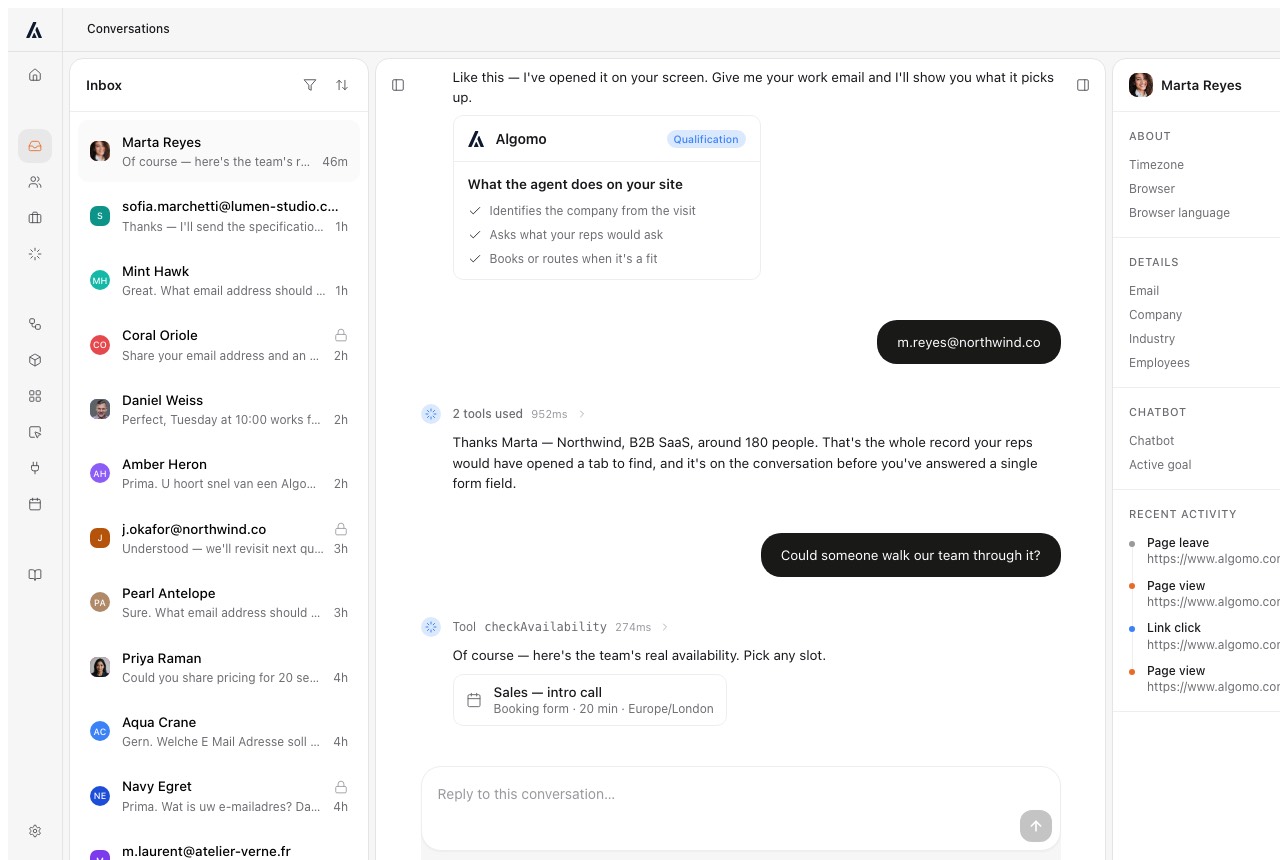
Algomo's browser extension previews the agent on your live site before you add any code. Tests spend their own credits, 200 a month on Free and 1,000 on Business, so testing never eats into the live budget.
Once live, each answer records the tools it called, with inputs, outputs, time and cost, and each workflow run keeps a step-by-step trace.
Our take: test both on the same live page of your site, not in a demo org, and ask each to show the exact calls behind one answer.
What happens when the agent hands over to a person?
TL;DRAgentforce routes the chat through Omni-Channel to a queue of your Service Cloud users, while Algomo alerts the right person by email and Slack and they take over the live chat with the transcript.
A refund, a complaint or a large buyer needs a person. What matters is whether that person sees the whole conversation or asks the customer to start again.
Agentforce handoff
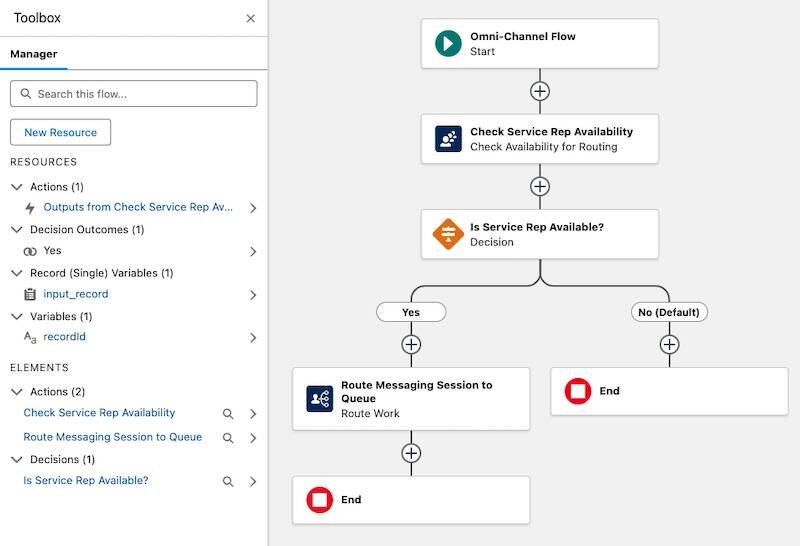
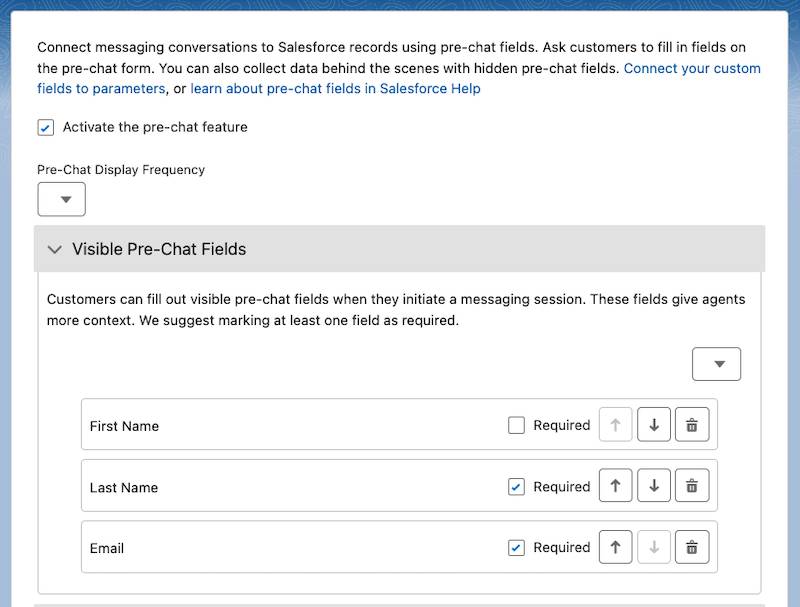
On a website, Agentforce chats run on an Enhanced Chat channel. A routing flow sends the conversation to the agent first and to a fallback queue of people after it. Salesforce's Trailhead example escalates through a second flow, which checks whether a service rep is free and then routes the chat to their queue. A pre-chat form can collect a name and email before the chat starts, so the conversation links to a Salesforce record.
Algomo handoff
Algomo hands over on rules you set: a topic, a page, or the visitor asking for a person. The right person hears by email and Slack and joins the live chat on your site with the full transcript. If your team works in a helpdesk, a connector can create the ticket there instead.
Our take: hand one conversation over on each, and check what your colleague sees before they type a word.
How long does setup take, and what does it involve?
TL;DRPutting Agentforce on a website means a messaging channel, a routing flow, an embedded deployment and a Data 360 connector, all set up inside Salesforce, while Algomo's free plan has a working agent on your site the same day.
Your team wants to see the agent answer questions about your own products before anyone signs. The shorter that path, the sooner you know if it fits.
Setting up Agentforce
Salesforce's Trailhead walk-through for a website starts with an admin creating an Enhanced Chat channel with Omni-Flow routing and a fallback queue. The admin then publishes an embedded service deployment with a pre-chat form. The example then places it on an Experience Cloud site and adds the domain to an allow-list.
Website knowledge is a second track. Someone plans the scope, sets up the connector, checks the page count with a query, then builds the search index and retriever. Salesforce Foundations lets any Salesforce customer start with Agentforce at no charge.
Setting up Algomo
Algomo's free plan is self-serve with no card. You give it your website address, it finds the systems your pages call, and the first version answers the same day. Connectors to systems behind a staff login come with the Business plan. You set them up from your coding assistant, or in a session with Algomo's team that usually takes a day or two.
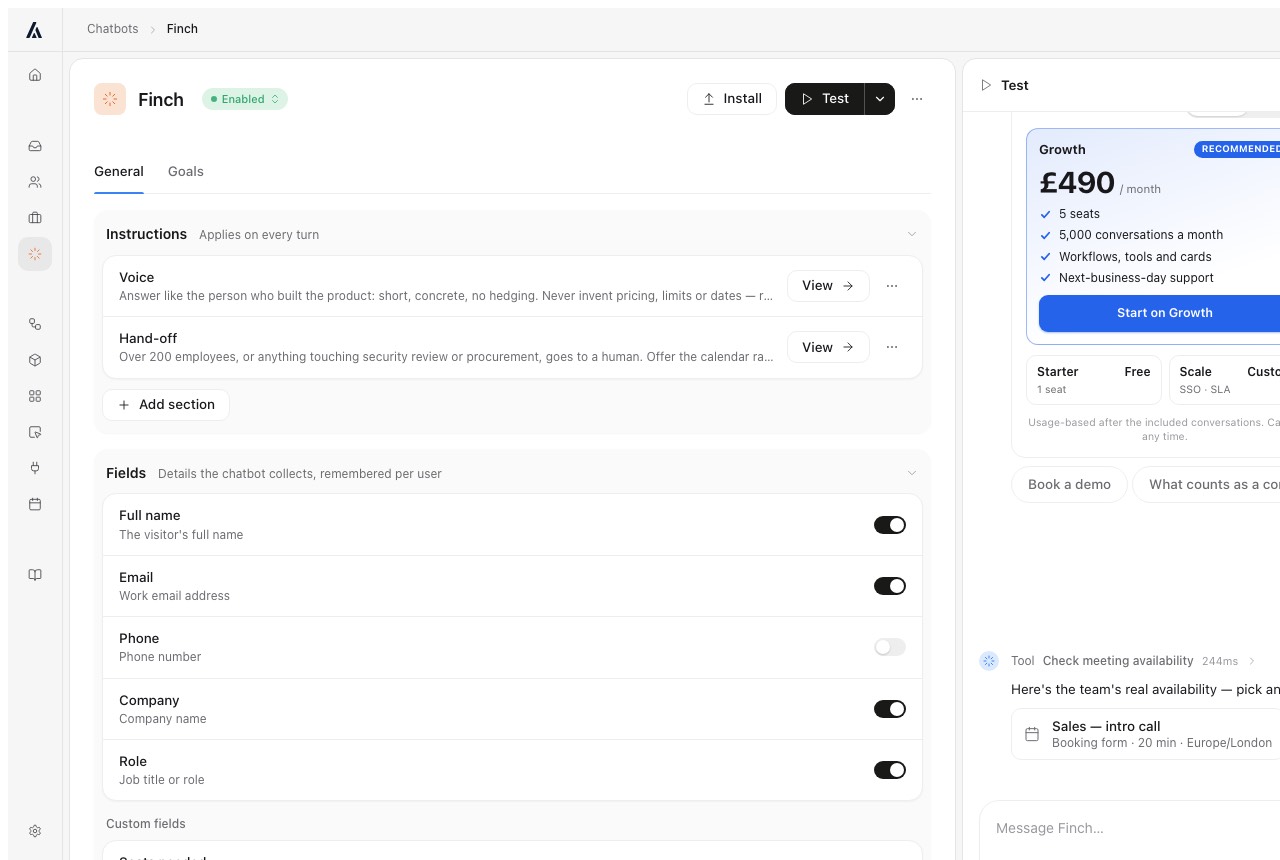
Our take: give both the same week, and count the people each one needed before it answered a real question about your products.
How does each one protect customer data?
TL;DRAgentforce carries Salesforce's audited reports and certificates, including a SOC 2 report for its AI platform, while Algomo's agent works from the visitor's browser and stores no token for anything your website already does.
An agent that can see orders needs access to customer data. Your security team will ask what the vendor keeps to get that access, and what has been audited.
Agentforce security
Salesforce's compliance site covers Agentforce Service Agent, Agentforce SDR and Agentforce Voice. It lists SOC 2 and SOC 3 reports for the AI platform and Agentforce, and a penetration test summary. It also lists ISO 27001 and ISO 42001 statements of applicability and an ISO 22301 certificate. The Einstein Trust Layer adds zero data retention and toxicity detection.
Algomo security
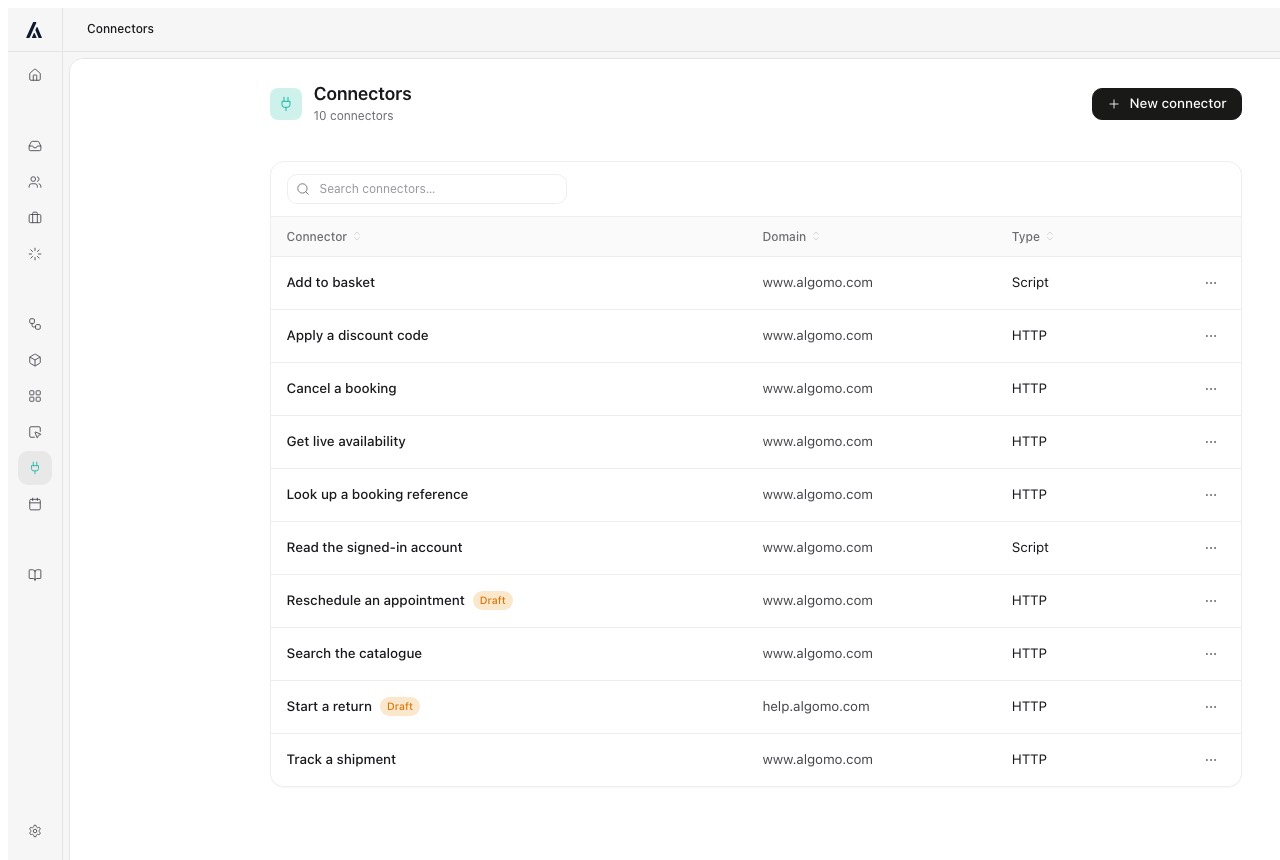
Algomo runs in the visitor's browser, on your page. A price check, a stock check or the visitor's own order goes from that browser, in the session it already has. For all of that, Algomo receives and stores no token or credential.
A system only your staff can reach, such as a CRM, needs a connector, and Algomo stores that login encrypted with AES-256-GCM. You can revoke it at any time.
Algomo holds Cyber Essentials for the whole organisation and is registered with the ICO under ZA821756. It works to UK and EU GDPR, the EU AI Act and DORA, and hosts its application, database and files in the EU. The data processing agreement covers every plan, and Algomo's compliance page has the detail.
Our take: ask each vendor to list what it stores that could open a customer's account.
How much does Agentforce cost?
TL;DRAgentforce charges $0.10 an action through Flex Credits, so 1,000 website conversations cost about $300 to $600 on Salesforce's own action estimate, while the same 1,000 on Algomo fit in a $200 plan.
Agentforce pricing has three models, and they bill different things. Your finance team needs to know which one it signs, and what happens to the bill in a busy month.
How Agentforce bills
Salesforce's Agentforce pricing page lists two ways to pay. Flex Credits cost $500 per 100,000, and each agent action uses 20 credits, which is $0.10. Per-user add-ons for Sales or Service cost $125 a user a month and give unmetered use to those staff. The page keeps a Conversations card for existing Conversations customers only, with no price on it.
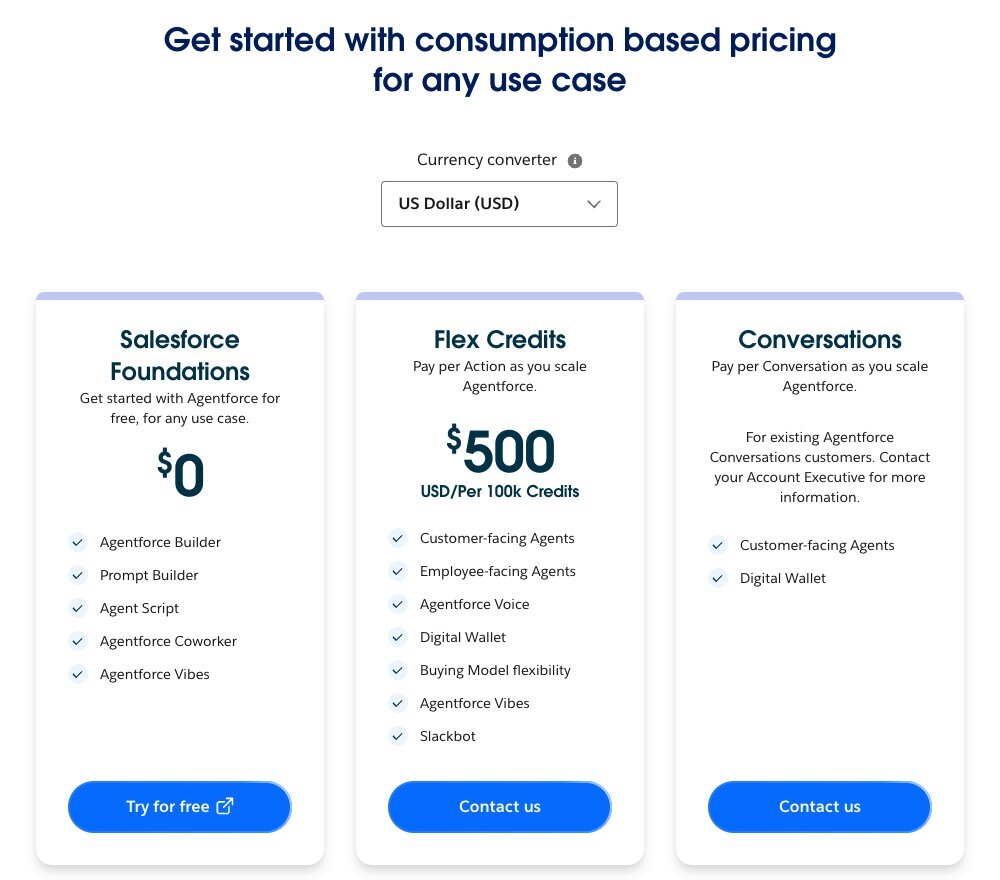
Two rules shape the bill. You cannot mix Flex Credits and conversations in one Salesforce org. Unused Flex Credits do not roll over into the next subscription term, and usage above your entitlement is billed monthly in arrears at the contracted rate.
The Flex Credits blog explains what an action is: a function the agent runs to get information or do a task. An exchange that needs no action costs nothing. Its own example, an SDR agent answering about two products and booking a meeting, uses three to six actions.
The editions sit on top. Your team's own seats are separate. Service Cloud's Core, Advanced and Max editions are $195, $395 and $550 a user a month, billed annually. Salesforce's editions story says Core includes 500,000 Flex Credits.
How Algomo bills
Algomo's free plan gives 100 credits a month, about twenty helped conversations, with no card. After that you choose one monthly amount, at 40 credits per dollar or more: $50 for 2,000 credits, $200 for 8,000, up to $4,300 for 200,000, with Enterprise above. The full ladder is on Algomo's pricing page.
A conversation that helped someone uses 5 credits, plus 5 for every further ten replies. Spam and conversations that went nowhere cost nothing. There are no seats, unused credits roll over, and the agent pauses at the amount you chose until you renew.
How the two bills behave
| Algomo | Agentforce | |
|---|---|---|
| Unit you pay for | ✓ Credits, 40 per dollar | A conversation, an action or a user |
| A website conversation | ✓ 5 credits when it helped | 20 credits for each action, or $0.10 |
| Unused allowance | ✓ Rolls over | Flex Credits do not roll over |
| A busier month than planned | ✓ Pauses at the amount you chose | Billed in arrears at the contracted rate |
| Charge per staff member | ✓ None | Edition and add-on prices per user |
| A free way to start | ✓ Free plan, no card | ✓ Salesforce Foundations |
Here is the sum for 1,000 website conversations a month on Flex Credits. Take Salesforce's own three to six actions a conversation. That is 60,000 to 120,000 credits, or $300 to $600 at $500 per 100,000. The action count is an estimate from Salesforce's example, and your agent's count may differ.
On Algomo, 1,000 helped conversations use 5,000 credits, so you would buy the $200 plan for 8,000. Neither figure includes Salesforce seats for the people who take over chats, which Algomo does not charge for.
Our take: ask your Salesforce Account Executive how many actions one of your typical conversations used in a pilot, then redo the sum above with that number.
What to ask any vendor selling you an AI agent
TL;DRFive questions, each with a test you can run during the demo.
- Who connects the agent to our booking or order system, and how many weeks does it take? Ask for the plan in writing.
- When we change a price, when does the agent quote the new one? Change one during the call and ask.
- Can it read a page that our site builds with JavaScript? Pick one and ask about it.
- Can it add an item to a visitor's basket at their price? Ask it to.
- What does one conversation cost in a busy month? Ask for the sum with your own volume.
Run every test on your own website rather than the vendor's sample site.
Which one should your team choose?
Choose Agentforce if
- Your customer data, cases and sales pipeline already live in Salesforce, and you have admins who build Flows and Apex.
- Many of your customers phone, and you want an AI voice on those calls.
- Your procurement asks for a SOC 2 report or ISO 27001 on the vendor's side today.
Don't choose Agentforce if
- The systems behind your website are not in Salesforce, and nobody is free to build the actions.
- Your site builds its pages with JavaScript, or its prices change during the day.
- You want a monthly bill you set yourself, with no seats and no per-action meter.
- You want the agent to work in the visitor's own session, with their basket and their prices.
Conclusion
TL;DRChoose Agentforce when Salesforce is your system of record and you want agents across voice, messaging and the CRM, and choose Algomo when your visitors are on your website and you want it connected for you and answering from the live page.
On integration, Agentforce gives your admins strong building blocks, and the work of using them stays with your team. Algomo discovers the systems behind your website and connects to them itself, with a first version the same day.
On accuracy, Agentforce answers your website from a daily copy in Data 360. Algomo reads the live page and puts a month's fee behind it. Salesforce now also owns Qualified and Fin, and the Algomo vs Qualified and Algomo vs Fin pages compare those products directly.
Questions buyers ask about Agentforce and Algomo
Is Algomo a good Agentforce alternative?
Yes, for the questions your customers ask on your website. Algomo connects itself to the systems behind your pages, answers from the live page, and costs one monthly amount with no seats. If you need voice, or agents working inside Salesforce records for your staff, Agentforce covers those.
Who owns Agentforce, and which companies has Salesforce bought for it?
Agentforce is Salesforce's own product. Salesforce completed its acquisition of Informatica on 18 November 2025, which it says strengthens Data 360 for its agents. It completed Qualified, the maker of Piper the AI SDR, on 1 April 2026, and Fin, formerly Intercom, on 10 September 2026.
What are the main Agentforce competitors?
For an AI agent on a website, buyers look at helpdesk vendors with AI built in and at agents built for the website alone, such as Algomo. Two products a buyer might weigh against Agentforce, Qualified's Piper and Fin, are now Salesforce companies themselves.
Is Agentforce free?
Salesforce Foundations lets a Salesforce customer start with Agentforce at no charge, and includes Agentforce Builder. Live use is then paid by conversation, by Flex Credits or per user. Algomo's free plan needs no Salesforce account and no card, and gives 100 credits a month.
How does Agentforce charge for a conversation?
By the actions it runs. On Flex Credits each action costs $0.10, and an exchange that runs no action costs nothing. The per-conversation model is now offered only to existing Conversations customers, through sales. You cannot use both models in one org.
What do 20,000 website conversations a month cost on each?
On Agentforce's Flex Credits, at three to six actions each, 20,000 conversations use 1.2 to 2.4 million credits, or $6,000 to $12,000. On Algomo, 20,000 helped conversations use 100,000 credits, which is exactly the $2,250 plan.
Can I move from Agentforce to Algomo?
Yes. Give Algomo your website address and it finds the systems your pages call, with a first version the same day. Your public pages are read live, so nothing needs exporting. If your team keeps working cases in Salesforce, a connector can create the record there.
Which AI model does Algomo use?
Algomo's default model is from OpenAI. On the Enterprise plan you choose the provider, and the application, database and files stay hosted in the EU.
Where these facts come from
All the information on this page was available in November 2026. The sources are:
- Salesforce's Agentforce pricing page: the three pricing models, Flex Credit rates, roll-over and billing rules, and Salesforce Foundations.
- The Flex Credits blog: what an action is and the three-to-six-action example.
- Salesforce's editions story and the Service Cloud pricing page: edition prices and included Flex Credits.
- Salesforce's Agentforce page and how-it-works page: actions, Flows, Apex, MuleSoft, the Einstein Trust Layer and the consulting partner directory.
- The Agentforce Builder page and Salesforce's MCP page: building, testing and the MCP client.
- Salesforce's guide to grounding Agentforce on your website, the crawler setup page and the connector's limits page: website ingestion, the 24-hour cycle and the JavaScript and language limits.
- The Agentforce Voice page: phone, languages and availability.
- Salesforce's compliance site: the Agentforce audit reports and certificates.
- The Informatica release, the Qualified release and the Fin release: ownership.
- Trailhead units, each named under the screen it belongs to.
- Algomo's pricing page, Algomo's compliance page, the data processing agreement and the guarantee page.
- The demo library, for the Qualtrics demo, the Blinds 2go demo and the Nike demo.